“Model Hunger” – (Movie Review)


By Andrew Buckner
Rating: **** out of *****.

Model Hunger (2016), the eighty-four minute full-length directorial feature debut from veteran actress Debbie Rochon, is cinematic madness. This is true in the gleefully off the rails tone Rochon so wonderfully presents. Such brilliantly intertwines the dark comedy of John Waters with the detailed splatter of an early tour de force from director Peter Jackson. There is also more than a touch of Troma Entertainment head, Lloyd Kaufmann. Ironically, the previously stated low-budget craftsman, and related company, Rochon has starred in more than a few films for. There is also a clear inspiration from the Italian maestros of terror, Lucio Fulci and Dario Argento, stylistically perceivable herein.

Such a component is also strikingly evident in Lynn Lowry’s vivid, increasingly unhinged performance. Lowry ever-intriguingly portrays the lead murderess with a deceptively gentle southern exterior, Ginny Reilly. But, one of the most remarkable feats Rochon and screenwriter James Morgart evoke is the delicate balance of adult humor and occasionally tongue-in-cheek, but largely serious, horror. The two complement one another throughout. Most remarkably, they are often orchestrated in the same sequence. Such only heightens the sensation of continually mounting lunacy which accompanies Reilly’s mannerisms. This is made all the more observable as the meritoriously made movie runs towards its sinisterly smirk-inducing climax. In addition, the effortless command Rochon and Morgart have over the material run far beyond the victorious interchanges and juggling of atmosphere and categorical shifts.

model hunger pic 3

Rochon and Morgart begin the tale by following a pair of Spartans cheerleaders, Katie and Missy (Samantha Hoy and Lisa Dee, who both give determined renditions of the stereotypical genre teen), to Reilly’s door. In a narrative shift reminiscent of Alfred Hitchcock’s Psycho (1960), the focus for the rest of the affair turns suddenly away from these potential heroines. After several minutes we find ourselves unexpectedly following the villanious protagonist, and cannibal, Reilly. Embittered from the rejection she has received from the business which was supposed to welcome her with open arms, she enacts violent revenge on those who might’ve passed the modeling industry’s rigorous standards. Reilly’s secret doings, most of which involve inflicting pain upon her victims before killing them in her basement, are threatened when Sal Lombardo (an enactment by Carmine Capobianco that is commanding and proficient) and Debbie (an exhibition by Tiffany Shepis that is ever-engaging) arrive in the community. Slowly, suspicions arise. As the high body count of this presentation rises, this mutual misgiving only accumulates.

The story itself, perfect for a grindhouse undertaking such as this, has been done in various manners beforehand. Regardless, the structure Rochon and Morgart evoke is so unique, wholly original and unpredictable that such a criticism is decidedly minor. Moreover, the pace is breakneck. Reilly’s good natured façade is broken early. This is signaled as the bloodbath imparts at a mere eleven minutes in. Afterward, the progression of such terrifying instances rarely wavers. This is as the chronicle continually twists and builds upon itself. All the while, we are given just enough exposition into Reilly and Debbie to care for the both of them. This is considering the personal faults the fiction makes clearly visible throughout. This is done without breaking up the interestingly mounted arc and general movement of the plot.

We are given two key flashback sequences of exposition. One can be found around the twenty-five minute mark. The other is arises a little over an hour into the production. Both are well done. They sting with the disapproval of body shaming, as well as the equally odious idea of beauty and parental disapproval, which has leaves many so acrimonious. Still, the photoplay doesn’t weigh itself down with its social conscious. This is an entertaining, old-school, late-night fright flick. It simply uses this as a window into understanding the various psychosis that the labor concentrates upon. Such is also utilized as a potential key into the obsessions, a product of the aforementioned delirium, the depiction is concerned with unveiling.

It is mirrored through a program, which always seems to be about to air, called Suzi’s Secret. The show is played for laughs. It also triumphantly generates them. Regardless, it also potently and powerfully brings forth through the aforementioned modus. This item reinforces how the strict guidelines of appearance affects, not only some of those present in the fiction, but society as a whole. Such is another of the many remarkable feats this terrifically conceived opus naturally pulls off.
model hunger pic 1

Similarly, Rochon’s behind the camera work is edgy and claustrophobic. Likewise, Morgart’s script is excellent. It provides the perfect celluloid playground for the players who inhabit the roles Morgart has penned to have wild fun with their turns. This is something everyone involved certainly notices and brings forth tenfold. To its further credit, the script also cracks with witty dialogue and characterizations. The piece walks the fine line between believability and the incredible. Despite this, it never breaks away from either. What is just as striking is Morgart’s clever and intelligent use of the age-old voice-over trope. Such narration comes from Reilly. This element is used in a manner that often reminded me of many of the nasty tidbits Margaret White would spout at her most overzealous in Stephen King’s classic novel, Carrie (1974). It also mechanizes expertly to augment the sense of Reilly’s perspective which radiates stalwartly throughout the picture. The incorporation of Michael Winters (a depiction by the continually fantastic Michael Thurber which matches Lowry’s portrayal in eccentricity and sheer bravura), as an initially pesky and almost voyeuristic neighborhood resident, adds to the bizarre intrigue transcendent through every frame. Simultaneously, the deaths are increasingly elaborate and imaginative. There is a torturous segment in the finale involving a virginal, “Restorationist” youth that is especially cringe-worthy. This particular section is as taunt, suspenseful and fantastically engineered as they come.

The New York shot and Wild Eye Releasing distributed account also sports an original score from Harry Manfredini, who is known for his legendary theme for Friday the 13th (1980). He gives us an illuminating, almost visceral orchestration. It resonates spellbindingly. The composition is frantic, complex and undoubtedly masterful. It, in the tradition of the greatest musical numbers in moving picture history, almost seems to jump right out of the framework and into our minds. Comparably, Wolfgang Meyer’s cinematography is grim and gritty. It gorgeously enhances the resonate mood of the endeavor. The same can be said for the smooth display of editing Darryl Leblanc provides. Relatedly, the sound, art, camera, costume and make-up department deliver in their respective fields spectacularly. Rochon’s exertion is impeccably cast by Richard Egbert. Suzi Lorraine, as the guffaw-inducing personality credited as TV Show Host Suzi, issues an endearing, standout demonstration. Additionally, David Marancik as Officer Jason O’ Bannon, Robert Bozek as Reginald Burke and Bette Cassatt as Chloe are phenomenal. This B-grade gem also showcases impressive special effects by Rod Durrick, Leblanc, Paul Mafuz and Ingrid Okola. The visual aspect of such a constituent, also constructed by Leblanc, is just as extraordinary.

With 246 acting gigs under her belt over a thirty-four year span, Rochon is more than acquainted with what makes audiences scream in both consternation and joy. She is also just as familiar with the inner-workings of the big screen itself. This is more than perceivable at any given interval of Model Hunger. Rochon has gifted her spectators, fans new and old, with a perpetually solid and dazzling addition to her ever-expanding catalogue. The photoplay is brutal, darkly comic, tightly-knit, thoughtful and engaging in equal strides. It is also more than willing to plentifully offer what viewers have come to commonly expect in the category of revulsion. It is rare that we get such a captivating combination of all these arrangements. Such is especially accurate of a gore drenched midnight movie. What is just as infrequent is for someone to prove their operative abilities on both sides of the lens so stirringly. Rochon, who remains a marvelous and ever-evolving talent, does just that and more. This is a winner. It will more than delight those who are left famished from the current trend of limp, anemic entries filling theaters as of late. Feed your appetite for a slickly erected and professionally made journey into insanity. See this delightfully morbid configuration at all costs.

model hunger pic 2

“The Amityville Terror” – (Movie Review)

amityville terror pic 2

By Andrew Buckner
Rating: *** out of *****.

It has been nearly thirty-nine years since Jay Anson’s #1 best-seller, The Amityville Horror, first captivated audiences with its initial September 13th, 1977 release. In much the same vein, the original, same titled entry in the cinematic series, spawned by Anson’s endlessly fascinating and re-readable tome, has just celebrated its thirty-seventh anniversary. On July 27th, 1979, director Stuart Rosenberg and screenwriter Sandor Stern gave us a faithful, now classic adaptation of Anson’s supposedly true haunted house saga. As time accrued, various theatrical and straight to video sequels, one blasphemously awful remake in 2005 and uncountable documentaries appeared later on. The most notable of which was My Amityville Horror, which starred Daniel Lutz himself, from 2012. What started with George and Kathleen Lutz’s 28 day combat with the ethereal, and ran from December 18th of 1975 to January 14th of 1976, is still an unwavering pop culture phenomenon.

Recently, the purportedly evil Dutch Colonial house located at 112 Ocean Avenue formed the backdrop of the opening sequence of writer and director James Wan’s brilliant follow-up, The Conjuring 2 (2016). In the aforementioned span, there has also been a number of low-budget items cashing in on the Amityville name. This is often with little or no relationship to the source material. Nonsensical, derivative features such as Amityville: Vanishing Point (2016), as well as the deplorable The Amityville Playhouse (2015), used the name of the town in Long Beach, New York as its only remarkable selling point. The Amityville Legacy (2016) was equally insipid. Nevertheless, it attempted to join itself, via a cursed antique toy monkey, to the preface of the primary narrative. At least the Dustin Ferguson and Mike Johnson directed and penned exertion had the good sense to incorporate a creative concept. Most importantly, it only lasted a meager sixty-six minutes.

Among this seemingly unyielding wave of related monikers is the August 2nd unveiled The Amityville Terror (2016). Luckily, this induction shares more of the hallmark qualities of the former than the latter. By simply doing so, it towers above its varied competition. This is, simply, because it possesses more of the sense of old-fashioned horror movie fun which made the inceptive Amityville pictures so memorable than the bulk of its predecessors. This is even if, in its brisk eighty-four minute duration, there is hardly anything here that the most timid genre fan would honestly assess as ‘new’ or ‘genuinely terrifying’. However, the tepid shocks are smartly fashioned. Even wiser is its restraint. This is especially visible in its minimalistic use of the, sadly, all too common jump scare tactic.

Regardless, the composition offers standard, plot serving archetypes. The same criticism can be liberally applied to the dialogue and routine situations. But, these are, for the most part, likably and believably delivered. There is a smooth authenticity here. It earns extra points, at least for this nostalgia admiring fright addict, in its ability to parallel itself so stalwartly to the overall feel of a garden variety terror flick from twenty to thirty years ago.

amityville terror pic 1

With a reported budget of $500,000, the AZ Films Studios, Uncork’d Entertainment, Master Key and Marquis Productions undertaking focuses in on a family moving to a new home. In an arc cut from almost any other modern day tale of this ilk, the kin all too gradually finds out that a malicious spirit is attached to and refusing to leave the residence without a fight. With this rises the inevitable sequences of the well-concealed information of the violent past. All of this is done in as much of a carbon copy modus as you would expect. This time around, the unknown tragedy involves a youth named Jimmie Oberest. It becomes known that he once drowned his baby sister in a tub of acid. But, as can be surmised long beforehand, this pivotal data comes when the presence inside the Amityville home is at its most menacing and inescapable. Soon our antagonists find out that the townspeople are also untrustworthy themselves. They want to keep the once close-knit ancestry there for their own mysterious reasons. It’s a thin account. But, it is just enough to keep us enthralled while getting us from one wraithlike incident to another. This is true even considering the familiarity of all the ingredients at play.

In retrospect, the whole fiction itself traces in its own way around what transpired in The Amityville Horror. There is a quick build-up of supernatural events in the first act. We are intriguingly thrown into the middle of a paranormal manifestation when the labor commences. This is mixed with the human focus in the mid-section. All of this makes these previously stated components all the more evident. Such actions, simultaneously, creates a pace that starts out intriguingly. The opus as a whole is often sluggish. This is a common impression director Michael Angelo and screenwriter Amanda Barton hand their spectators. This is before the energetic, satisfactory climax of the photoplay. It is an odd, but not entirely unpleasant, way of structuring the composition.

Also augmenting the connection to the initial account, is the murderous backstory. We are also witness to the father, this time named Mike (in an authentic, intriguing and rounded performance by Bobby Emprechtinger), and his slowly diminishing grasp on reality. This draws a continued equivalence to both the Amityville franchise and the ardent tropes of similarly nail-biting exhibitions of celluloid. Such a comparison also provides us with an intriguingly orchestrated death at nearly an hour. This also is a product arising from Mike’s increasingly unbalanced condition.

The tone is also more competently issued and serious than most current Amityville endeavors. Further assisting matters is that there are also slight nods to Stanley Kubrick’s epic adaptation of Stephen King’s The Shining (1980). This gravitates during an early happenstance involving a bath tub. Correspondingly, there is an equally obvious collation to be drawn from a smirk-inducing moment where a demonic face peers through a fractured door. Such occurs within the amusing and engaging final twenty minutes. These slight winks at its spectators undoubtedly heightens the enjoyable nature of the material. This climactic segment also calls to mind Sam Raimi’s splatter masterpiece, The Evil Dead (1981). Such is observable in its impressive, 80’s appropriate effects. These are courtesy of Frederique Barrera. It is also exhibited in the general sense of chaos in this section.

amityville terror pic 4

Angelo and Barton’s exertion, both of whom arrange skillful but indecipherable work in their separate departments, lingers a beat too long on the character-oriented emphasis of the middle forty-five minutes. This is while giving us exposition, such as an all too tired and Young Adult genre worthy flirtatious friendship between our heroine, Hailey (Nicole Tompkins in a wonderful, vulnerable enactment) and Brett (Trevor Stines in an exceptional depiction). This section can easily be deemed as commonplace as the leads themselves. Yet, there is undoubted chemistry among Tompkins and Stines. It certainly elevates the frequent scenes they are in together. More than anything, it amends us, amid an otherwise non-relatable gathering, someone to frankly care and root for.

This inclusion also instills a nice balance between the human and the spectral. Even though there is nothing new about those we encounter on-screen, the aforesaid personalities come off as well fleshed out. They are entities that we know well. In turn, we find ourselves caring more than a little about. Needless to say, this is an absorbing, well-made watch. It is one which is, unfortunately, cut short by a concluding epilogue that stands as the most predictable aspect in Angelo and Barton’s arsenal. The final credits constituent, complete with newspapers proclaiming the horrifying matters that we learned of in the undergoing, is uniformly rote.

Scripter Barton is effectively creepy as Mike’s sister, Shae. Lai-Ling Bernstein as Jenny, Phillip Day as William and David Cranston, Cher Hubscher as Sally and Kim Nielsen as Jessica all exude phenomenal showcases in their respective roles. Likewise, Tony Kaye as the sexually obsessed Delilah, Priscilla Emprechtinger as Claire and Sarah Lieving as Mrs. Taylor fare just as well. They all round out a certainly capable cast of varied individuals. The variety of the small town dispositions herein never becomes uniquely molded. Yet, the talent behind them makes them both fresh and charismatic. Ultimately, this diverse nature evokes one of the strongest points herein.

Darren Morze’s music is atmospheric and solid all around. Michael S. Ojeda’s editing and cinematography is sharp and masterfully constructed. Larae Mychel and LaRae Wilson’s costume design is superb. These elements enhance the credibility at hand indefinitely. The sound and make-up departments offer splendid contributions to the quality of the piece. Stephen Krystek, who is credited with the poster art viewable above, does beautifully in his particular artistic field.

With Blumhouse Productions’ long delayed Amityville: The Awakening now scheduled for January of 2017 and other efforts such as Amityville High (2016) and Amityville: No Escape (2016) vowing for ticket buyers’ attention in the near future, it’s hard to tell if The Amityville Terror can hold its standing as one of the better, albeit non-cannon, installments in the on-going series. Despite this, I can state with certainty that this is a comfortably exhilarating popcorn venture. Though it may not merit multiple glances, it is well worth a look. It doesn’t come anywhere near the daring darkness of the criminally underrated sequel, Amityville II: The Possession (1982). Also, the movie is not as rampant with its mystic goings on as Amityville: It’s About Time (1992). Yet, it remains a welcome addition to the cycle. The result is a minor, but charming foray into subtle trepidation. It is strengthened by its ardor for, as well as the manner in which it embraces and makes the most of, its B-show trappings. For someone who whose personal interest is immediately thwarted to any ghostly account the trusted Amityville name, this is more than reason enough to recommend what Angelo and Barton have erected.

amityville terror pic 3

Richard Griffin Releases “A Misdummer Night’s Dream” Trailer

By Andrew Buckner

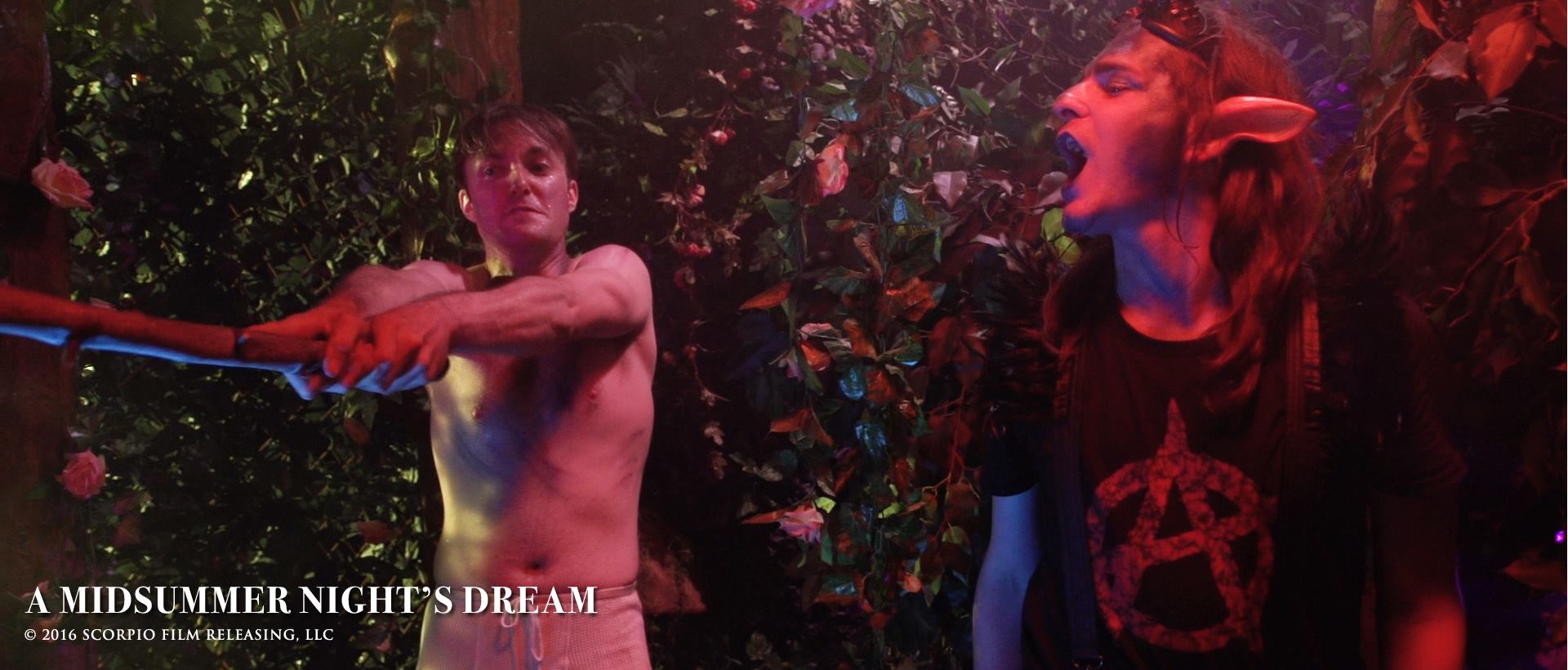
A mere three days after its wrap-up of filming On July 30th, the official trailer for acclaimed writer and director Richard Griffin’s adaptation of William Shakespeare’s timeless comedy, A Midsummer Night’s Dream, has arrived. At precisely 7 p.m. on August 2nd, 2016, Griffin gave a seventy-second glimpse into the twenty-first full-length feature under the Scorpio Film Releasing banner via Facebook. The motion picture, scheduled to be released on January 14th, 2017, promises to be a take on the immortal Bard’s oft tackled play, which was first published in 1596, as never spied before. With an incredible cast led by Anna Rizzo as Titania and Jamie Dufault as Demetrius, along with Griffin’s uncanny knack for comic timing, such is a promise the talent at hand is more than capable of delivering upon. There is also a true sense of magic clearly evident. Such is only made all the more palpable and vibrant by Jill Poisson’s lush, gorgeous cinematography. This is another spectacular characteristic which is proudly at the forefront throughout the hypnotic preview.

midsummer pic 2

The movie also stars Christian Masters as Snug, Steven O’ Brien as Theseus and Laura Pepper as Robin Starveling. It also oversees the incredible talents of Johnny Sederquist as Puck and Robin Goodfellow, Casey Wright as Robin Peaseblossom and Elizabeth Loranth as Helena. Aaron Andrade appears as Snout, Lee Rush as Hippolyta and Ashley Harmon as Hermia. Margaret Wolf provides the wonderful costume design. It is another astonishing attribute immediately noticeable in the above exhibited advertisement. John Dusek and Torey Haas are credited with the special effects. The editing is conducted, much in the manner of Griffin’s prior efforts, by the principal of the piece.

Bringing Griffin’s distinct version of A Midsummer Night’s Dream to the screen has been a passion project for the cinematic artist. He has been trying to get the endeavor to see fruition since 2000. In that year, he released his cinematic debut, Titus Andronicus. This was a modernization of one of Shakespeare’s lesser known works. The original composition of which was understood to have been initially distributed circa 1588-1593. With this in mind, it is easy to see Griffin’s knowledge and respect of the literary master. Such a realization makes the excitement to see Griffin’s latest production, which he is not shy about sharing his own enthusiasm for, all the more intense. I know I greatly anticipate experiencing the sure too be masterful opus myself.

midsummer pic 1

“The B.C. Butcher” – (Movie Review)

By Andrew Buckner
Rating: **** out of *****.

The B.C. Butcher (2016), the fifty-one minute debut feature from then seventeen year old co-writer and director Kansas Bowling (who appears here as one of several on-screen models), operates as a winning homage to the distinctly tongue-in-cheek nature of the American cinema of the 1960’s. Billed as “the first prehistoric slasher”, the labor captures splendidly much of the spirit of the popular American International Pictures’ seven Beach Party movies. This financially stalwart series ran from 1963 to 1965. There is also more than a dash of inspiration derived from the Raquel Welch starring and Don Chaffey directed dinosaurs and ancient humans remake, One Million Years B.C. (1965) Bowling’s attempt also captures the wildly inaccurate nature of the previously stated production terrifically.

Much in line with Chaffey’s film, the girls of The B.C. Butcher are visibly wearing lipstick and other forms of make-up. These details are spectacularly done. They arrive courtesy of Jason Adcock. He is also credited with summoning the appearance of the flick’s monster. The creature himself, played admirably by Dwayne Johnson, is smirk-inducing. This is in its uncanny similarity to Leatherface from Tobe Hooper’s timeless horror classic The Texas Chain Saw Massacre (1974). Continuing the above stated comparison, the females of The B.C. Butcher are adorned in what can best be described as “Paleolithic chic”. This is a mixture of what we have come to expect of antediluvian dress with a semi-modern sensibility. Not only does this summon to the psyche the aspects mentioned earlier, but also makes one think of Michael Chapman’s failed adaption of Jean M. Auel’s novel, Clan of the Cave Bear (1986). This only adds to the heavy nostalgia Bowling’s opus elicits.

bc butcher pic 4

As can be expected from the originally addressed parallel, we are lent an exuberantly cheery, decade appropriate opening title arrangement. It is beautifully orchestrated. Moreover, it uses the pleasant din of “Alley Oop”, performed by the Hollywood Argyles and penned by D. Frazier, as a wonderful modus of setting the campy and largely old-fashioned tone of the entire composition. True to form, there is also an unexpected musical performance. As is often the case with such interludes, it adds nothing to the story. Yet, it still far accelerates the fun factor of the material. With The B.C. Butcher, this comes shortly into the third act. It is a performance of the catchy track “Nobody Likes You” by The Ugly Kids (authored by A. Tijeria). Complete with watermelons mechanizing as guitars and drums, this is just like a concert item one might see from a live-action visualization of The Flintstones (1960-66). Such makes the results of this energetic, several minute depiction all the more inventive and highly endearing. What could’ve easily been filler comes off as one of the more memorable passages in the affair.

Keeping true to its obvious inspiration, the gore is, with the exception of an originating section where the main ladies of the tale are seen eating innards, nearly non-existent. For fellow Troma Entertainment fanatics this may come as a letdown. The unimaginatively executed deaths we spy here may evoke an analogous sense of disappointment. This is excluding an intentionally hilarious skit involving a woman being thrown into a hole. Such is juxtaposed with alternating shots of both a real and faux snake attacking the individual. But Bowling, who shows incredible behind the camera flare (especially considering her age), and executive producer Lloyd Kaufman know exactly what they are doing. These aforesaid faults still follow the notion of what one may logically see in a construction from fifty years ago. Such is especially true in the conception, effects, pace and general veneer of Bowling’s narrative. In turn, the undertaking comes off as both a knowing and ardent letter to a bygone era. It is one constructed, and made all the more intriguing, by its slight modern touches.

bc butcher pic 2

Despite the initial shortcomings, these traits endure as a mirror of the obvious inspirations for The B.C. Butcher. Just as charmingly, Bowling has issued an enterprise that noticeably incorporates the hallmarks of a Troma epic. This is most evident in the dialogue and performances. All of which are delivered with an ‘in on the joke’ B-show wit. These qualities are also visible in one of the most victoriously humorous sequences herein. It is a flashback to the relationship between Rex (in a strong, appropriate for the material enactment by Kato Kailin where the above attributes certainly apply) and the heroine of our tale, Neandra (in a heroic yet, vulnerable turn from Leilani Fideler that is phenomenal. It is uniquely well-rounded and wholly watchable). This particular moment comes at about fifteen minutes in. It works so well because of how the whole segment operates as one successful parody of such stereotypically overdone instances usually found in film. Kailin’s depiction here, which makes all the lines he is handed come off like a rambling stand-up comic in the most effective manner possible, is what makes this strangely well-executed bit so successful. It’s intriguing, to say the least, notion of romance is equally guffaw-inducing. The laugh factor here is almost duplicated in a montage. It utilizes narrator Kadeem Hardison’s smooth narration as ambiance to create a gleeful opening scene. Such is one which cleverly comes off like a shakily recorded, though this may be intentional, trailer for the photoplay we are about to view.

Bowling, along with fellow screenwriter Kenzie Givens, chronicles Neandra’s management of a tribe of cavewomen. These include the blind prophetess Bamba (Devyn Leah), Poppy (Molly Elizabeth Ring) and Anaconda (Natasha Halevi). As you can tell, some of the slyest gags in the composition arise from a lot of of the characters’ names. After a within community sacrifice, the title fiend begins to pick of Neandra’s clan one by one. Ignoring Bamba’s prophecies of impending doom, the collective finds themselves forced into an attempt to unravel the mystery of those who have gone missing. Eventually Neandra and the angry, murderous and correspondingly despairing cave-dwelling giant, who has been thinning out Neandra’s followers, find themselves facing off against one another. Yet, their parallels to one another run deeper than they may ever know. It is a plot that is admittedly sparse, but has never feels that way. Moreover, it takes the largely replicated Halloween (1978) and Friday the 13th (1980)-like psycho on the loose elements, so often recycled, and incorporates them in a time and location never before seen. Such makes these well-worn components feel refreshingly new.

bc butcher pic 3

The proficient script by Bowling and Givens is smarter than may be immediately perceptible. It is also well-structured and endlessly amusing. Tomoaki Iwakura, Aaron Meister and Richard Samuels provides sleek, vibrant and alluring cinematography. Robby DeFrain’s editing is brilliant. William Preston Bowling, Nathan Lowe and Joel Steven administer sharp displays of sound. Florent Clavel’s music department contribution helps elevate the entirety. This is with a mixture of pop and rock tunes which embody the upbeat essence of the exertion deftly. The soundtrack here is the perfect ambiance to the visuals Bowling and company have crafted. Additionally, the rest of the cast, with Miranda Robin as Dina and Rodney Bigenheimer as himself, are as cheerily active as the depictions of the leads.

Though Bowling lingers too long on the search for the individuals who have disappeared, the piece as a whole is undeniably, consistently impressive. The finale is fitting, but wonderfully underplayed. It represents another extension of remarkable ability for Bowling’s endeavor to turn dramatic tropes into comic gold. This item mechanizes incredibly well to the benefit of the product as a whole. Yet, Bowling’s immense talent, visible in her accomplished and stylish direction and literary participation unveiled within, is undeniable. This factor is illuminated in every winning wink at the audience her luminous composition exudes. It is further exposed in every purely enjoyable frame in this delightful, gleefully low-budget popcorn venture. Bowling assuredly has a bright future ahead of her. The B.C. Butcher, complimented in various means by its brief length, is many cuts above the genre competition.

bc butcher pic 1

“Lights Out” – (Movie Review)

lights out pic 1

By Andrew Buckner
Rating: *1/2 out of *****.

Lights Out (2016), based on the near three minute 2013 short film of the same name from director David F. Sandberg, is a cheap, cloying horror gimmick posing as a full length feature. The Atomic Monster, New Line Cinema and Grey Matter Productions release possesses a single item, a laughably redundant jump scare, in its fright arsenal. This is via a dark, ethereal figure dubbed Diana (Alicia Vela-Bailey in a limited and ineffectual enactment). She all too gradually appears closer to her next victim every time the lights go out and disappears as soon as they come back on. Such is a fairly interesting notion for the Sandberg penned medium Diana first appeared in. Yet, as for an obviously pushed beyond its boundaries eighty-one minute motion picture, with a reported budget of $4.9 million, much more needs to be offered to satisfy the increasingly ravenous pallets of the average genre fanatic. This is true even with the less cinematically experienced, teenage audiences this dull, pedestrian, PG-13 rated affair is obviously catering to.

It also becomes all the more ridiculous in moments like the eye-rolling preface of this all too safe exertion. In this extended bit, Esther (in a fair turn from Lotta Losten; the star of the short this is based on) is about to leave her job at a factory late at night. Unsure if she is seeing something from the door a mere room away, she hits the light switch repeatedly. This is while the above-articulated fear tactic, wrong-headedly exposed in the movie’s trailer, flashes again and again before our eyes. In one of the first of many erroneous moves, we are not revolted by the ominous sight of Diana as Sandberg and company have obviously intended. Instead, we laugh at the absurd amount of times it takes Losten to discern if what she is seeing is real or not. Such is especially guffaw-inducing when we recognize that most people would’ve turned the lights back on once and fled immediately to safety the first time around.

lights out pic 6

Perhaps this aforementioned criticism wouldn’t be so painfully noticeable if Sandberg and writer Eric Heisserer were able to give us more of an original fiction. At the least, the team could’ve indulged in more innovative plot elements along with a meatier account. Instead, Diana and those she haunts are given garden variety backstory and motivations. The personalities we encounter are all cardboard archetypes. Luckily, they are somewhat elevated by solid performances. This is especially true of Teresa Palmer’s portrayal of Rebecca. She is a stepsister to the mentally ill Sophie (in a presentation by Maria Bello that is undoubtedly skillful and gripping) and Sophie’s son, Martin (a well-done representation by Gabriel Bateman that is constrained by the commonality of Heisserer’s dim depictions). Palmer and Bateman share a palpable chemistry. It is one which makes it all too easy to see them as a pair of semi-distant relatives who are forced to rely on another unexpectedly for survival. These two are the anchor that helps keep the movie afloat. This is even as its first two acts pile on scene after scene of exposition and tired, predictable character development.

In this portion, we learn that Martin is finding himself in the tormented footsteps Rebecca endured years prior. This is with Martin falling asleep at school arriving as a telltale sign of the youth’s restless nights avoiding the nightmarish whims of Diana. After a call from a school nurse who could not reach Sophie (who is not taking her medication and becoming increasingly obsessed with Diana), Rebecca reluctantly takes Martin to her home to catch some much needed sleep. It is at this point Diana makes her presence increasingly known in Martin and Rebecca’s life. From herein, the strange noises and unnerving scratching Martin has been hearing suddenly becomes much more. It’s a simple, accustomed, but not entirely unattractive, premise. Yet, it misses nearly every opportunity it has to be anything more than a one-dimensional, strictly on the surface thriller. It doesn’t even operate satisfyingly enough as pure, mindless entertainment.

lights out pic 2

What is worse is that all of these aforesaid instances come off more as filler than an honest attempt to get its spectators to care for our young hero and elder heroine. During this time, the terror elements are, sadly, sparse. Yet, the talk is long and uninteresting. Likewise, the cringe-worthy dialogue is that of a Lifetime Movie of the Week brought to the big screen. In much the same vein, the visual effects, credited to seven individuals, are your usual sub-par, computer generated shtick. Alongside these detracting details, we realize more than ever before, how little narrative Heisserer’s dismal script actually delivers. Simultaneously, such tedium and pointless circle running creates a punishingly slow pace. It is one that only really seems to find its footing and come to life in the surprisingly energetic and tense final twenty-five minutes.

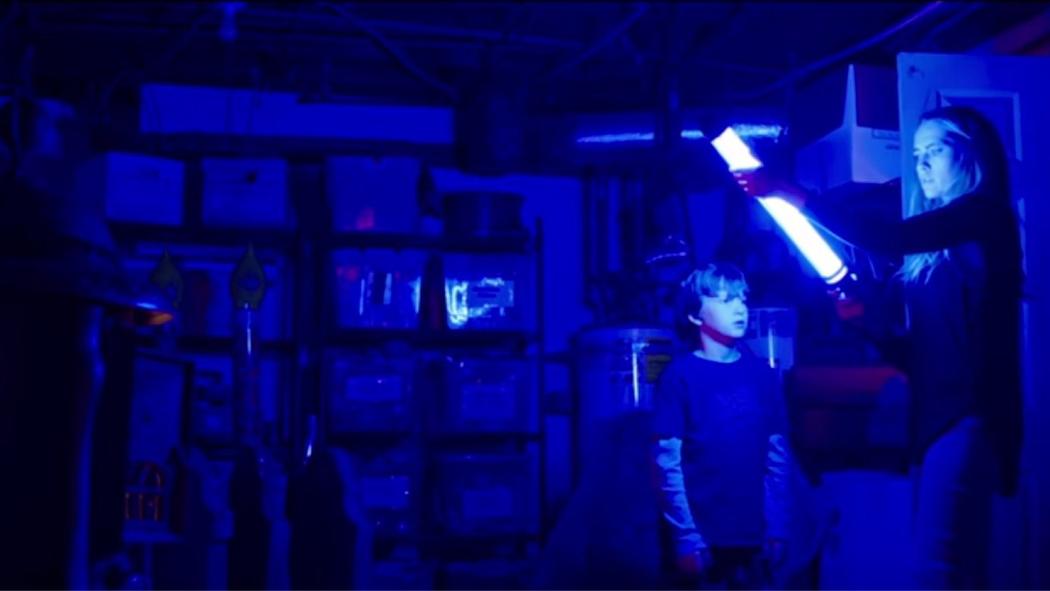
Amid this concluding stretch, Sandberg abandons the standard, point and shoot directorial style which dominated the rest of the opus. For once he seems to finally be allowing himself to have some fun with the material. Relatedly, a late sequence in a basement excellently and claustrophobically toys with the concept of finding a light source amid increasing blackness. It is an idea that is not given half as much creativity beforehand. Despite this, we are still amended many of the categorical tropes which weighed down most of the first hour. For instance, a fiendish hand reaching out from under the bed. But, it is done in a way that is still entertaining despite its familiarity. If only this sensibility was utilized earlier, Lights Out wouldn’t be such an underwhelming chore to sit through. Just as mournfully, it goes back to these disappointing origins for an end segment that is as imitative and stale as the first fifty-six minutes.

lights out pic 4

You know you are in trouble when the various rock and roll posters sprawled out on the walls of Rebecca’s home are more visceral, terrifying and immediately stimulating than any of the actual attempts at trepidation Sandberg invokes. Lights Out suffers from this affliction and much more. It is complimented by atmospheric, but unmemorable, music from Benjamin Wallfisch. Marc Spicer’s cinematography works best, like the rest of the endeavor, in the later and more moody sections. Still, it is pleasant enough. Michael Aller and Kirk M. Morri offer sharp editing. The sound and make-up department are fair. Yet, they suffer much the same results as the songs which accompany the fabrication. The same can be said for Shannon Kemp’s art direction, Lisa Son’s set decoration and Kristin M. Burke’s costume design. Alexander DiPersia as Bret, Billy Burke as Martin’s father and owner of the plant spied in the hackneyed opening arrangement, Paul, and the rest of the cast are adequate.

But, none of these comparatively brighter flashes can make up for the fact that most of the movie is a lumbering, overblown and underdeveloped mess. Why the usually reliable modern day master James Wan, who is producer of this vehicle and recently gave us the most accomplished offering of the summer with The Conjuring 2 (2016), would want to sully his good standing with having this title on his resume is beyond me. Sandberg’s effort is a forgettable, uninspired trek through the motions. All of which we have seen done much better, often by Wan himself, umpteen times before. Do yourself a favor and be sure to put the lights out on any further thoughts of seeing this for yourself. I guarantee that you will be better off that way.

lights out pic 5

“Tastes Like Medicine” – (Short Film Review)

tastes like medicine pic 1

By Andrew Buckner
Rating: ***** out of *****.

“Tastes Like Medicine” (2016), the sixteen minute and thirty second debut short from writer-director Steven Alexander, is an absolute triumph. It operates spectacularly well as both a non-linear, character-driven drama and as a meditative allegory. Alexander presents a journey into the fragmented recollections of our lead, Drew (in a well-rounded, emotional powerhouse of a role from Damion Rochester), that is undeniably harrowing. It is also courageous and challenging throughout. Moreover, it is full of abstract, insightful glimpses into the sad plight of those who, like Drew himself, sense that they cannot let go, or escape from, what has been.

In fact, one of the grandest accomplishments here is how beautifully Alexander blends the situation Drew keeps returning to. This is a celebration for the expectant ex-lover of our protagonist, Allison (a wonderfully honed, slice of life enactment by Marisa Rambaran). All of these are balanced alongside the more surreal, poetic elements issued throughout. Additionally, a mid-film shouting match between Drew and Allison’s current beau evokes how well the authentic and dream-like counterparts of the endeavor are handled. The end result is a profound, technically and tearfully dazzling construction. It is one made all the more magnificent by Alexander’s stylish directorial flare.

All of this is further complimented by Alexander’s intelligent, layered, competently paced and awe-inspiringly designed screenplay. For example, an impressive initial portion demonstrates Alexander’s ability to dually transport thoughtful and entertaining exposition. This is while making a larger statement about society as a whole. The bit comes at a mere two and a half minutes in. It oversees a discussion concerning Drew, felonious background, how the term “criminal” haunts one, especially from an employer’s standpoint, and the male and female double standard. Such is the perfect manner to construct a narrative such as this. It allows us to see the vulnerability and internal wounds of the main personality through his own eyes as well as those around him. Similarly, it also enhances the incredible degree of artistry, skill and ingenuity at hand.

In the tale, Drew arrives at the aforementioned party with a call girl named Kake (in an excellent, down to earth turn by Wi-Moto Nyoka). Continuing to be overwrought with grief and jealousy at how his romance with Allison went wrong, he has a mental breakdown. This causes a situation somewhat reminiscent of what deceased director Harold Ramis laid down in Groundhog Day (1993). Such is where Drew finds himself destined to continuously relive the same incidents connected to the joyous gathering for Allison as if in an eternal loop. The main difference is that, unlike Ramis’ critically acclaimed feature, Drew may not get the chance to move on. This is even if he somehow gets everything ‘right’.

Besides what is clearly visible in the underlying nature of the account itself, Alexander brilliantly fills all that we come across with obvious representations, as well as subtle indicators, of Drew’s inability to live in the present. For instance, a stunning looking title card over a dark screen informs us early of the name of the labor. It than simply states, “Chapter I”. Yet, there is no “Chapter II” anywhere to be found. Even the moniker of the piece itself can be seen as a deserved treatment; a purgatory-like punishment for errors Drew has made. This is punctuated by a chilling, and certainly appropriate, climax. It is one where Drew finds himself doomed to repeat the events which we just encountered.

Likewise, we are also amended a striking, elegiac, lustrous and stirring opening sequence. It runs a mere seventy-seconds. Still, it provides an incredible bit of narration that functions as a stalwart thesis statement of what comes afterward. The arrangement immediately exhibits Alexander’s knack for imagery. This is as a montage of shots of Allison, all of which ingeniously capture her in a range of expressions that could possibly personify the attitudes Drew saw her in during their long extinguished rapport, are spied. During this memorably attention-garnering segment, Alexander poses a question for his audience. This is articulated in the afflicted inflection of our broken hero. Such is repeated in the finale. It sets the tone of the entire endeavor. It is the centerpiece of, not only this scene, but of the work itself. Here Alexander forces his spectators to ponder: “Have you ever stared at something so long that it changes before your very eyes”?

Further crediting the affair is Oliver Covrett and J. Anders Urmacher. The duo drapes the production in moody, alluring black and white cinematography. This veneer matches the overall atmosphere incredibly. Furthermore, Charles Allen Brownley III’s sound contribution is remarkably crisp and proficient. Joanna Rodriguez conjures tremendous make-up. Alexander’s editing is masterful. Justin Walker White as Kevin, Lauren J. Daggett as Julie and Randall Holloway as Alex are all terrific in their respective depictions.

All of these essentials come together to create a multi-genre undertaking that is endlessly believable. Such rings true even when utilizing its more fantastic third act components. That, in itself, is more than enough reason to recommend this evocative, sentimentally rousing tour de force. Alexander has given us a riveting composition. It is one that is unafraid to display the flaws of all of those unveiled within the chronicle. In so doing, it commands us to peer inside ourselves and reflect on the bleaker moments in all our lives. From herein, it pushes us to do just as Kake states to Drew near the conclusion of this magnum opus and “Let it go”! Such is only a hint of the transformative and cathartic strength of the spellbinding fiction Alexander has delivered to his spectators. “Tastes Like Medicine” is a winner on all fronts!

tastes like medicine pic 2

“Sisyphus” – (Short Film Review)

sisiphus pic 2

By Andrew Buckner
Rating: ****1/2 out of *****.

“Sisyphus”(2016), the fourteen minute and thirty-three second debut short from director David Graziano, is an incredibly clever and strikingly original modernization of Albert Camus’ 119 page philosophical essay on the pointless quest for understanding, The Myth of Sisyphus (1942). In Camus’ famed text, the title Greek Mythology figure labored to roll a boulder up a mountain. It was a duty he was forced to endeavor for all of eternity. The futility of this back-breaking chore was articulated in the fact that once this was achieved he would watch the rock slide back down the elevation. The job was then repeated to no avail. Such was an expression of the human condition that endures as easily visible. It can still be applied to various aspects of our own personal lives. In turn, it is more than deserving of the updating Graziano and screenwriter Christopher DiNunzio, from a story by Bryan Casey, so marvelously craft here.

In Graziano’s effort, the symbolic pillar is that of a secret romantic relationship. It has blossomed from a friendship between Gretta (in a warm, gentle and credible performance by Jami Tennille) and Marlene (an enactment by Diana Porter that is just as nuanced and wondrous as her on-screen counterpart). The passage of days into years is gently, wisely expressed. This is through their various meetings at the same coffee house. At the heart of this dramatic undertaking is Gretta’s impending divorce. She sees this as a perfect opportunity to cement the once ardent bond she had with Marlene. Yet, Marlene is indecisive. It is an attribute of Porter’s role that she conjures brilliantly. This is as she goes through the majority of the piece coyly, as if unsure of what Gretta is desperately trying to communicate to her. It is from this point other interestingly conveyed concealments begin to get in the way of what Gretta and Marlene once had with one another.

The affair is punctuated by sparkling, immersive cinematography by Nolan Yee. He captures the mature, yet down to earth, tone Graziano injects spectacularly into each frame. This is with incredible visual flare. There is also a vastly appreciated underlying commentary on our diminishing face to face talks with one another. This is as the labor opens with everyone on their phones, directly avoiding all the people surrounding them. There is even an impression that Gretta and Marlene, with the exception of the baristas to their customers, are the only ones who are actually speaking to one another directly. All of this increases greatly the highly representative nature of this beautifully executed opus.

Likewise, Steven Lanning-Cafaro, who appropriately appears here as The Guitar Player, builds upon the sophisticated ambiance unveiled throughout. This is with his musical contribution. Cafaro provides soothing, melodic rifts. All of which are precisely what you may hear at a setting such as the one found herein. Such sweet sounds are continuously streamed in the background during the coffee house sequences. In turn, it often seems as if it is in sequence with and, simultaneously, helping edify the sentiment being uttered by our leads at every turn. Yet, astonishingly, it never once overshadows the dialogue driven emphasis of the account. In this sense, as well as many others, “Sisyphus” is a masterful demonstration.

Further facilitating matters is DiNunzio’s terrific, seamless editing. Graziano, who has wide-ranging involvement as a scripter and actor, has a behind the lens approach which is stalwart and engrossing. He will assuredly fare here as well as he did in his previously stated doings. Graziano’s bravura also compliments the material splendidly. There is also strong sound and camera work present. Such continues to build the excellence found herein.

DiNunzio’s screenplay is smartly paced. The aforementioned banter between our two leads is intelligent, authentic and well-written. The only occasion the feeling at hand seems to lapse is in a mid-way segment and in another nearly identical one during the concluding seconds. This is when we witness the shot of a package being opened. Instead of letting this transpire leisurely, and in real time, it is sped up. On each instance this plays out it momentarily throws us out of the saga. This is because it seems too rushed. It betrays the gingerly constructed illusion to watching life unfold that arose beforehand.

Yet, these are but a few erroneous flashes in an otherwise stellar, highly gripping composition. The fiction, which is scheduled for release in December of this year, is magnificent told. This is in a simple, straight-forward manner. Such mechanizes splendidly in the overall context. Best of all, the characters are always at the forefront. Gretta and Marlene are spectacularly developed. This is especially noteworthy given the exertion’s brief duration. Our protagonists, as well as the photoplay itself, should prove relatable to a wide-audience. Graziano has erected a truly impressive, emotive experience. I look forward to seeing what moving picture wonders he will conjure in the future.

sysiphus pic 1

“It’s Not You” – (Short Film Review)

It's Not You pic 2

By Andrew Buckner
Rating: ****1/2 out of *****.

“It’s Not You” (2013), the four-minute debut short from writer-director Sophie Peters-Wilson, is a sentimentally searing powerhouse; a visual poem told largely via flashbacks. It is one where joy is overtaken by a hidden heartache. What makes the material all the more potent is that it these memories, and the emotive journey attached to them, personify what is occurring in the mind of a young girl. She is referred to in the credits merely as Daughter (a performance by Abigail Spitler that tremendously conveys all the conflicting sensations someone in her position would undergo in such a situation). As the undertaking commences, she is being told that her parents are about to partake in a divorce. What follows showcases magnificently, achingly Daughter’s altering perspective. This is concerning what initially appeared to be happy times.

Peters-Wilson communicates this to the audience with small tidbits, all of which suggest transformative secrets, which were either regressed or deliberately hidden from Daughter’s eyes. For instance, one sequence showcases a close-up of Father (in another commanding, passionate and hypnotic enactment from Timothy J. Cox) pulling himself out of the locked hand of Mother (in a phenomenal, well-rounded depiction by Sarah Ruth Blake). This is to address another woman who has stopped to ask Father a question. Yet, the moment, heightened by the angry glimmer in Mother’s eyes as the instant occurs, speaks of jealousy. There are also various other hidden undertones. These are of her suspicions that Father is not being faithful. As the mid-section becomes a balance of arguments between both the maternal and paternal halves of this familial unit, Peters-Wilson clearly states the concealed tiff, revolving around the fear of breaking the matrimonial bond, between the two. It is during this succession, more than ever, we also note how remarkably Peters-Wilson has put us into the mind of Daughter. This transpires as we find ourselves asking many of the same questions that the character herself must be forced to ask during this deliberation. These are inquiries like: “Is this particular time what caused their falling out? Was this simply part of a bigger sequence? What could’ve been done to change this while it happened?”

It all helps to make this brief affair, which was shot in New York City, victorious. This is as both a psychological portrait and a maturely fashioned character study. Likewise, Peters-Wilson, who created this haunting composition with a reported budget of only $100, provides a screenplay that is credible at every turn. This specific section is also brilliantly structured and fluently, suitably paced. Moreover, the sparse bits of dialogue Peters-Wilson provides her leads are endlessly believable. Such is especially accurate with the circumstances the collective kin unveils. Though Daughter’s outlook fuels the majority of this stalwart opus, Peters-Wilson goes out of her way to be respectful to the plight and perception of all involved. Such a decision amends the effort with all the more dimension and detail. In turn, it makes it feel all the more complete. Peters-Wilson’s stirring, meditative authorship is given a stylish visual component through her directing. It is one which is equally elegant and impressive. Both elements find the perfect note for the material immediately and execute it beautifully throughout. All of these aforementioned attributes are more than visible in the final product.

Peters-Wilson also offers cinematography which is absolutely stunning. This is from the aspect of its overall veneer and tonal mastery. The more upbeat moments are merry, bright and cheery. When the story exposes the dark underbelly of Mother and Father’s relationship, what we see on-screen is drenched in a color palette that is appropriately bleak. Peters-Wilson’s contribution in this respective category is all the more striking and wondrous because of how well she speaks to her audience through this, and all the previously stated, mediums. Her editing is just as sharp and seamless.

With the further assistance of tremendous camera work from four individuals, this is just as pleasurable to admire from a technical angle as it is to witness. Peters-Wilson and her moviemaking crew have provided a narrative that has undoubted resonance and true cathartic value. This is for those who, sadly, may find themselves in a similar condition as those we encounter within the venture. It is just as much for the personalities who can look back, much as Daughter may do years after the events of this tale have happened, in continued meditation. “It’s Not You” is a heartfelt, courageous, challenging and necessary drama. Peters-Wilson has crafted an unflinching, cerebral masterpiece. It is one which all of its spectators can utilize to understand, in one arena or another, and grow from. That, in itself, makes it certainly worthy of recommendation, seeking out and experiencing for yourself.

It's Not You pic 3


“Mail Time”- (Short Film Review)

Mail time pic 1

By Andrew Buckner
Rating: ****1/2 out of *****.

Writer-director Sebastian Carrasco’s six minute and twenty-four second short, “Mail Time” (2016), is quietly compelling and magical. It is also grandly emotive in the manner of silent films from the early twentieth century. This sentiment is greatly enhanced, and made all the more operatic, by the remarkably stirring, uncredited score which drives every frame of the composition. Such an element is made so herculean that even mundane bits are immersed in a magnetic cinematic light. An example of this can be spied in a mid-way sequence that involves our lead, Ted (in an enactment by Timothy J. Cox that is commanding and likable as always and made all the more impressive by the performance being completely without dialogue), sitting at home. The moment conveys volumes by merely showing him smiling giddily as he watches a magician on television.

What continues to assists matters magnificently is that Carrasco has erected a screenplay which is artistic, beautifully honed, structured and contemplative. Yet, he gives Cox room to breathe and to create. Such a decision makes Ted something special. He is a hero who, like many of us, are unaware of such a stature. This is projected through the duration to great impact here solely through the lens of his everyday actions.

The narrative focuses in on Ted’s faux magician act suddenly becoming genuine. Initially, this behavior is an undertaking he has evoked to make the grinding routine of his occupation enjoyable. This is as much for his customers, the faces he sees repeatedly and to divert the nefarious man who constantly tries to rob him, as it is for Ted’s own sense of childlike wonder and awe. It is also utilized for the sake of keeping Ted’s employment as fresh and new as possible. This also mechanizes as a method to help make the transaction between mailman and customer memorable. Almost unthinkably, genuine mysticism begins to finds its way into his life. Soon the humdrum pattern of his days are anything become anything but ordinary. Ted now has now become real-life illusionist. His once banal delivery route has become a stage, a setting for truly joyous and numinous exploits.

The piece is a simple, innocent tale at its heart. It knows this on a conscious level. Therefore, it never gives into any possible inklings lesser exhibitions of this ilk may have. This would be to make the work more complex than it needs to be. That, in itself, heightens the wonderfully old-fashioned joviality and storytelling at hand. This assists in making Carrasco’s brief endeavor all the more charming.

Carrasco’s direction is equally illuminating. It is endlessly stylish and further calls to mind similar entries which are a hundred years or more behind us. Moreover, Carrasco has a sharp sensibility of pace. This effort moves along much in the manner Ted does through his day of labor here. It is briskly casual. We glide from incident to incident with sufficient time to get a strong impression of all necessary details of the situation. Also, we never assume the sensation of being pushed along doggedly to get from point A to B. Despite this, it miraculously never feels as if it lingers or any of the sequences go on longer than they should. This is a difficult and delicate balancing act in itself. It is one worthy of great acclaim. Such is one of the many astounding feats this marvel pulls off wonderfully.

Enhancing the overall prowess of this composition is Makeela Frederick. She is excellent in her small role as The Girl. Additionally, Bernardo Salazar’s cinematography is resplendent and certainly striking. Carrasco’s editing is just as impressive. Simultaneously, the sound and make-up contributions are just as terrific as the previously stated traits. These details conduct an account, stated to have a budget of only $1,000, which is pure, exuberant delight.

Carrasco opens on a loving note. He carries that ardor respectfully, engagingly until the closing credits. Such evokes an undeniably positive experience. It is one which will undoubtedly leave even its sourest of spectators in a far better mood after viewing it. That, in itself, is a rarity. This only makes “Mail Time” all the more worthy of recommendation. To its further recognition, the touches of comedy here are natural and endlessly successful. They appear as much of the story as everything else we come across. For instance, a commencing gag in the first sequence which dramatically showcases postage articles falling onto a table in slow motion, reminiscent of something one might see in a soap opera, are where this is most effective. Such an aspect only further represents the upbeat nature of the visions radiating on-screen.

It all comes together to create a tour de force. Carassco has concocted a mesmerizing opus; a well-deserved ballad to the often unsung powers of those who take up the reins of laborer dutifully. This is a stroke of brilliance. It is one that broad ranging audiences will assuredly have no problem relating to. Carassco has provided us a touching, illuminating and enchanting masterpiece. It is as much necessary viewing for the stressed out adult who is long exhausted of the repetitive nature of our quotidian doings as it is for the wide-eyed youth lurking within. Carassco has fashioned a gentle character study. It is one that hits us on a passionate level, speaks to us and makes us want to unveil the magic in our own lives.

mail time pic 2

“Linda LeThorn & the Music Box” – (Short Film Review)

lethorn pic 1

By Andrew Buckner
Rating: ****1/2 out of *****.

One of four short films writer-director Meg Skaff constructed in 2012, “Linda LeThorn & the Music Box” is a hypnotically erected, splendidly paced and, ultimately, rousing success. Skaff takes the tried and true horror element of a haunted music box and builds a world around it that is mesmerizing and wholly new. This is courtesy of, and made all the more engrossing by, Skaff’s witty, wry observations of the weird and commonplace intertwining. Her brilliant screenplay and impeccable eye for framing these components into entertaining, stylistic bravura makes this mixture all the more illuminating. Such items punctuate the plethora of uncanny observations at hand. All of these are produced in a manner as if the camera itself is reflecting the interpretation of our enthrallingly odd title heroine (in an impeccably realized performance by Aundrea Fares where her monotone, emotionless character expressions only heightens the effectiveness of the already potent humor).

Such a tone is established immediately in an opening montage of sorts which showcases LeThorn’s various pets. This sensation never wavers throughout the seventeen minute runtime of this dazzlingly made comedic opus of innocence and melancholy. Even the most routine of moments, such as a repeated sequence in the first half which showcases LeThorn peering at frozen food as if both ravenous and drugged in a grocery store, are put together in a manner that is both hallucinogenic and ominous. They are also darkly hilarious and captivating. All of these words are perfect for the atmosphere Skaff gives the material. It fits wonderfully. Such makes the intelligence and expertise resounding through every frame all the more intense. Yet, all of the distinctive images, and the incredibly delivered bits of Skaff’s well-penned and credible dialogue which accompanies them, conjures a wisely underplayed, yet visible, level of emotion. I related to LeThorn and the projected assessment of the landscape she inhabits more than I care to admit.

lethorn pic 4

Skaff, who has a small bit as a homeless person here, tells the tale of LeThorn receiving a collection of one of a kind articles from her Aunt Lucinda (in a fantastic role of the domineering by Susan Kirby that etches her character, largely via flashbacks, remarkably well through brief glimpses). Among these is the aforementioned container of sound. It is one which happens to play songs on its own accord. Almost immediately after receiving this resplendent item, LeThorn becomes possessed by Lucinda. From herein, she learns of a debilitated love triangle involving Lucinda. She also feels the need to start a skin-picking society. This is something of an ode to one of Lucinda’s equally inexplicable traits. Such a characteristic becomes the pushing force for a large portion of the dryly riotous second half. Likewise, the account ends on an appropriate note. It is just as attention-garnering and expressive of LeThorn’s isolated domain as what opens the venture.

The rest of the cast and crew provide exceptional work. Timothy J. Cox is delightful in his depiction of the sweat-suit wearing, bespectacled individual we come to know as Purple Green. He lives in the same building as LeThorn. Simultaneously, he also appears to be named after the color of clothing he wears. Ashley Peoples as Geraldine, Brit-Chardle Sellers as Terry Kendall and Kimberly David as Traffy are all terrific. The previously stated depictions are as singularly off-beat and watchable as LeThorn herself.

lethorn pic 3

Composer Insula Dulcamara’s music echoes the nature of the fiction well. The soundtrack is melodic, uniquely beautiful, dramatic and evocative. Skaff’s cinematography is marvelous. It makes all we encounter into a consistently gorgeous visual feast. This is especially evident in the more dream-like instances. We see this in one spectacularly done early moment. Such transpires when LeThorn is viewed dancing in her apartment. This strange segment is made all the more so as a majestic glimmer of a disco ball arrives out of nowhere. Immediately, it begins spinning radiantly in the background. The direction, editing, production design, costume, wardrobe and make-up work by Skaff are just as proficient and appealing.

Skaff has proven herself an incredible talent with “Linda LeThorn & the Music Box”. There is a striking parallel to her approach here and that of a film by Wes Anderson (2001’s The Royal Tenenbaums, 2014’s The Grand Budapest Hotel) at his most sophisticated and striking. Furthermore, some of the more ethereal scenes call to mind, in their own way, the behind the camera flare of moviemaker Tim Burton (1988’s Beetlejuice, 1990’s Edward Scissorhands). Best of all, the laughs are quietly underplayed. They are never highlighted as such as many modern mainstream genre entries appear obliged to do. Each guffaw is planted in one sense or another in reality as exclusively spied by LeThorn. Such only adds to the skill and craftsmanship pulsating throughout. It all comes together to create a masterpiece; a commentary on social interactions and society itself that is biting, bold, memorable and downright hysterical. This is a must-see!

lethorn pic 5