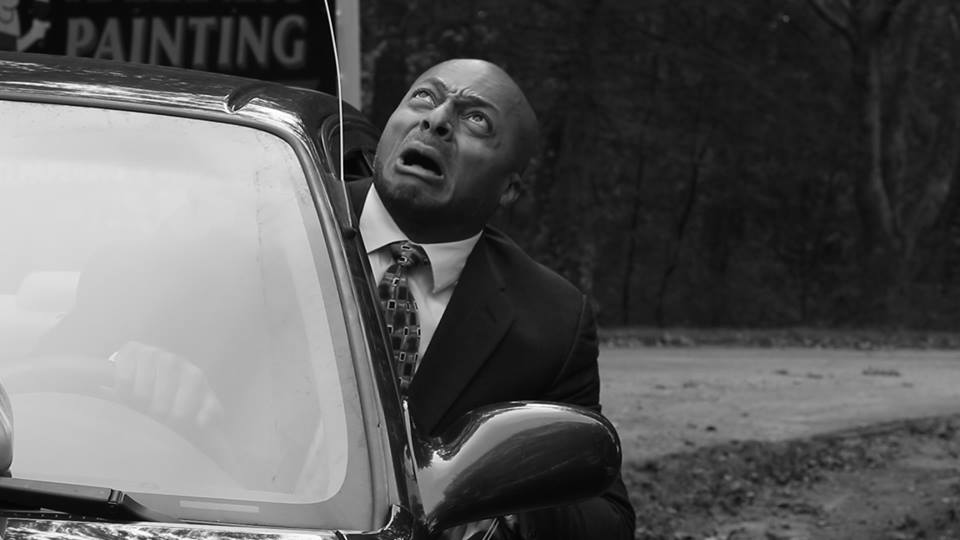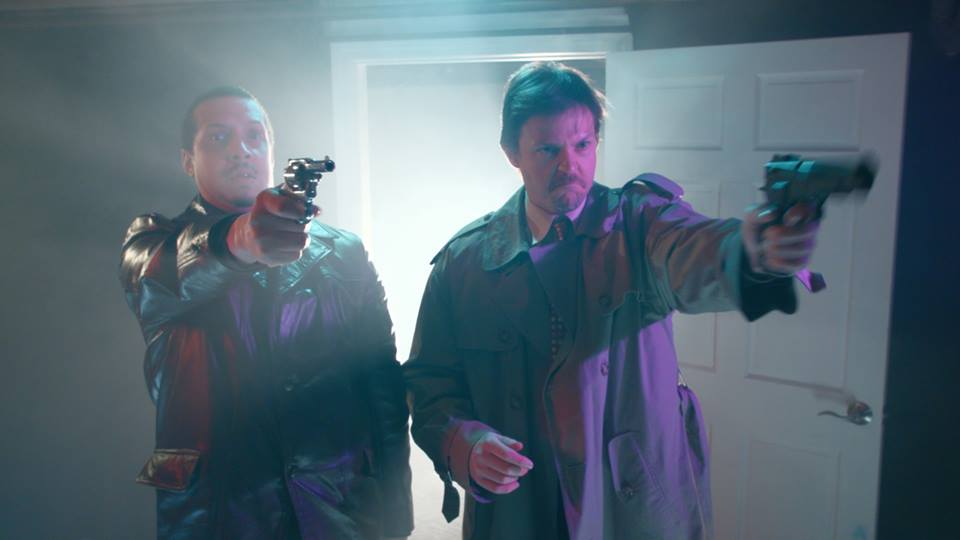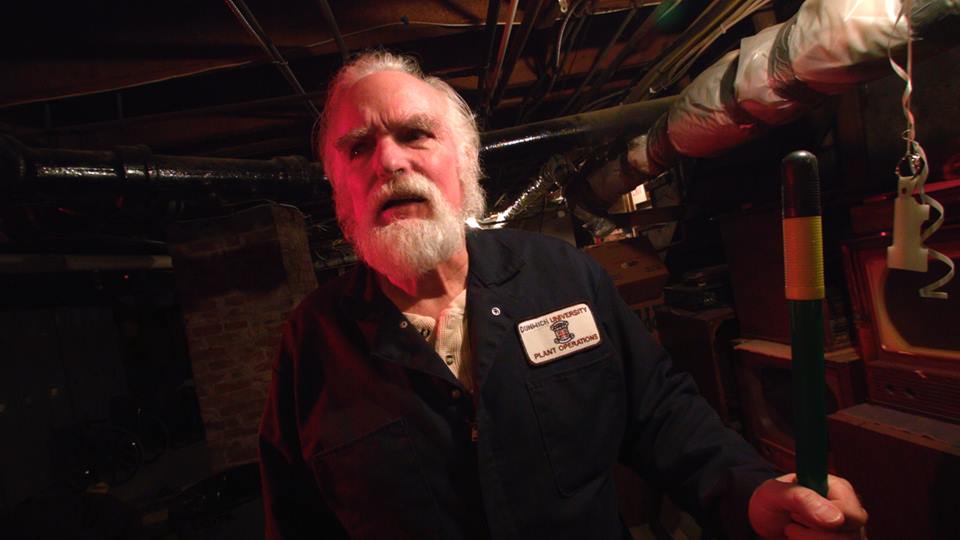
“The Corpse of Anna Fritz”- (Movie Review)

anna fritz 1


By Andrew Buckner
Rating: **1/2 out of *****.

Released on October 8th, 2015 through Invincible Pictures, the unrated Spanish thriller The Corpse of Anna Fritz has the benefit of a certainly intriguing set-up. To its further credit, director Hector Hernandez Vicens, who co-wrote the strictly serviceable screenplay with Isaac P. Creus, paints the seventy-five minute chronicle in a largely subtle, classic genre approach. True to form, there is wonderfully welcome, gradual build-up throughout much of the first act. The tale gets extra mileage from such a decision. It summons the viewers into its web initially with effective degrees of mystery. There also appears to be an ominous tension waiting to strike from beneath its surface. Ricard Canyellas’ dark and brooding cinematography compliments this attribute splendidly.

What is just as interesting is the manner in which the composition successfully comments on the way the public views and treats celebrities in its commencing moments. This combination of atmosphere and social commentary, mixed with the taboo of necrophilia which is heavily mixed into the plot, assures us the resulting feature will be bold and fascinating. Alas, these opening bits are the pinnacle of this silver screen travesty. They suggest far more than the movie actually delivers. Once a twist kicks into play at the twenty minute mark, the tale jolts us again. It seemingly ups the ante on the nightmarish situation unfolding. Sadly, the promise Vicens and Creus so delightfully conveys up until this point is quickly unveiled as a scheme. Once the previously stated segment arises, the last fifty-five minutes of the depiction stumbles with a decidedly by the numbers story arc. During this later period, the piece proceeds to constantly run itself around in circles. It’s insistence on keeping the leads in the morgue for much of the duration also becomes quickly grating. Such also limits the opportunities of the account severely.

In the end, Vicens and Creus’ cinematic affair has its amusing sections. Still, it’s as if the auteurs used all their invention on pulling us in. Once this was victoriously achieved, the pair decided to fall back on genre conventions and repeated ideas remained ad naseum. It makes the whole an ultimately a tedious exercise. The undertaking is never quite dull. Yet, it is certainly unfulfilling. By the time the similarly predictable and underwhelming finale comes into play we find ourselves admiring the restraint of the effort, especially given its off-putting subject matter, more than anything else the filmmakers conjure herein.

Vicens and Creus tell the tale of Ivan (Cristian Valencia), Pau (Albert Carbo) and Javi (Bernat Saumell). They are led into a hospital morgue where the title individual, a popular actress, lies sprawled out on a gurney. Soon the three seize the opportunity to indulge their fantasies of being with the deceased. Amid this action, the trio unveil that Anna Fritz (Alba Ribas) may not be as dead as she seems.

Among the problems of the script is that Ivan, Pau and Javi are all treated like adult variations of the stereotypically hormone driven teens who are killed off one by one in your garden variety horror offering. This attribute is especially highlighted early on with the three spouting juvenile dialogue galore. Once the actual story arrives and the tone becomes decidedly more serious so do the men. Not only is this much fitting to the fashion of such terror archetypes as mentioned above but, it is almost as if we are supposed to forgive and forget the heinous light the application illuminated them in previously. This could be overlooked if the screenwriters gave them even an ounce of character development or even a reason for us to care for them. Fritz is given much the same treatment. We never get to know anyone on-screen in the least. It makes the experience distant and cold. The run-around motions of the last two acts might not have been so noticeable if we were invested in any of these personages in any manner.

To its credit, Ribas is fantastic. This is visible in her ability to convey emotion through wide-eyed facial expressions. Given that her role hinges on the quality of such characteristics, with the writers giving her almost no dialogue, this becomes one of the flick’s few triumphs. Valencia, Carou and Samuell distribute fine enactments with what material they are given. Yet, the ultimately hollow script rarely utilizes such opportunities for the aforementioned individuals to showcase their capabilities in the way it does with Ribas. Ultimately, the on-screen personalities are simply put there because the narrative requires them to be. They are pawns. We see this in the reality that they are given no depth. Nor do Vicens and Creus issue any attempt at them becoming fully realized. Such is a shadow that eclipses the entire exertion.

Despite this, Tolo Prats’ sparse, but unnerving, original music serves the venture well. Alberto Bernad’s editing is masterful. It helps the illusion that what we are seeing is actually transpiring before our eyes. Zeroquatre’s art direction is tremendous. The same can be said for the moody lighting. It is also true of the believable visual effects from Javier Peirot. Urko Garai and Miquel Linas deliver top-notch sound department contributions. Pi Piquer’s costume and wardrobe choices add further commonplace authenticity to the project. Cristina Pellicer and Cristina Pellise provide excellent make-up. This is visibly evident in the credibility of Franz’s recently passed appearance in the early instances. Regardless, these solid influences do little to mask the gaping flaws of the fiction itself.

The Corpse of Anna Fritz begins promisingly. Despite this, it ultimately falls victim to its own choppy pace. It issues suspense intermittently. Our interest ebbs and flows throughout. Yet, it cannot sustain its nail-biting demeanor long enough to be deemed satisfactory. This is especially baffling given the taut movement suggested by the wisely scant running time. Likewise, there are rarely any genuine surprises in store. Not to mention, the piece ends on a whimper. All these details indicate a disappointment. Vicens and Creus have created a sadly mediocre, forgettable affair. It is one that will have even the least demanding of genre fans waving their hands and shouting, “That was it?”!

anna fritz picture bottom 2

“Choosing Sides’- (Short Film Review)

choosing sides 3


By Andrew Buckner
Rating: ****1/2 out of *****.

Director Lee Loechler and writer Yael Green deliver a quietly powerful statement on religious conversion with the short picture from 2013, “Choosing Sides”. Painted with several moments of genuine hilarity, mostly deriving from the aforementioned situation, the exertion defies the bitter, preachy sermon the piece could’ve easily become in less capable hands. Instead, the two frame the composition in a radiant likeability. There is a perpetual warmth throughout that walks the line between comedy and drama. Such allows the audience to pick up on its message through their own assessment of the happenstance. This is a brilliant move. Such is true in that it allows the configuration, which plays entirely as a single extended segment, to unravel naturally and believably. In turn, there is never an instant where the illusion that we are watching a scene that could have occurred over numerous dinner tables throughout the world becomes shattered. This is another fantastic element of this effort. The experience overall will be wholly unique and intimate to every one of the exertion’s patrons. Such is another wonderful turn from the filmmakers’ decision to simply show the sequence without interrupting with their own thoughts. Never do Loechler and Green add any unnecessary cues as to how they want us to feel. They are inherently confident in their vision. Such only heightens the professionalism glistening through every frame of this subtle masterwork. The result is amazing. This is pure magic.

Though the set-up is amusing on its own, the confidence and competence at every level adds supplemental layers of depth and profundity. They unravel as the mind meditates its instances. Such adds a perpetually immersive luster to an already memorable bit of celluloid. Aided by terrific and endlessly watchable performances from Timothy J. Cox as the Catholic father, Peter, Rachel Lynn Jackson, as the Jewish mother, Ellen, and Max Abe Plush as Mikey, this is an all- around winner.

Loechler and Green’s tale focuses largely on Peter and Ellen. A pleasant enough, if rather mundane, discourse at dinner takes a noticeably disagreeable turn. Such occurs when faith slips into the dialogue. With young Mikey in ear’s range of the pair, the duo take the opportunity to use various methods, both derogatory to the opposing side and praising their own creed, to sway the innocent child to their side of the theological argument. This becomes, in the eyes of the parents, a battle for Mike’s moral direction. It is one which ends masterfully. We are given a concluding reveal that personifies another tremendously effective narrative choice on Loechler and Green’s behalf. Not only is it surprising, but it drives home the inevitable judgment sadly cast by some when they hear your doctrines do not align with their own. The last few minutes are a wonderfully strong punctuation point. It is one which re-states all that was communicated prior with brute force. Such makes this spectacular conclusion all the more riveting.

Among contributing the finely honed and competently crafted direction of this scant journey, Loechler provides cinematography which is striking, lush and alluring. His editing is just as skillful. The same can be said for Green’s nuanced and meditative screenplay. It is filled with credible, often successfully guffaw inducing, dialogue. What makes this all more operative is that Green has penned the type of speech one can easily hear erupting from the mouths of someone in the same combat Peter and Ellen become engaged in. These round out but a few of the various accomplishments visibly radiating from this production.

“Choosing Sides” works splendidly. This is true of both its laughter oriented and more sentimentally intense components. It also excels as a utilization of both genres to create a cohesive statement on the subject matter at hand. This is a rousing, well-executed and evenly paced undergoing. Though some may leave the labor offended at the picture painted, stating that such brawls would never derive from differing dogmas, the chronicle forces us to do as the title states. Such is an example of how accessible the characterizations are on-screen. It is also evidence of the participation we are pushed into inevitably. This, in itself, is verified proof of the emotive tiers buried immediately beneath the account’s apparently straightforward surface. All of these attributes join brilliantly. The outcome lingers with us long after the bit has settled. Such is evidence of the transcendence of the endeavor. It is also consequence of the volumes spoken in such a diminutive span. What Loechler and Green have provided here is challenging cinematic art; a sum which illuminates beautifully.

“That Terrible Jazz”- (Short Film Review)

terrible jazz 1


By Andrew Buckner
Rating: **** out of *****.

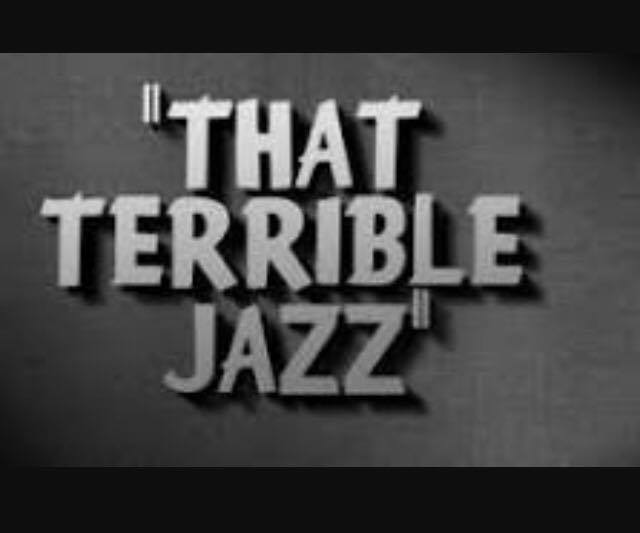
Inaugural writer and director Mike Falconi’s near seventeen minute short thesis film for The Art Institute of Philadelphia, “That Terrible Jazz”, is every bit as smooth, classy and elegant as its title musical genre suggests. It is complimented by the pulpy attitude one would expect from a 1930’s – 40’s noir. This Falconi has ardently fashioned his debut cinematic achievement after. Also, the narrative is similarly fitting in that it is packed with sly, diminutive, cryptic dialogue. This hallmark aspect is as intriguing, illusive and mesmerizing as ever. It is another of the fiction’s many trademark attributes. Regardless, it adds layers of additional mystery and sophistication to an already compulsively intriguing dramatic composition.

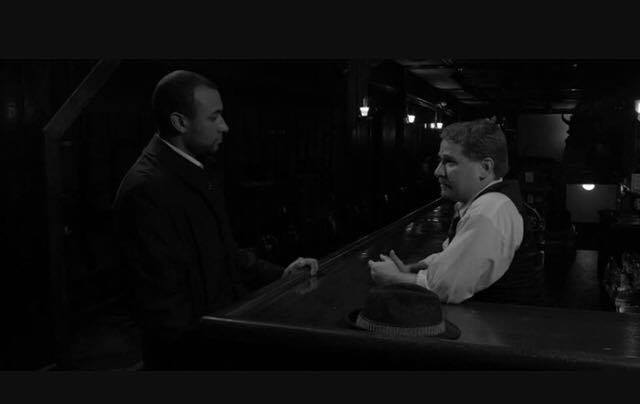
The plot concerns the chain-smoking and heavily drinking protagonist and private Investigator Sellers (Ephraim Davis in an enactment which brings to mind Humphrey Bogart with a uniquely splendid and well-executed spin) and his attempts to locate a missing saxophone player. The ticking clock motif, another common quality of similar affairs, is utilized here. This comes into play as Sellers learns that the individual needs to be uncovered before the jazz band performs that night. It is an amusing jump-off point. Such is perfect for the scant form it is presented in. Likewise, the account is punctuated with an underlying intensity throughout. Falconi and his moviemaking crew, keeping the enigmatic traits of its brood in check, frame the yarn largely as one interrogation sequence after another. This administers supplementary respect for the roots of similar entries of its ilk. It also mechanizes incredibly well as a tried and true manner of delivering exposition. With several genuinely unforeseeable twists in tow to add to the attention-garnering at hand, Falconi develops those who populate the screen in a consistently engaging, charismatic and alluring fashion.

These well-developed cinematic dispositions themselves endure as enigmatic as the lead himself. They follow the modus impeccably well of such a classically stylized entry. Such can also be said of Ellay Watson’s brilliant embodiment of Elizabeth Alksne. Timothy J. Cox gives us another of his many masterful turns in his portrayal of the barkeeper, Nicky. Cox’s always welcome presence is reserved for a small amount of the runtime. Still, he makes a certainly memorable impression. David A. Rodriguez is exceptional as Jimmy Calder. Jim Snyder as Gregory and John Rifici as Dean fare just as well in their respective depictions. Thomas Schmitt as Dallas, Bruce Clifford as Mac and Gyasi Howard as Wynn Dumont astound. Together these performers complete a cast of characters etched with both dimension and a hard-boiled edge. We, the audience, sit spellbound by everyone we meet herein.

What also heightens and illuminates such a parallel is Stephen Grancell’s moody black and white cinematography. This is complete with beautifully done lighting that augments the visual splendor. Contributing to this appeal is Earl Stepp’s immersive, era appropriate music. Such sophisticated luster is treated by the dress of the aforementioned period. There are suits, ties and pork pie hats aplenty. With these elements in mind, this could’ve easily come off as mere imitation. Instead, the sum of this labor soars far beyond such a broad description. This is accomplished by issuing a tautly-knit, relentless pace. It is also assisted by sharp editing from Falconi and Grancell. Additionally, Falconi has crafted a screenplay that is smart, absorbing and proficient. The well-constructed piece makes exceptional use of its low-key sensibility. Furthermore, this rousing effort demonstrates phenomenal make-up work from Frances Gonzalez-Chavarria. It also exhibits incredible sound from Strepp. These jaw-dropping components illuminate this magnum opus dazzlingly. They help establish the competence resounding from every technical facet.

Among its other wise moves is opening, as if being dropped in the middle of a scene, with Watson hiding her face in a pillow. The words are uttered: “You better end this, Betty. Because you don’t want me to.” Such a display grips us immediately. It urges us to put the broken portions of this seemingly broken puzzle together quickly. This is before the actual narrative ventures in that direction. Falconi’s production is compulsively watchable from its first frame onward. As the tale moves on, the same sense only accumulates. When the end credits arrive, with a grey moniker in quotations that recollects the days when crime sagas such as these dominated movie theaters, we realize that we have been riveted in the manner this exertion commenced upon throughout.

Ending on a brilliant, suspenseful and pensive note that suggests the name of the effort represents the unpleasant goings-on of the leads’ daily lives, Falconi has given us a debut exertion that is sophisticated and clever. With a budget of only $1,000, Falconi has delivered a composition that mirrors the rugged gloss of an antiquated Hollywood production spectacularly. Falconi does this so well that one cannot help but feel awestruck by how well he creates the illusion of watching an eighty year old classic.

“That Terrible Jazz” is phenomenal. This is true as an example of old-fashioned storytelling as well as its enduring contemporary hold. It is also a promise of great things to come for Falconi. His contribution behind the lens is fantastic. Yet, this splendidly crafted love letter is striking all around. Falconi’s exertion proves that the genus it ardently models itself after needs a modern-day resurrection. It also subtly suggests that some definitions of ‘cool’ are eternal. They continue to excite and compel us as years stretch on and pass. Such is just one of the many reasons why Falconi has concocted both a wonderful love letter and a sight well worth seeing.

terrible jazz 2

“Accidental Incest”- (Movie Review)

Rating: ***** out of *****
By Andrew Buckner

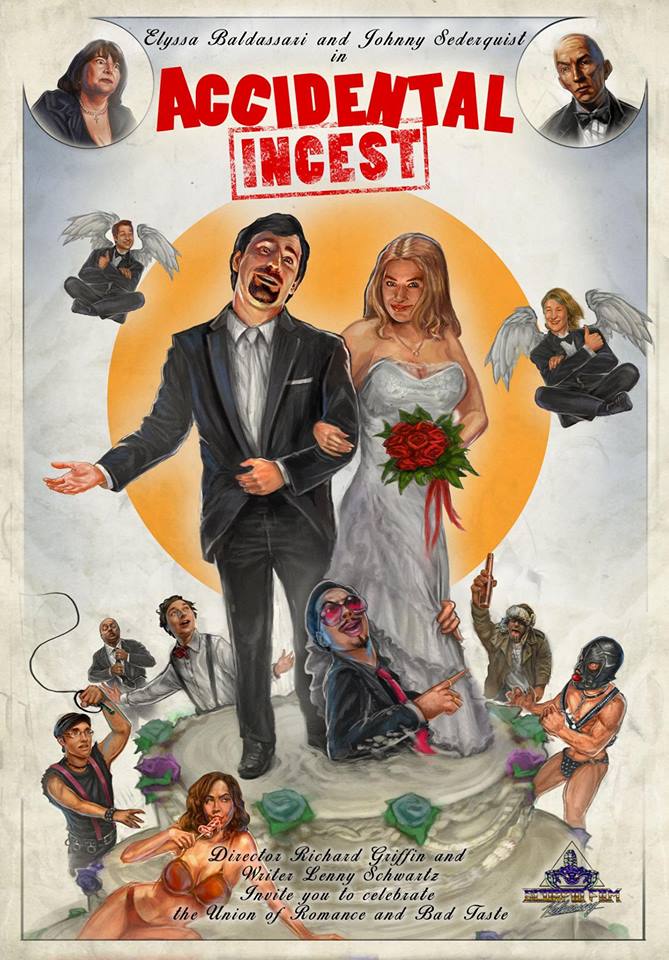
Accidental Incest, based on the off-Broadway production (published through Indie Theater Now) by Lenny Schwartz, plays like a gloriously successful mash-up of John Waters, Kevin Smith and South Park creators Matt Stone and Trey Parker at their most riotous and wildly unhinged. Schwartz has engineered a consistently funny, beautifully constructed and intelligent screenplay adaptation. It is one that is alternately meditative and unabashed. Likewise, it is consistently cunning, engaging and conclusively uplifting in its own respect. These elements assist in making this one hundred and two minute piece undeniably bold. Not only is this visible in the taboo bridled title subject matter, with much of its humor deriving from its sexual frankness, but also in the stances it takes against religious persecution. Additionally, the faux sense of superiority instilled in those who take the reins of such facets. This is the increasingly rare feature that utilizes the comedy genre as not only an instrument to entertain but, also, to drive home its timely thematic conscience. From the first effective comic segment, a tone-setting quote by Irving Berlin that flashes over a dark screen in its initial seconds, to the splashy extravaganza marking its heaven sent conclusion: the proof of this statement reverberates through every frame of its expertly paced one hundred and two minute runtime. This audacity is also visible in the unconventional manner the endeavor is told. It is just as foreseeable in the truly impulsive chain of events which dominate the general story arc. Such makes the whole affair endlessly intriguing; a vigorous breath of fresh air for those of us who are long exhausted, dulled to fury with the timid, rote manner in which the genre of laughter is so often served up on the silver screen.

accidntal movie picture 3

The narrative concerns Milton and Kendra (courageous, attention-garnering enactments by Johnny Sederquist and Elyssa Baldassarri that are full of surprising dimension and heart). After an extended six-minute opening, that is just as successful in establishing Milton’s carnal promiscuity as it is the string of rousingly victorious and well-timed unorthodox gags which pop up throughout the duration of the picture, our male lead swears to better himself and absolve such sinful deeds. Cut to Kendra waking up “Somewhere in Mexico”. She is disoriented, disrobed and has little remembrance of how she got there. As can be readily anticipated, the paths of the two unite during a motel stay. A date soon ensues that pushes the promises the two have made quickly out of the way. After finding out that they have the same father, their collective passions and fleshly indiscretions heighten to new zeniths entire. Eventually,  this anything but standard issue romance is tested. Such occurrs as the outside world, especially a pair of religious fanatics that the second half of the chronicle gets to know in depth, try to enact their fervent sense of moralism upon them.

accidental movie picture 2

This represents another show-stopping exhibition of range for both Scorpio Film Releasing and the incredibly talented and the always reliable director, Richard Griffin. Being his third collaboration with Schwartz, their first such venture was the spectacularly inventive 2012 slasher saga Murder University and the 2013 drama Normal, the duo remain a terrific creative team. Griffin, who is marked as the ‘Drunken Film Director’ in the end credits, and his behind the lens work here is the perfect combination of indie artistry and its respective spirit. In particular, his ability to bring us something wholly unique and liberated from the conventional trappings of mainstream cinema. This characteristic is visible in the ravishing manner in which it incorporates five endlessly uproarious tunes throughout. Each of these ravishing, anything but commonplace ditties are every bit as side-splitting and amusing as the one which came beforehand. Among these are the Crimson-Al Khelmia (who depicts Angel #1) penned ditty “Nicolas Cage”, which utilizes the title actor’s movies as erotic innuendos with magnificent results, and “Circuit Board Christ”. The latter track oversees The Lord, God Almighty (played with fervent relish by the author of the number, Aaron Andrade) displaying his lyrical prowess in what can be described as a dead-on parody of modern hip hop clichés. Not only are these show-stopping, off-the wall segments that represent the un-fettered spirit of the piece entire but, they are among the best moments in the entirety of the exertion. The send-off tune, “Sentimental Incest”, sung by Jesse DuFault, The Young Adults performed and co-scribed “Kill Yourself”, and the Mark Cutler authored and Patrick Keefee executed, “Next Door Neighbor”, are unswervingly adroit. Such sonic oddities, and the routines which often accompany them, simultaneously remind us of the story’s stage roots (as does the leads’ various intimate discussions with the camera as if such is a silent audience). Similarly, it succeeds as both extensions of tone and sheer entertainment. Griffin, true to the form he established in earlier endeavors, drapes the project in nods to various other genres. An example of this is seen in a repeated shot of a sign for a motel. Composed over Jill Poisson’s gorgeous and sleek black and white cinematography, this scant segment wonderfully calls to mind a noir fabrication from the 30’s. Yet, despite such occasional departures the general demeanor of the composition is rooted in our modern times. The attitudes and point of views from the personages on-screen highlight this point incessantly.

Not only is this escapade beautiful to look at, with its brief color bits as eye-catching as its aforementioned classic cinema veneer, but its allure stretches beyond the screen. There are layers of emotion to the tale that are made all the more immersive and powerful due to the sheer talent at hand. Timothy Fife’s music is brilliant. The visual effects by Jill Poisson and John Dusek are skillful and astounding. Griffin’s contribution as editor is just as exceptional here as it was in his previous escapadeses such as 2015’s similarly genius Seven Dorms of Death and Flesh for the Inferno. Angela Shulman’s art direction is astounding. Also, every cast member is spectacular in their roles and make them wholly their own. Tonya Free as the oblivious wife of a homosexual, Susan, does a fantastic job of delivering wild guffaws. This is through the medium of facial expressions and the well-hewn dialogue coursing throughout the affair. Jose Guns Alves as The Anxious Man, Anna Rizzo as Tabitha, Jamie Lyn Bagley as Jen, Jesse Dufault as Rex and Christian Masters as Alex fare just as incredibly. Laura Pepper delivers another display of her magnificent rib-tickling aptitude in her brief, but certainly memorable, part as The Brain Damaged Wife. Bernard Larrivvee Jr. is just as stupendous as the eye-patched hotel manager. Paul Lucenti as Issac, Kevin Kilavey as Tool, Dan Mauro as Bob, Sean Carufel as Wesley, Christopher L. Ferreira as Tyler, Rich Tretheway as Kevin, Ryan Hanley as St. Peter, Michael Thurber as Harrison, Rosemary Pacheco as a receptionist, Sissy O’ Hara as a landlady, James Bagley as a doctor, Mark Hutchinson as a bartender and Steven O’ Broin as Dr. Emil Locust are delightful in their corresponding depictions. Knate Higgins as Sven, Casey Wright as Ariel and Erin M. Olson as Mary also embody their portrayals just as masterfully as those mentioned previously.

Accidental movie picture 1 Jose Gonsalez

Griffin and Schwartz’s latest collaboration is an example of high-risk taking resulting in a singular, innovative and distinctively captivating experience. There is a finely etched concern for all of the individuals we meet along the way. It is both smart and exuberant. Furthermore, the arrangement entire showcases proudly the admiration for motion pictures of the past and present. This has become another of Griffin’s many charming staple attributes. In an age when mainstream romantic-comedies are so by the numbers we can predict every movement the story takes before we even sit down to view it, Accidental Incest seems determined to take these routine twists and demolish them. In turn, we are delivered a completely capricious undergoing. The result is wall to wall cackles at situations ‘polite society’ would turn their nose up at. There is also an unexpected mirth, a merriment to the proceedings that is genuine. Such is another component multi-million dollar Hollywood productions package artificially, as if via an assembly line. Griffin’s feature is a grand masterpiece; authentic, rousing and both ground and rule-breaking. For those of us who enjoy boundaries being pushed so far away from our eyes that we are capable of enjoying the briefly held sense of being truly and utterly free: this feature, along with all of Griffin’s other celluloid journeys, should go immediately to the top of your ‘must-see’ list.

accidental movie picture 4

“Seven Dorms of Death”- (Movie Review)

seven dorms 1

By Andrew Buckner
Rating: ****1/2 out of *****.

Director Richard Griffin has mastered the retro genre form. His 2008 venture, Nun of That, was a wickedly amusing take on 70’s B-movie actioners. He victoriously journeyed  back to the days of low budget monsters filling drive-in screens in the 1950’s with 2010’s spectacularly entertaining and loving homage to old-fashioned alien tales, Atomic Brain Invasion. 2011’s The Disco Exorcist took the Saturday Night Fever spirit and painted it blood red. The results were endlessly clever and uproarious. Griffin’s recent Flesh For the Inferno (2015) modeled itself after terror features from the 80’s. The outcome was every bit as terrific as his previously mentioned endeavors. Seven Dorms of Death, whose essence is rooted much in the same decade as the previously stated composition and which was shot on video, shows that after thirty-one directorial credits, Griffin’s admiration, and effective parodying, of features from a bygone age is still every bit as welcome and on target as the works he’s honed beforehand. It also proves his style behind the lens is just as fresh and imaginative as ever. Griffin brings to mind Roger Corman and Lloyd Kaufman. This is in the manner in which he relishes B-movies and holds dear their distinctly unique charm. Yet, there are flashes of Mario Bava, Lucio Fulcio and the Italian Giallo master himself, Dario Argento, gleaming among the bloodshed. His craftsmanship, as well as his influences, are visible and their appreciation for them courses splendidly throughout.

Presented as a vanished VHS tape of a second feature from Baron Von Blah’s Celluloid Crypt, a late-night television program which becomes a pulpit for Michael Thurber’s scene stealing and undoubtedly transformative turn as the eccentric title host, we learn immediately that Seven Dorms of Death was uncovered from the deep, forgotten recesses of a library basement. This portion of information, delivered via scrolling text, becomes the first of many successful gags aimed at the endeavor’s low-grade quality placed throughout. As the work goes further on, we learn that the narrative itself concerns a cursed stage play. When a college in New England, filled with students who listen incessantly to Judas Priest, attempts to put on a production of the work a series of brutal murders commences. Those involved in the production are killed off one by one in unique ways. Also, keeping true to the tradition of the post- modern slasher offerings, the mystery of who may be the one enacting these fatal episodes is up to a pair of unorthodox detectives. One of whom the often used term “loose cannon” is more than fitting. These are Aaron Andrade as Vargas and Dan Mauro as Sam.

seven dorms cop picture

With grandly exaggerated mannerisms aplenty, same said dialogue, facial expressions and the far over the top performances equated with a buddy cop picture from the 90’s, this aforementioned duo is a perfect personification of the hilariously exaggerated and unrestrained spirit Griffin instills into every frame of this side-splitting masterwork. Laura Pepper is just as triumphant in her portrayal of Jane Peach: a reporter lifted right from an archetypical 1930’s crime saga. Mahoney (Dave Almeida), fares just as well as the editor for Peach’s newspaper, Dunwich Penney Saver. Vincent Perrone, as Officer Kosinski, is also wonderful in his obviously tongue in cheek depiction.

seven dorms pepper picture

The rest of the cast mimics the varied assortment of caricatures found in teen related fright flicks, especially those in the 80’s, especially well. Lead by Anna Rizzo as the spectacled and socially awkward, Severin, Hannah Lum as Bambi, Graham King as Chad, Mike Zuccola as the undergraduate of the occult and heavy metal aficionado, Mark, and Rich Tretheway as Lumpy, every portrayal here is top notch. Evan Clinton, as the drama professor and play director, Jason, enacts his often grandiose role spectacularly. The flare Clinton puts into his every gesture and line creates a character that is consistently watchable.

The several on-screen deaths themselves also carry on these characteristics incredibly well. They lampoon the visibly second-rate effects in the B movies it mirrors itself after to an ardent and splendidly comic outcome. A drill through the head near thirty minutes in oversees its victim replaced during the goriest bits with what is discernibly a mannequin. As the sequence goes on, it drives this point home to great comic consequence. Such is one of the most interesting uses of such humor. Such occurrences, especially one such bit in the finale where a character states that his life and his death are one and the same, only punctuates the plethora of wildly well-timed, manic self-referential humor at hand. It also has intentional goofs, such as a scene where the director yells “cut” and the actors all breathe a sigh of relief and go about their normal business, which is just as effectively raucous. Yet, the cinematography by Jill Poisson, the moody music by Timothy Fife and Daniel Hildreth, sound by Anna Goodchild and David Ryan Kopcych, as well as the editing by Griffin himself, are all seriously skillful and striking. These attributes, along with Torey Haas’ stop motion animation and make-up by Jordan Pacheco and Margaret Wolf, seamlessly create the illusion that we are seeing a cult classic from the 80’s. This movie works splendidly as an extended wink at the audience. It is just as much a professional display of the talent at hand.

Likewise, the screenplay by Matthew Jason Walsh drips with giddy facetiousness and fun. It has the even pace and build-up that is much on par with the specific brand of motion picture it is modeling itself after. Michael Varrati penned some of the wonderfully entertaining fake commercial bits sprinkled in between the main program throughout. They are just as successful in celebrating past shlock, through new venues entire, as the main feature itself. Among the most memorable is the novel adaption called “Yesterday’s Winds of Tomorrow’s Fortune”, the 70’s grindhouse style Dracula’s House of Sadism and the self-explanatorily titled, “Smooth Nut and Vacuum Ads”. “1-900 Hot Link Commercial”, penned by Pepper, and Future Shock 199o, scribed by Alex Divincenzo”, are just as riotous. They are also well executed and issue the great comic timing found throughout. Varrati also contributed text for the ghoulishly delightful sequences of Baron Von Blah’s Celluloid Crypt (which sport incredible lighting work from John Mosetich). These elements are all just as winning as the feature itself. Such luminous characteristics only further heightens the script’s appeal. Varrati is just amusing on-screen as Von Blah’s off-balance puppet sidekick, Sockenstein.

seven dorms old dude picture

Seven Dorms of Death is an eighty-nine minute delight. It will appeal most readily to those of us who grew up with an unquenchable thirst for low-budget opuses. Moreover, those of us who have an unyielding esteem for the real life variations of Baron Von Blah (for me it was Joe Bob Briggs on TNT’S Monstervision) who showed a double bill of Z grade features on their respective programs every week. Griffin, as always, finds the right note to create his special blend of admiration filled genre spoof instantly. He continues on that course throughout the entirety. In turn, he delivers another deliriously innovative throwback to a time and cinematic style that we, fellow horror film and cinephiles in general, hold dear. This is an incredibly successful love letter; another fantastic addition to Griffin’s catalogue of unconventional satires. It is also a must-see for those of us who vividly recall staying up late into the night, put under a spell by Von Blah’s true life counterparts. Griffin and production company Scorpio Film Releasing’s latest is nostalgia inducing greatness of the highest order.

“Simple Mind”- (Short Film Review)

By Andrew Buckner

Rating: ****1/2 out of *****.

simple mind main picture


Director and screenwriter Phil Newsom has crafted a searing portrait of admiration, obsession and psychosis with his seven minute and twenty-two second 2012 short film, “Simple Mind”. Not only does the work issue a stunning amount of story in its scant runtime but, it also succeeds immeasurably at sharpening an intimate, understanding perspective of its otherwise villainous lead, Bob. The viewpoint established is a testament to Timothy J. Cox’s fabulous, alternately vulnerable and menacing, portrayal. This is also noticeable in the claustrophobic sensibility Newsom so masterfully constructs throughout. A slow motion sequence of Bob running, heart heard hammering in the soundtrack, which opens the affair, proves such successes. The audience becomes one with the character immediately. Later moments, which seem to be gazing into his eyes as they look around at everything but the camera, as if into his soul, as well as the frequent focus on the area around such lenses of sight while he speaks are brilliant, hypnotic and haunting. These segments heighten the overall atmosphere of the piece immensely. Moreover, these instances are among the many such bits where the arrangement visually exemplifies Bob’s own personality.

On much the same note, the story, as well as the manner it is told, is certainly layered. It captures our attention immediately with its fanatical stalker/ love narrative. It only grips us all the more as it becomes gradually becomes darker, its thriller elements all the more apparent, and even more captivating. Newsom tells this story through a series of flashbacks. This decision makes the endeavor come across even more as a trip through the fractured psyche of a disturbed individual. We learn about Bob as he does, peeling away every coating with increasing interest and horror. Yet, it avoids making Bob out to be another garden-variety deviant at every turn. Because of this we find ourselves all the more sensitive to his contemplations and often greatly concerned for his well-being. This is just one example of how well Newsom defies both conventions and anticipations.

The chronicle concerns Bob’s discovery of himself through repeated therapy sessions. During this time, he confesses to a violent impulse to his counselor, Samantha (spectacularly played by Kristi McCarson). This instinct Bob attributes, in one of the most chilling scenes herein, to being his only measure of achievement. It’s delivered in a startling, mesmerizing, terrifically underplayed quip; a centerpiece in a composition where all the previously stated words apply. The final reveal is just as jarring. It commands us to reassess the package as a whole. With it we confront the Hitchockian cleverness visible in its effortless manipulation of audience expectations.

simple mind 3

The technical aspects are just as astounding. Paul Nameck’s cinematography and editing is gritty, raw and perfectly suited for a tale such as the one Newsom presents. Keith Campbell’s music, with additional contributions from Jeremy Gonzalez, is evocative and effective. Newsom’s screenplay is a blueprint for a well-conceived suspense yarn. Incorporating authentic dialogue that drips with intrigue, motive and exposition that is smartly woven into the fabric of the account, Newsom’s writing is just as riveting. It is on par and as unique as his directorial handling. Most impressive of all, Newsom packs an incredible amount of twists into a compact runtime. Each sequential turn being all the more surprising and delightfully macabre.

Newsom has given us a taut, fast-paced rollercoaster ride with “Simple Mind”. It fascinates viewers as much with its unsettling take on self-discovery as it does with its various, and beautifully executed, nail-biting sections. Both of the personas on-screen are equally absorbing. Bob is a bold, dynamically explored and fully fashioned individual. Samantha is enigmatic and enthralling. By keeping the characters at the forefront and giving us an effort that is full-bodied, competently done in all respects and strikingly balances both its thriller and dramatic touches: Newsom has crafted a tour de force for fellow genre addicts. This is a must-see for those who like to think as well as scream.


simple mind 2

“Under the Dark Wing”- (Short Film Review)


By Andrew Buckner
Rating: ***** out of *****.

Director Christopher Di Nunzio (2011’s “Her Heart Still Beats”, 2015’s A Life Not to Follow) continues to astound with his fifteen minute short film from 2014, “Under the Dark Wing”. Released through Creepy Kid Productions this is a darkly poetic, hypnotic and utterly unique take on the paranormal tale. This brilliant work, which plays like a combination of Ingmar Bergman and Martin Scorsese, is enriched by Nolan Yee’s gorgeous black and white cinematography. Further enhancing the visual appeal of this already dazzling endeavor is Di Nunzio’s masterful direction. In particular, his apparently effortless knack for framing alluring shots. Alongside this, Di Nunzio summons mesmerizing angles which heighten the sense of claustrophobia, always a necessity for thrillers such as these, on-screen. An extended conversation in a secluded area, an office of sorts, between Johnny Boy (a riveting, nuanced performance by Fiore Leo) and George (in a portrayal by David Graziano which is suitably menacing and extraordinary), which takes up most of the first half of the effort, are where such touches are most evident. But, it is also present in a beautifully rendered moment where Johnny Boy walks cautiously through a field, his left hand extended before us as if guiding, as the camera treads scant inches away from the young man. This is all a compelling build-up to coming face to face with The Girl (a fascinating enactment by Jessy Rowe which exhibits the character’s underlying currents of power and vulnerability spectacularly well). Di Nunzio also captures the isolation of the characters, and the region in which they dwell, with shots of largely empty streets and abandoned buildings. Such elements immerse us in the mind of Johnny Boy, as he treads through them in the affair’s earliest moments, instantly. These are all indicators of the high-arena of technical conception Di Nunzio and his crew are laboring at throughout.

The narrative revolves around Johnny Boy, who claims to have been drug free for a year, returning to his boss, George. Frustrated, Johnny Boy relates the failure of his past job, where he was supposed to slaughter a C.E.O., to the presence of a young girl. But, when an enigmatic female figure begins to find her way into the lives of the two: George is blind-sided by the idea of the profit she could bring in. Immediately afterward George and Johnny Boy begin to realize that the fate they thought they had a firm hold of could be in someone else’s hands entirely.


under the dark wing 2


“Under the Dark Wing” grabs ahold of our attention immediately, with a sharply done title scene, punctuated by the exclamatory clattering of bells, and concludes on a just as impressive climactic note. The piece is propelled by cryptic, noir-like dialogue. It is also fashioned with a non-stop pace that is both quick yet, authentic and brooding. Not only does this tighten the already wire-like grip on underlying suspense Di Nunzio has fabricated but, it adds heightened style, menace and intrigue to an already white-knuckle horror effort. What mechanizes just as tremendously to its acclaim is that it unveils a manner to develop its characters cleverly, through wordplay and ominous, poetic and visually stunning images that never shatter the tense guise hovering over the entirety of the project. Furthermore, they never seem artificial. This is as much a testament to Di Nunzio’s masterful guidance of the exertion as it is the intelligent, beautifully constructed screenplay he penned, from a story Di Nunzio (who has an uncredited role as the Dead C.E.O. in this venture) is solely attributed with conceiving, with Pedro Alvarado.


under dark 3


Di Nunzio, among his many prodigious contributions here, gives us music that is cloaked in temperament, perfect for the material and only adds to the classic veneer which hangs over the proceedings. He also contributes editing which is proficient, seamless and as eloquently crafted as the endeavor itself. The involvement from the rest of the crew is just as spectacular. Special make-up effects artist, Jessica Van-Winkle, does an astounding job with her respective participation. Boom-operator/ sound-recordist, Laura Grose, delivers sound that is crisp and alive. Alex Huang’s camera influence is terrific. Keith Bennet, who appears in the role of The Thug, is gripping. He makes an incredible impression with his brief time on-screen.


under dark 1


With “Under the Dark Wing” and the feature film he created one year later, A Life Not to Follow, Di Nunzio has proven that, not only he has absolutely mastered the creation of mature, grimly stunning and thoughtful thrillers. His characters are credibly etched, a vigorous facet which makes him stand triumphantly above the legion of those who toil in similar genres with antagonists and protagonists practically indecipherable from similar cinematic ventures. His stories walk the ledge of reality so well that we, the audience, never have any problem believing what our eyes are seeing. Not only is this because of the impeccable way he develops the personalities on-screen but, because he puts them first and makes us care for them all. It is a feat that many attempt but, few can pull off in such a consistently entertaining manner. Di Nunzio is an astonishing filmic auteur and “Under the Dark Wing” is every bit as tremendous as the other entries in his varied catalogue.


under dark poster

“Socks and Cakes” – (Short Film Review)

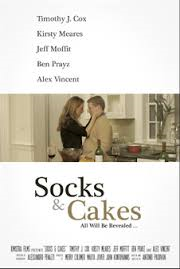
socks and cakes poster

By Andrew Buckner
Rating: **** out of *****.

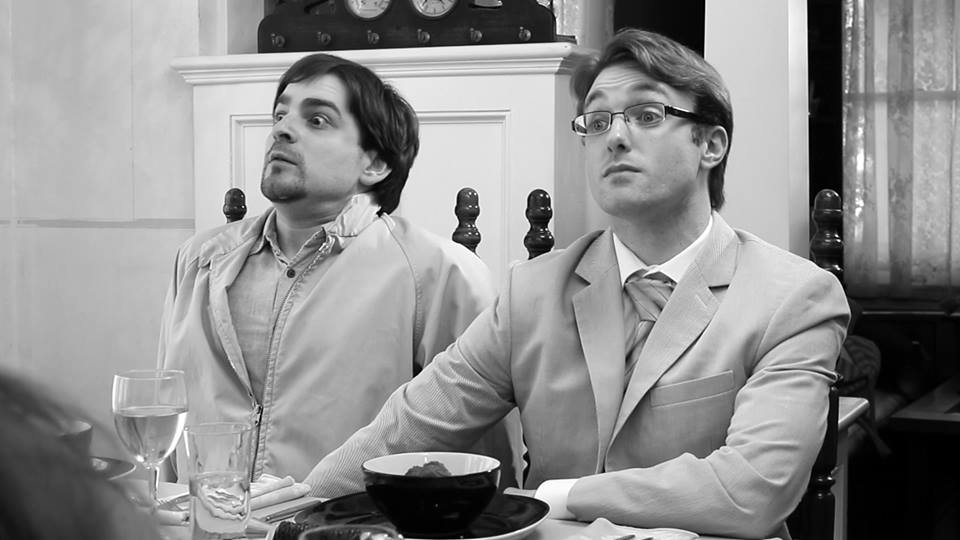
Writer and director Antonio Padovan’s twelve and a half minute short, “Socks and Cakes”, produced by Kimistra Films, is exhilarating entertainment. It is a sly comedy with delicately woven dramatic touches that is stylistically and tonally reminiscent of a Woody Allen venture. The magnificent composition wins its audience over immediately. Such is accomplished with both its widely relatable characterizations as well as a deftly honed screenplay (courtesy of Padovan). It is one filled with biting observations about life itself. The clever dialogue sharply reflects this characteristic. Often, its most effective humorous bits echoes such components. We laugh with those on-screen as we nod our heads in agreement. The serious bits are just as potent. This is because they evoke these attributes and hone them in a way that is not only sentimentally riveting but, intensely credible. For example, a stirring monologue delivered near the finale regarding the drudgeries of daily labor and other responsibilities gradually replacing dreams as one ages and matures is where such qualities are most evident. The commonplace attributes of those included within make their likability all the more transcendent. In turn, this becomes all the more accessible to a wide, varied audience. The result is a delightful concoction. It is one which is well-rounded, intelligent and uniquely meditative.

Padovan’s tale concerns five individuals who meet at a dinner party in Greenwich Village. Discussions of the past, the present and the future inevitably intermingle as the guests await the preparation of their meal. All the while, the chief personalities attending this event try to keep about a proper, respectable air as secrets involving these individuals are released. Emotions resonate but, seem to be pushed to the side until they can no longer be contained. This is where the piece gains its hefty dramatic intensity and sentimental resonance. Such arrives as the endeavor becomes largely a succession of clandestine talks between pairings of exes, lovers and friends after its stupendously mood-setting opening credits, which is resurrected just as successfully in its end acknowledgments. These segments are complete with fitting selections of music that only enhances its warm, hypnotic effect.

The topic of the production largely concerns the various relationships of the leads. It toys with the idea that men and women can attain pure friendships. This is, of course, after an isolated incident of giving into initial passions(as the French literature professor Harry Mogulevsky, a sophisticated and outstanding enactment by Timothy J. Cox that is pitch perfect for the material, informs us in one of his several Shakespearean lectures to the audience). Not only does this provide one of the most comedic moments in the effort but, it provides a grand example of the appropriately subtle manner in which such instances are handled.

The laughs are beautifully woven into the fabric of the narrative. Such is done in a way that doesn’t take away from the overall effect. Instead, it enhances the sensibility that one is watching a collection of close-acquaintances, people we immediately sense we’ve known for a long time, gather, reminisce and indulge in great conversation. The smartly smooth pace mimics this illusion of being present to what transpires; a silent comrade as the measures of the account unfold. Yet, Padovan also concerns his brief work of cinema with decision. Primarily, the ones which existence wields at us unexpectedly. This is most notable in its open-ended resolution. Not only is this a perfect punctuation point for the endeavor but, it draws the audience in all the more. Because of this the proceedings become all the more warmly intelligent, personal and gripping.

What also makes the effort all the more impactful is that it contains beautiful performances all around. Kristy Meares embodies the character of Amanda, Mogulevsky’s ex-wife, masterfully. Jeff Moffitt is terrific as the architect, Richard, Amanda’s present spouse (who just happens to be Mogulevsky’s best friend). Ben Prayz, as jovial and joking David, (whose impeccable comedic timing is utilized to great effect throughout) and Alex Vincent, as Sophie, fare just as spectacularly.

The affair also boasts gorgeous cinematography by Alessandro Penazzi and Redmond Stevenson. The veneer found on-screen is classy, elegant and natural; creating an immaculate visualization of the demeanor and atmosphere found in both the antagonists and beneath the surface of the material. Padavan’s direction is marvelous and his editing is seamless. Jackie Caruso’s use of make-up is phenomenal. Robert Albrecht’s sound is stellar. The same can be said for the art direction from Gabriela Guidino Jaime. All these wonderful elements come together strikingly well; the charm of the composition is infectious. Because of these wonderfully constructed technical elements the composition radiates triumphantly from the screen and into our own hearts.

Among the many fantastic feats Padovan and his filmmaking crew accomplishes here is how we leave this brief bit of cinema feeling that we have known the characters on-screen intimately all our lives. Padovan provides rollicking glimpses into those who populate his story through speech that is consistently fascinating and exposition that is just as natural and engaging. The fact that the exertion is so beautifully crafted, acted and provides such an exceptional example of the power of nuance makes the effort all the more admirable. Padovan’s ambitions to discourse on the human condition in such a quaint setting is all the more awe-inspiring. The reality that this is executed as brilliantly and effortlessly as all the high-caliber herein makes the piece all the more worthy of our time and attention. “Socks and Cakes” is terrific.

socks and cakes 2

“Dirty Books”- (Short Film Review)

dirty books poster


By Andrew Buckner
Rating: ***** out of *****.

Director and co-writer Zachary Lapierre’s sixteen minute short, “Dirty Books”, released through Fitch Fort Films, tackles the matter of the death of the printed word in an outright, yet sincere, heartfelt manner. It is one that succeeds ravishingly as an illustration of naturalism, humor and insight. The composition is consistently entertaining yet, meditative. Moreover, Lapierre finds a way to earn our emotions genuinely, without ever manipulating them. He finds an incredible balance between a tone that is pleasant, down to earth and upbeat, perfect for its more light-hearted instances, and an underlying somberness that makes its argument all the more dire. This creates the perfect stage for the wonderful, and relatable, message held in its central theme. Such is also reflected, in many ways and attitudes, in the title itself. This massive cinematic achievement speaks to its audience without ever appearing preachy or as if it is negating storytelling to do so.

What also works in its favor is that the manner in which the chronicle unfolds is appropriately breezy and direct. It mirrors various teenage angst classics from mid-1980, namely The Breakfast Club and Ferris Bueller’s Day Off, but feels distinctly like its own entity. Furthermore, it triumphantly accomplishes this without giving into its wisely planted gags and comic undertones to the point that it takes away from the dramatic forefront. Because of this it never negates its sharp focus on serious characters and characterization, as well as the gravity of the subject matter. Lapierre walks a delicate line between these genres effortlessly. This is done so deftly and with such care that its gentle respect for both areas it categorizes itself within is worthy of envy. It also, in turn, makes the composition all the more varied and dimensional.

The narrative oversees David Burroughs (Noah Bailey) creating fiction and selling it as truth. This dishonesty revolves around pornographic pictures being placed by an enigmatic individual in an unspecified book in the school library. It is done to save his newspaper, for which he is both publisher and editor-in-chief, from being turned into an online blog by the end of the year. Given that the newsprint’s most intriguing tales in the past few weeks have been “retiring faculty and changes to the fitness curriculum”, as we learn early on, he comes to believe that this deception will be the spark which catches the fiery interests of all of his peers. In turn, Burroughs thinks that this will appeal to classmates and will, alternately, make Dr. Bradley (Timothy J. Cox) change his mind about the upcoming transition from page to screen. What Burroughs doesn’t expect is how this fabrication will modify his own life as well as those around him. This is when this pleasing production turns to another timely topic, which it addresses with the same quiet potency as its prime focus. This is the extent one will go for fame, notoriety and to be remembered. These concerns undoubtedly summon great emotion. The piece ends on a staggering exclamatory note that recalls these elements magnificently.

As a cinephile the high-caliber performances, especially Timothy J. Cox’s phenomenal and sophisticated turn as Dr. Bradley, helped make this an immediately absorbing watch. This is heightened by Noah Bailey’s alternately vulnerable, relatable and quietly empowering turn as the rebellious protagonist. These aspects, especially the palpable and combative chemistry between the two in the attention-garnering opening segment, where Burroughs is informed that he is “being shut down”, drew me in immediately. It made the on-screen personalities all the more rich, multi-layered, likable and alive. Ansley Berg as the sports writer, Charlotte, and Isaiah Lapierre as Owens are superb. The rest of the cast fares just as spectacularly.

What also enticed me in the aforementioned manner is that Lapierre exhibits consistently confident, and incredible, direction. The smart screenplay he has crafted with Ian Everhart, who also provides the appropriately fantastic and gratifyingly tone-setting cinematography, as well as the smooth pace and the seamless editing by Michael Kutsch made the endeavor all the more captivating. This is further aided by Megan Provencial’s vibrant graphic design. Lapierre, who also contributed the delightful sound on display, has issued music which catches the essence of the account just as phenomenally as these aforementioned attributes. These stellar characteristics come together beautifully. They assist in the creation of a labor of love that is both urgent and endearing, gorgeous in what is on the surface as well as beneath it.

But, the narrative, especially the fight David wages against the powers that be was riveting, enabling even, to me as a writer. It is an eternal issue that is presented here in a fresh, vigorous, innovative way. This brilliant approach made it easy for me to cheer for David as he combats authority, while admiring the care put into all technical aspects of the composition. The result is overwhelmingly effective. Lapierre has undoubtedly crafted a timeless masterpiece. In the space of a brief runtime, Lapierre and his moviemaking crew have concocted a terrific, charming and pensive exertion. It is one that will speak to audiences of all ages as it showcases the price one must often pay for both their treacheries and their passions. This is a lesson, a message that we all must be reminded of every now and again. “Dirty Books” does this, and much more, marvelously well.

You can check out Fitch Fort Films’ Facebook page here.

The I.M.D.B. page for “Dirty Books” can be seen here.

“The Witch”- (Movie Review)

By Andrew Buckner

Rating: ****1/2 out of *****.

The Witch, from first time feature director Robert Eggers, is that increasingly uncommon, and boldly unconventional, horror feature that sets its sights far beyond simple jump scares and the genre’s various tired recycled staples of fright. Instead, it is out to coil gradually beneath your skin, burrow itself into your imagination and linger there for an extended period; long after its ninety-three minute runtime is far behind you. Eggers takes the long exhausted topics of possession, necromancy, religious persecution and fear of the unknown and transforms them into a composition of endless magnificence. He appears doggedly determined to go out of his way to deliver these well-worn topics into a succession of riveting sequenceso that is, not only as believable as possible, but, unlike anything we’ve seen before.

Backed by powerhouse performances, immaculate attention to the dress (courtesy of Linda Muir’s immaculate costume design), dialogue and demeanor of its circa 1630 period detail: Eggers has crafted an instant genre classic; one where the term ‘unnerving’ and ‘spine-chilling’ seems custom made to describe its lasting impression. What is just as extraordinary is that Eggers, who also wrote the meticulously erected screenplay, delivers a slow-burn thriller whose pace only heightens the suspense to almost unbearable levels while being both confident and intelligent. The effort never talks down to its audience or goes outside the confines of what would logically occur within the narrative for an unearned scream. That, in itself, makes this more than worthy of a recommendation. Moreover, it looks and feels wonderfully old-fashioned. This cinematic experience brings to mind timeless terror masterpieces, most notably Stanley Kubrick’s 1980 magnum opus The Shining (which Eggers declared was a great inspiration for the piece), while appearing fresh and wholly original. The similarities are remarkably evident in both Mark Koven’s brilliantly sparse orchestral score, Louise Ford’s seamless film editing and Jarin Blaschke’s ominous, eerie and elegiac cinematography. This results in a tremendous achievement; one that is exceptionally well-done on all accounts.

Eggers’ extraordinarily mounted and intense “New England folktale”, as the opening informs us and which we uncover immediately before the end credits has portions taken directly from the diaries of 17th Century Puritans, can be seen as a precursor to the religious fervor of The Salem Witch Trials. This occurred sixty-two years after the chronicle takes flight. To accomplish this goal Eggers has constructed a piece which concerns a family who is made to leave a plantation because of the father, William (in a portrayal by Ralph Ineson that is passionate and commanding), and his severe biblical interpretation. Later, the group of seven settles down to build a new life. They construct a home with a barn in front of a strangely brooding and deeply-reaching wooded expanse. Soon William and his children seem drawn to the region and find themselves making up excuses to explore its recesses. Almost immediately afterward a series of unearthly events begin to build. These are all surrounding the forest and the strange acting animals within and around it.

The unconsecrated sensibility emanating from the area becomes all the more palpable when the youngest child, in an effectually staged first act sequence, vanishes during a game of peak-a-boo with oldest daughter, Thomasin (in a depiction by Anya Taylor-Joy which is as gripping, varied and alive as the striking images Eggers puts on-screen). The mother, Katherine (in an enactment by Kate Dickie that is successfully accomplishes turns of vulnerability and outright danger masterfully), and William are understandably grief-stricken. Caleb (Harvey Scrimshaw) and twins Mercy (Ellie Grainger) and Jonas (Lucas Dawson), all of whom are wonderfully and uncannily played, seem to either be dealing with the loss in their own way or strangely removed from the situation altogether. Soon the presence of evil, which becomes pinpointed to a scene-stealing goat named Black Phillip, who is rumored to talk to Mercy and Jonas, grows. This existence of a malicious entity continues to steadily make itself known. Such disturbing goings-on progressively transpires until the clan is pitted against one another. From herein, the word ‘witch’ is hurled to practically everyone involved. This is distributed with increasing rapidity as the wickedness takes over.

The feature is a triumphant combination of both drama and visceral gothic horror. Most importantly, it avoids the clichés of the genre at nearly every turn. A large part of the success of this exertion derives from the factor that Eggers treats nearly every personality we encounter on-screen as if they are the lead of the tale, especially in the beginning  thirty-five minutes. Eggers builds his characters with the patience of a work by Ingmar Bergman and, simultaneously, finds the way to craft moments of menace that are sly and quietly intimidating. This balance is evoked so seamlessly that it makes the increasingly accruing evil appear all the more authentic. Initial scenes involving a rabbit with an unnerving stare, though it is initially difficult to declare exactly why it produces such an outcome, is initial proof of how meritoriously this blend of real-life and the unholy is accomplished. Often the terror is carved, just as masterfully as the more obvious jolts, from extended periods of unsettling silence.

There are moments, mostly reserved for the first and last ten minutes, which also brought to my mind thoughts of F.W. Murnau’s ground-breaking, expressionistic approach in his silent 1922 vampire masterpiece, Nosferatu. This duration also contains a sense of the abstract quality and rhythms of David Lynch’s 1977 avant-garde classic, Eraserhead. In these early and late sections, Eggers showcases terror sequences at his most grimly poetic and evidently visceral. Though these are obviously designed to chill your blood and stay with you, and they certainly achieve their intended consequence, these more obvious attempts at trepidation are just as victorious as the more subtle anxiety setting starts that take up the bulk of the picture. Moreover, Eggers never betrays the Kubrickian catalyst flowing throughout the endeavor. The result is a big-screen endeavor which commences brilliantly, grabs our attention and continues to defy our expectations just as smartly until its appropriately understated conclusion. The Witch works so well because it leaves just enough to get our imagination to fill in the blanks while it tosses one beautifully macabre image after another our way. This is an incredible feat, made all the more plausible due to the always believable credible contribution from both Luc Benning’s special and Andrew Alzner’s visual effects team, that Eggers pulls off without a hitch.

There are many other terrific technical attributes which make this endeavor such a one of a kind marvel. Christopher Guglick, Jason Perriera, Adam Stein, Orest Sushko and Robert Turi’s influence in the sound department is terrific. Mary Kirkland has issued tremendous set decoration, which only adds to the painstaking period authenticity present. The make-up department, credited to Francois Dagenais and seven others, does excellent work. These consistently high-quality markers help illuminate all that radiates from the screen and make the overall effort all the more immersive.

Eggers’ intentions with this project, besides scaring the hell out of us, was to understand the spiritual mania of the era and, alternately, give us a precursor to The Salem Witch Trials. Because the individuals here are so well-honed, and he elicits such concern for them, we understand William’s actions as he accuses those around him of witchcraft. Yet, we are just as sympathetic of those who are the indicted. In so doing, we often wonder if he is handling himself in such a manner as to cover up his own personal dabbling in such a field. This is because the production, true to the tradition of the best terror endeavors, effortlessly transports us inside the mind of those the tale follows. The spectacularly constructed shocks are all the more potent because Eggers and company dare to do what few horror features wish to do nowadays. This is gaze far beyond the surface and into the beating heart of those involved. Such is one of the primary reasons The Witch is so uncommonly effective. It is guaranteed to remain a favorite for both genre and art-house aficionados for years to come.

the witch poster