“Simple Mind”- (Short Film Review)

By Andrew Buckner

Rating: ****1/2 out of *****.

simple mind main picture


Director and screenwriter Phil Newsom has crafted a searing portrait of admiration, obsession and psychosis with his seven minute and twenty-two second 2012 short film, “Simple Mind”. Not only does the work issue a stunning amount of story in its scant runtime but, it also succeeds immeasurably at sharpening an intimate, understanding perspective of its otherwise villainous lead, Bob. The viewpoint established is a testament to Timothy J. Cox’s fabulous, alternately vulnerable and menacing, portrayal. This is also noticeable in the claustrophobic sensibility Newsom so masterfully constructs throughout. A slow motion sequence of Bob running, heart heard hammering in the soundtrack, which opens the affair, proves such successes. The audience becomes one with the character immediately. Later moments, which seem to be gazing into his eyes as they look around at everything but the camera, as if into his soul, as well as the frequent focus on the area around such lenses of sight while he speaks are brilliant, hypnotic and haunting. These segments heighten the overall atmosphere of the piece immensely. Moreover, these instances are among the many such bits where the arrangement visually exemplifies Bob’s own personality.

On much the same note, the story, as well as the manner it is told, is certainly layered. It captures our attention immediately with its fanatical stalker/ love narrative. It only grips us all the more as it becomes gradually becomes darker, its thriller elements all the more apparent, and even more captivating. Newsom tells this story through a series of flashbacks. This decision makes the endeavor come across even more as a trip through the fractured psyche of a disturbed individual. We learn about Bob as he does, peeling away every coating with increasing interest and horror. Yet, it avoids making Bob out to be another garden-variety deviant at every turn. Because of this we find ourselves all the more sensitive to his contemplations and often greatly concerned for his well-being. This is just one example of how well Newsom defies both conventions and anticipations.

The chronicle concerns Bob’s discovery of himself through repeated therapy sessions. During this time, he confesses to a violent impulse to his counselor, Samantha (spectacularly played by Kristi McCarson). This instinct Bob attributes, in one of the most chilling scenes herein, to being his only measure of achievement. It’s delivered in a startling, mesmerizing, terrifically underplayed quip; a centerpiece in a composition where all the previously stated words apply. The final reveal is just as jarring. It commands us to reassess the package as a whole. With it we confront the Hitchockian cleverness visible in its effortless manipulation of audience expectations.

simple mind 3

The technical aspects are just as astounding. Paul Nameck’s cinematography and editing is gritty, raw and perfectly suited for a tale such as the one Newsom presents. Keith Campbell’s music, with additional contributions from Jeremy Gonzalez, is evocative and effective. Newsom’s screenplay is a blueprint for a well-conceived suspense yarn. Incorporating authentic dialogue that drips with intrigue, motive and exposition that is smartly woven into the fabric of the account, Newsom’s writing is just as riveting. It is on par and as unique as his directorial handling. Most impressive of all, Newsom packs an incredible amount of twists into a compact runtime. Each sequential turn being all the more surprising and delightfully macabre.

Newsom has given us a taut, fast-paced rollercoaster ride with “Simple Mind”. It fascinates viewers as much with its unsettling take on self-discovery as it does with its various, and beautifully executed, nail-biting sections. Both of the personas on-screen are equally absorbing. Bob is a bold, dynamically explored and fully fashioned individual. Samantha is enigmatic and enthralling. By keeping the characters at the forefront and giving us an effort that is full-bodied, competently done in all respects and strikingly balances both its thriller and dramatic touches: Newsom has crafted a tour de force for fellow genre addicts. This is a must-see for those who like to think as well as scream.


simple mind 2

“Socks and Cakes” – (Short Film Review)

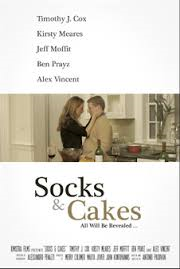
socks and cakes poster

By Andrew Buckner
Rating: **** out of *****.

Writer and director Antonio Padovan’s twelve and a half minute short, “Socks and Cakes”, produced by Kimistra Films, is exhilarating entertainment. It is a sly comedy with delicately woven dramatic touches that is stylistically and tonally reminiscent of a Woody Allen venture. The magnificent composition wins its audience over immediately. Such is accomplished with both its widely relatable characterizations as well as a deftly honed screenplay (courtesy of Padovan). It is one filled with biting observations about life itself. The clever dialogue sharply reflects this characteristic. Often, its most effective humorous bits echoes such components. We laugh with those on-screen as we nod our heads in agreement. The serious bits are just as potent. This is because they evoke these attributes and hone them in a way that is not only sentimentally riveting but, intensely credible. For example, a stirring monologue delivered near the finale regarding the drudgeries of daily labor and other responsibilities gradually replacing dreams as one ages and matures is where such qualities are most evident. The commonplace attributes of those included within make their likability all the more transcendent. In turn, this becomes all the more accessible to a wide, varied audience. The result is a delightful concoction. It is one which is well-rounded, intelligent and uniquely meditative.

Padovan’s tale concerns five individuals who meet at a dinner party in Greenwich Village. Discussions of the past, the present and the future inevitably intermingle as the guests await the preparation of their meal. All the while, the chief personalities attending this event try to keep about a proper, respectable air as secrets involving these individuals are released. Emotions resonate but, seem to be pushed to the side until they can no longer be contained. This is where the piece gains its hefty dramatic intensity and sentimental resonance. Such arrives as the endeavor becomes largely a succession of clandestine talks between pairings of exes, lovers and friends after its stupendously mood-setting opening credits, which is resurrected just as successfully in its end acknowledgments. These segments are complete with fitting selections of music that only enhances its warm, hypnotic effect.

The topic of the production largely concerns the various relationships of the leads. It toys with the idea that men and women can attain pure friendships. This is, of course, after an isolated incident of giving into initial passions(as the French literature professor Harry Mogulevsky, a sophisticated and outstanding enactment by Timothy J. Cox that is pitch perfect for the material, informs us in one of his several Shakespearean lectures to the audience). Not only does this provide one of the most comedic moments in the effort but, it provides a grand example of the appropriately subtle manner in which such instances are handled.

The laughs are beautifully woven into the fabric of the narrative. Such is done in a way that doesn’t take away from the overall effect. Instead, it enhances the sensibility that one is watching a collection of close-acquaintances, people we immediately sense we’ve known for a long time, gather, reminisce and indulge in great conversation. The smartly smooth pace mimics this illusion of being present to what transpires; a silent comrade as the measures of the account unfold. Yet, Padovan also concerns his brief work of cinema with decision. Primarily, the ones which existence wields at us unexpectedly. This is most notable in its open-ended resolution. Not only is this a perfect punctuation point for the endeavor but, it draws the audience in all the more. Because of this the proceedings become all the more warmly intelligent, personal and gripping.

What also makes the effort all the more impactful is that it contains beautiful performances all around. Kristy Meares embodies the character of Amanda, Mogulevsky’s ex-wife, masterfully. Jeff Moffitt is terrific as the architect, Richard, Amanda’s present spouse (who just happens to be Mogulevsky’s best friend). Ben Prayz, as jovial and joking David, (whose impeccable comedic timing is utilized to great effect throughout) and Alex Vincent, as Sophie, fare just as spectacularly.

The affair also boasts gorgeous cinematography by Alessandro Penazzi and Redmond Stevenson. The veneer found on-screen is classy, elegant and natural; creating an immaculate visualization of the demeanor and atmosphere found in both the antagonists and beneath the surface of the material. Padavan’s direction is marvelous and his editing is seamless. Jackie Caruso’s use of make-up is phenomenal. Robert Albrecht’s sound is stellar. The same can be said for the art direction from Gabriela Guidino Jaime. All these wonderful elements come together strikingly well; the charm of the composition is infectious. Because of these wonderfully constructed technical elements the composition radiates triumphantly from the screen and into our own hearts.

Among the many fantastic feats Padovan and his filmmaking crew accomplishes here is how we leave this brief bit of cinema feeling that we have known the characters on-screen intimately all our lives. Padovan provides rollicking glimpses into those who populate his story through speech that is consistently fascinating and exposition that is just as natural and engaging. The fact that the exertion is so beautifully crafted, acted and provides such an exceptional example of the power of nuance makes the effort all the more admirable. Padovan’s ambitions to discourse on the human condition in such a quaint setting is all the more awe-inspiring. The reality that this is executed as brilliantly and effortlessly as all the high-caliber herein makes the piece all the more worthy of our time and attention. “Socks and Cakes” is terrific.

socks and cakes 2

“Dirty Books”- (Short Film Review)

dirty books poster


By Andrew Buckner
Rating: ***** out of *****.

Director and co-writer Zachary Lapierre’s sixteen minute short, “Dirty Books”, released through Fitch Fort Films, tackles the matter of the death of the printed word in an outright, yet sincere, heartfelt manner. It is one that succeeds ravishingly as an illustration of naturalism, humor and insight. The composition is consistently entertaining yet, meditative. Moreover, Lapierre finds a way to earn our emotions genuinely, without ever manipulating them. He finds an incredible balance between a tone that is pleasant, down to earth and upbeat, perfect for its more light-hearted instances, and an underlying somberness that makes its argument all the more dire. This creates the perfect stage for the wonderful, and relatable, message held in its central theme. Such is also reflected, in many ways and attitudes, in the title itself. This massive cinematic achievement speaks to its audience without ever appearing preachy or as if it is negating storytelling to do so.

What also works in its favor is that the manner in which the chronicle unfolds is appropriately breezy and direct. It mirrors various teenage angst classics from mid-1980, namely The Breakfast Club and Ferris Bueller’s Day Off, but feels distinctly like its own entity. Furthermore, it triumphantly accomplishes this without giving into its wisely planted gags and comic undertones to the point that it takes away from the dramatic forefront. Because of this it never negates its sharp focus on serious characters and characterization, as well as the gravity of the subject matter. Lapierre walks a delicate line between these genres effortlessly. This is done so deftly and with such care that its gentle respect for both areas it categorizes itself within is worthy of envy. It also, in turn, makes the composition all the more varied and dimensional.

The narrative oversees David Burroughs (Noah Bailey) creating fiction and selling it as truth. This dishonesty revolves around pornographic pictures being placed by an enigmatic individual in an unspecified book in the school library. It is done to save his newspaper, for which he is both publisher and editor-in-chief, from being turned into an online blog by the end of the year. Given that the newsprint’s most intriguing tales in the past few weeks have been “retiring faculty and changes to the fitness curriculum”, as we learn early on, he comes to believe that this deception will be the spark which catches the fiery interests of all of his peers. In turn, Burroughs thinks that this will appeal to classmates and will, alternately, make Dr. Bradley (Timothy J. Cox) change his mind about the upcoming transition from page to screen. What Burroughs doesn’t expect is how this fabrication will modify his own life as well as those around him. This is when this pleasing production turns to another timely topic, which it addresses with the same quiet potency as its prime focus. This is the extent one will go for fame, notoriety and to be remembered. These concerns undoubtedly summon great emotion. The piece ends on a staggering exclamatory note that recalls these elements magnificently.

As a cinephile the high-caliber performances, especially Timothy J. Cox’s phenomenal and sophisticated turn as Dr. Bradley, helped make this an immediately absorbing watch. This is heightened by Noah Bailey’s alternately vulnerable, relatable and quietly empowering turn as the rebellious protagonist. These aspects, especially the palpable and combative chemistry between the two in the attention-garnering opening segment, where Burroughs is informed that he is “being shut down”, drew me in immediately. It made the on-screen personalities all the more rich, multi-layered, likable and alive. Ansley Berg as the sports writer, Charlotte, and Isaiah Lapierre as Owens are superb. The rest of the cast fares just as spectacularly.

What also enticed me in the aforementioned manner is that Lapierre exhibits consistently confident, and incredible, direction. The smart screenplay he has crafted with Ian Everhart, who also provides the appropriately fantastic and gratifyingly tone-setting cinematography, as well as the smooth pace and the seamless editing by Michael Kutsch made the endeavor all the more captivating. This is further aided by Megan Provencial’s vibrant graphic design. Lapierre, who also contributed the delightful sound on display, has issued music which catches the essence of the account just as phenomenally as these aforementioned attributes. These stellar characteristics come together beautifully. They assist in the creation of a labor of love that is both urgent and endearing, gorgeous in what is on the surface as well as beneath it.

But, the narrative, especially the fight David wages against the powers that be was riveting, enabling even, to me as a writer. It is an eternal issue that is presented here in a fresh, vigorous, innovative way. This brilliant approach made it easy for me to cheer for David as he combats authority, while admiring the care put into all technical aspects of the composition. The result is overwhelmingly effective. Lapierre has undoubtedly crafted a timeless masterpiece. In the space of a brief runtime, Lapierre and his moviemaking crew have concocted a terrific, charming and pensive exertion. It is one that will speak to audiences of all ages as it showcases the price one must often pay for both their treacheries and their passions. This is a lesson, a message that we all must be reminded of every now and again. “Dirty Books” does this, and much more, marvelously well.

You can check out Fitch Fort Films’ Facebook page here.

The I.M.D.B. page for “Dirty Books” can be seen here.

“Total Performance”-(Short Film Review)

By Andrew Buckner

**** out of *****.

The seventeen minute serio-comic short film from writer-director Sean Meehan, “Total Performance”, boasts both incredible talent and a unique and intriguing narrative concept. What further strengthens this fantastic endeavor is that the people in Meehan’s screenplay are lively and endearing. Moreover, the dialogue is dripping with authentic, frequently funny and often slyly witty banter. This is interpreted with equally magnificent turns from Tory Berner as the lead, Cori Sweeney, and Steven Conroy as Tim Madsen. These tremendous enactments grandly compliment the personalities Meehan has erected. This is so largely because the main depictions are all so tremendously realized. They bring home all the multi-layered facets of those we meet in the proximity of the tale. Such is done with nuance and unwavering believability. There is an everyday likability about Sweeney and Madsen that make them immediately relatable.

Meehan’s smoothly structured and magnificently directed and penned account focuses in on Sweeney. She is a struggling actress who is employed by a company, whose name graces the title of the piece, that lends out their members to represent an individual who is about to suffer a break-up, be let go from their occupation or dealt unfortunate news. The only catch is she can’t give any advice. But, when the comfort of being out of the practiced discussion long before it occurs, as is her only rule, is unexpectedly broken she finds herself amid the chaos. This transpires as a situation she was hired to provide her particular service to manifests while she is still on the premises.

When the endeavor turns from effectively humorous and often playful to dramatic to thoughtful in the second half the transition is effortless. This is thanks to the continued character-oriented focus throughout. It is also attributed to, not only the stalwart impact of the depictions from Berner and Conroy, but a secondary cast that is equally spectacular. The on-screen depictions by Caitlin Berger as Annie Heron, Anthony Rainville as Rafi, Timothy J. Cox as Walter Baron, Paul Locke as Bruce, Phoebe Kuhlman as Lauren and Lauren B. Nelson as Susan inspire awe. They quietly captive the audience with their multi-layered, high-caliber enactments. The event that brings about the conversion in tone is harrowing and genuinely unexpected. It heightens our emotional investment in these fictional personalities even more. Furthermore, it is punctuated by a closing shot that perfectly illuminates the various questions and conflicting emotions that must be going on in Sweeney’s mind. The open- ended nature of this only makes the results all the more effective and cerebral. By doing so the spectators is boldly forced to put themselves in Sweeney’s shoes. The composition is all more potent because it asks us to figure out what decision any of us would make in the state of affairs Sweeney finds herself in.

The first sequence draws us in immediately. We see Sweeney going through a job related rehearsal. It is her approach to her profession which is naturally fascinating. Yet, it also grips us on a technical level. This is thanks to, not only a naturally innovative storyline, but also mood-catching music by Cesar Suarez. Further appreciation for this attribute is courtesy of Chris Loughran’s colorful, striking and always luminous cinematography. Meehan’s film editing and digital effects are marvelous and impressive. Hair stylist and makeup artist Maya Landi and gaffer Joe McLeish’s particular contributions are just as phenomenal. Everyone involved presents magnificent work. This factor illuminates the proceedings significantly.

“Total Performance” is magnificently orchestrated throughout. It showcases a tremendous balance of humor and heart. It is also made all the more poignant by Meehan’s ability to seamlessly fill the screen with riveting cinematic personalities that we care about. The writing is sharp and the interpretations of the individuals that populate Meehan’s script are knock-outs all around. This is a brief composition that is not only a beauty to be caught up in but to watch unfold and to meditate upon. Meehan has crafted a dazzler. It is one that is propelled by both a tremendous and original plot idea and same said execution. This is a must-see.

You can check out the Facebook page for “Total Performance” here.

“Here Lies Joe”- (Short Film Review)

here lies poster

By Andrew Buckner

Rating: ***** out of *****

From the opening moments of director Mark Battle and Sweven Films’ hauntingly beautiful twenty-three minute short, “Here Lies Joe”, a riveting tonal balance of melancholy, peppered with effective humor and an ebbing sense of optimism, is brilliantly established. We watch our lead, whose name is referenced in the title of the piece (rivetingly played by Dean Temple in a performance that is always watchable, absolutely perfect for the material and showcases his incredible abilities by speaking volumes through frequently sorrowful facial gestures) taping up the windows of his beat-up car, full of books and family photographs, in an attempt at ending his life. This sequence lasts but a minute. Regardless, it immediately pulls us into Joe’s world. This early bit is so triumphant at doing so that we instantly care for and desperately want to learn more about this lonely soul.

This segment is just the first of many such smart moves on Battle’s behalf. Such decisions result in a towering achievement. It is one which reaches its sentimental zeniths through the lens of credibility and realism. Such is presented through its continued emphasis on sheer subtlety. This occurs in both characterization and in the way the entire endeavor is crafted. These factors, thanks to the gorgeous and perfectly suited for the overall atmosphere attributes of Battle’s superb cinematography, ravishingly compliment the atmosphere and the narrative impeccably well.

The story, dazzlingly constructed by both Pamela Conway and Battle, concerns Joe meeting an unpredictable young woman known as ‘Z’ (in a portrayal by Andi Morrow that is every bit as intriguing, well-honed and fantastic as Temple’s) at a Suicide Anonymous meeting. This is one headed by Bill (Timothy J. Cox in another of the many magnificent enactments herein). He is a self-proclaimed “suicide addict”. In this same sequence we also meet several other immediately gripping personalities. For instance, Joe is confronted by Carol (a presentation by Mary Hronicek that is both exceptional and charismatic) who believes her fish is clinically depressed. Even with the brief screen time Hronicek is given she makes Carol just as absorbing as the forerunners of the account. It proves the high-caliber of both the writing and the acting talent at hand.

hlj_z

Though Joe is quiet and introverted, and Z is more than happy to make her presence known to the entire group upon introduction, they inexplicably find a common bond with one another. The rest of the saga focuses sharply on this relationship. The friendship between Joe and Z demonstrates their unspoken dependence upon one another. Because of this the interest initially garnered when we first see each of these characters becomes unwavering. It also increases in its stalwart nature. Such is especially true with each new breathtaking scene.

Battle and Conway’s bold screenplay takes full advantage of the differences in personality between Joe and Z. This is largely evident up until the seventeen minute mark in the composition. It is utilized as a chance to provide phenomenal discussions between the two. These often relate these differences in either a direct or ancillary fashion. This works as entertaining character development. Yet, these instances are so well-written and immersive that we find ourselves even more captivated by these opposite personalities. What is just as mesmerizing is their semi-unlikely attachment and the strange fate which has pulled them together. This prior focus only makes the last six minutes, complete with elegiac and instantly memorable lines such as Z’s: “I am an ugly thing in a beautiful world”, all the more of an emotional knockout. It all comes together to create a certainly well-rounded and touching dramatic portrait as the endeavor becomes more sentimental and heart-wrenching in this conclusive stretch.

This attribute is punctuated by a final bit of dialogue, a reference between a shared interest among Joe and Z, which, in its context, calls back to mind all of the mournful, hilarious and poignant instances which came beforehand. It makes the endeavor all the more masterful as it finds the perfect climax for such a touching, intimate and relatable effort. This is done simply in its last touch of underplayed, but smirk-inducing, dialogue. Yet, the imprint it leaves lingers, much like the sum of the material itself, long afterwards.

From a technical standpoint this often unexpectedly exuberant affair is just as impressive. Battle’s editing is seamless. It is also spectacularly orchestrated. Robert Beal III and Sean Meehan’s sound is crisp, alive and continuously striking. Hair stylist and makeup artist Nicole Celso evokes a great contribution to the overall quality of the piece in her respective arenas. This makes this short picture all the more of deft and alive.

“Here Lies Joe” is an example of how much can be done, stated, examined, as well as the lasting impact conducted, in a brief span. Battle has an incredible aptitude in his respective fields. The same is true for the rest of his moviemaking crew. The proof of such a statement is illuminated in every second of this wonderful and often unexpectedly life- affirming tour de force. This is an intelligent, meditative affair. It is one with just the right balance of heart and laughter. Furthermore, every on-screen personage herein is highly likable. Every individual we encounter throughout seems deserving of being the principal of their own cinematic endeavor. This is an exhibition of moving art that audiences can grow with as the years pass and age and accruing wisdom inevitably takes further hold. This is a visual treasure trove. One destined to bring about new pearls of insight and continue to enthrall and move moviegoers with each viewing. Because of this, Battle’s latest demands to be seen.

You can check out the website for the short here.

You can check out Sweven Films’ Facebook page here.

You can check out Timothy J. Cox’s web site here.

You can check out the IMDB page for “Here Lies Joe” here.

hi joe bottom