“Araf” – (Short Film Review)


By Andrew Buckner
Rating: ***** out of *****.

“Araf” (2016), an eight-minute and forty-five second collaborative short from writer-directors Fidan Jafarova and Tofiq Rzayev, is a masterful meditation on pain and suffering. It is also a heart-wrenching example of moving picture art beautifully evaluated through the lens of human tribulation. Such is phenomenally expressed through the underlying theme of the incredible tolls of war on mankind. This is signified by several distinctly woven personalities. The Angry Student Films, Synaps Production and Fidan Jafarova release, made for 1,000 AZM in the Eurasian country of Azerbaijan, also brilliantly elucidates echoes of Swedish cinematic auteur Ingmar Bergman’s tour de force, Cries and Whispers (1972). This is especially evident in its mature, sobering handling of grave subject matter. These are all articulated unflinchingly, yet respectfully. Such transpires with the topics of disease and dying at the forefront. Furthering this correlation, is the concentration in both endeavors on the measures and sentimental outcomes such unavoidable trials brings about on the family members which dominate each singular tale. Given that the term “araf” is often utilized to reference the Muslim borderlands between heaven and hell, instituted for neither the wholly good or wicked, there is also a religious constituent to the proceedings. This connects Bergman’s material with Jafarova and Rzayev’s latest in this respect as well. Likewise, the character-oriented emphasis is credibly etched in these accounts. This technical component is so well formulated that this quality alone carries each corresponding composition to greatness.

Additionally, the performances in each item are exceptional all around. This is with the incorporation of a superb balance between the photographic, the everyday and the theatrical. Also, the cinematography in each respective entity, with that in “Araf” stemming from Rzayev and that from Bergman’s construction from Sven Nykvist (who won an Academy Award for his work on the aforesaid invention), is gorgeously grim and appropriately bleak. There is a brooding, meditative color palette shared between these undertakings. Such is undeniably striking and ambient throughout. Yet, in Jafarova and Rzayev’s brief effort, the general veneer arises as more shadowy, stylish and thriller oriented. The constant rumble of thunder and the highly demonstrative sights of the rain hammering outside, which creates a breathtaking image which opens and closes the piece, spectacularly heightens this attribute. Thus, when the fabrication slides into an unanswered question of actuality, ghosts or delusions, all through the eyes of daughter Feride (in a captivating enactment by Konul Iskender), the progression is simultaneously natural and complimentary. This transpires to alluring consequence in the second half. There is also a countless deal of symbolic imagery laced into practically every frame of these presentations. At the heart of this is a focus on feminine strength, vulnerability and courage amid nearly impossible circumstances. Enduring this representative correlation, there is a concentration on inner-wars. This is noticeable, in one manner or another, through every disposition dominating these already addressed exertions. These are both unspoken or verbalized. In “Araf”, this figure is physically embodied. This is via an unnamed combat with an unspecified menace. It is frequently discussed but never seen. Yet, we ceaselessly impress upon ourselves the unnerving ideology that this brutality is inching ever closer to the treacherous mountains our protagonists call home. In so doing, the incorporation of this abhorrent item akin wonderfully increases the previously mentioned allegory. It also makes it all the easier to delve into the uncertain psyches of those we follow within the chronicle.

The story, credited to Rzayev, concerns a son, Ali (in a phenomenal turn from Adil Damirov), who becomes caught up in the previously addressed violence. Early on, the plot oversees the young man’s Mother (in a gripping, quietly commanding portrayal from Basti Jafarova) tending to her sickly husband. He is credited here simply as Father (an emotionally gripping turn from Sabir Mammadov, which triumphantly communicates his anguish largely through tormented grunts and groans). Enhancing the strain upon Mother and her kin is that her blood relations are all nearing starvation. It is also an ever-present fear for Ali. With this in mind, Mother braves departing her nearby loved ones. This is after defiantly declaring to Feride: “My other child…is out there fighting against the enemy and has nothing to eat. I cannot accept them both suffering hunger. You just don’t be afraid.” Such brings Mother on a quest to uncover a source of nourishment for those she is leaving behind. Feride than takes up Mother’s position. Almost immediately, the anxiety stemming from the unseen confrontations outside is personified in increasingly unique ways. This occurs as the situation around her instantly begins to deteriorate.

araf-pic-1

Such is a genuinely intriguing premise. It is one which requires much insight into both the psychology and attitude of those living under the persistent threat of real life terror. This is to be as successful as it obviously strives to be. Jafarova and Rzayev offer exactly that with their intelligent and richly constructed screenplay. They concoct personas, situations and dialogue that are as fully-realized, elegiac and memorable as any Bergman production. Regardless, their use of deceptively straight-forward discourse is meticulously sharp and profound. For instance, the commencing narration pronounces that “In these mountains…it always rains a lot. It’s unfortunate that we cannot hear it anymore”. Such a sweeping declaration draws us in instantly. But, when contemplated in retrospect, this line exemplifies tremendously just how far-reaching the apprehension is that our leads are under. Continually, the arc is largely unpredictable. This is without ever becoming implausible. Jafarova and Rzayev also unveil a perfectly even, cerebral pace for the brief opus. It is one that compliments the atmosphere splendidly. This is without weighing down the overall progression of events. Such is an astonishing feat itself.

All of this is made progressively encapsulating and hypnotic by Gergo Elekes’ remarkably emotive, piano driven score. Simuzar Aliyeva provides fantastic costume design. Shahmal Novruzlu and Kamil Ismaylov evoke a sound department contribution that is illimitably crisp and undoubtedly attention-garnering. The same can be said for the seamless visual effects from David Kislik. Jafarova’s editing is just as stellar. Similarly, Mitch Davies’ use of premiere stock footage is thoughtfully delivered.

At only twenty-two years of age, Rzayev has reflected his big screen heroes Andrei Tarkovsky (1975’s The Mirror, 1986’s Sacrifice) and Stanley Kubrick (1971’s A Clockwork Orange, 1987’s Full Metal Jacket) with deft precision. Such is seen in the plethora of unique camera angles, the experimental nature of his celluloid catalogue and in the sheer prowess in guiding the project at hand. “Araf” is no exception. Prior depictions, such as “In a Time For Sleep” (2016) and “Nihan: The Last Page” (2016), only re-enforce this factor. With sixteen scripting and directorial recognitions already to his name in only a five- year span, he is incessantly re-affirming that he is a talent far beyond his years. The same can be spoken of twenty-one-year old, Jafarova. This is her third such labor. The $500 budgeted documentary “Nagillar Alemine Seyahet” (2016) and the autobiographical “Fidan Jafarova Film Portrait” (2016) arrived previously. Given the evident might between these moviemaking forces, and the all-around excellence of this first alliance, I sincerely hope that the ingenious “Araf” marks the commencement of many future pairings among the duo. What they have created here is enlightening, profound and engaging. It is indisputably one of the best entries in its genre of the year.

araf-pic-4

“The Girls Were Doing Nothing” – (Short Film Review)

girls-were-doing-nothing-pic-2

By Andrew Buckner
Rating: ***** out of *****

Thirty-something Marta (in a commanding, beautifully formed depiction from Katie Alexander-Thom), the heroine of “The Girls Were Doing Nothing” (2017), has a sharp retort concerning the debut title of writer-director Dekel David Berenson’s short film (the twenty-one minute work in progress “press preview” cut of which I base this review upon). It comes while Marta regales her similarly aged husband, Jake (in a quietly stalwart turn from Malcolm Jeffries), with a yarn from her youth. In this tale, the boys in her school would go out to play football. She goes out of her way to affirm that they would engage in such an activity in even the harshest snows of winter. While watching them busily go about their sports, Marta’s teacher would pose a question to the young ladies of the learning institution. This was why they “weren’t doing nothing.” Here the thesis statement of this slyly enigmatic, deeply meditative and highly symbolic production arrives. This is when Marta, with agitation visibly growing in both her voice and eyes, declares: “We weren’t doing nothing. We were watching”.

Such directly explains the hypnotic, subtle and clandestine tone of this erotically charged tour de force. Previously titled “The Vacation”, this presentation calls to mind Stanley Kubrick’s underrated masterpiece Eyes Wide Shut (1999) and Lars von Trier’s same held Nymphomaniac Vol. 1 and 2 (2013). This parallel is visible in the sheer craftsmanship on display. It can also be spotted in its mature handling of carnal subject matter. In retrospect, Berenson is providing the audience the opportunity to tread in the footsteps personified by the young ladies in Marta’s chronicle. Yet, this accrues in an undoubtedly adult world. We view the measures of Marta’s daily life, whether she is going through photographs or trying to quietly provoke her husband’s sensual passions, without the component of clarifying precisely what is transpiring at every narrative twist. Given that this element is far too prevalent in cinema nowadays, the decision to excise what most would deem pivotal makes the proceedings even more riveting. It also comes across as refreshing and natural. Keeping true to this structure, the credible and gorgeously penned dialogue (which was partially inspired by psychologist Carol Gilligan) is kept to a minimum. Such makes the results increasingly voyeuristic and addictively appealing. The concluding sequence, which wordlessly proposes what is too come, is especially brilliant and captivating.

Despite this brave stylistic approach, another telltale sign of Berenson’s incredible risk-taking capabilities, the engaging plot thread is never lost. Even when we find ourselves unsure of why some sights are unfolding, Berenson forces our imagination to fill in the blanks. Moreover, our interest, our glimpse into Marta’s world of luxurious restaurants, private gyms and high-paying professional positions adds to the fascinating rhythm of the demonstration. All of this is punctuated further by the Marta’s inner-struggles to overcome the commonplace motions of her marriage. It makes the piece as much an exhibition of routine as it is a meditation on how to break out of such a monotonous extension of events. Marta and Jake find it in their charismatic neighbor, Andrea (a well-rounded, extraordinary enactment from Jolie Sanford). This occurs when she asks the couple to do a favor for her while she is on vacation. Such an invite becomes an unexpected chance to add both variety, spontaneity and intimacy to their lives. Yet, they soon learn the paradox of this meticulously paced fiction. This comes in the form of a quote from psychotherapist Esther Perel, which is exposed in the opening moments of the invention. This is that “Love longs for closeness, desire thrives in distance. And therein lies the rub”.

girls-were-doing-pic-1

Adding to the sheer excellence at hand is the highly representative imagery. For instance, there is a shot near the commencement which also closes the effort. This is of a sugar cube absorbing. It is ultimately spied as a perfect mark of Marta’s bland, imprisoned outlook on life slowly wilting away. Additionally, it declares her willingness to find the exhilaration in being by seizing new prospects when they arise. There are several sequences involving Marta’s blood which are powerfully indicative of feminism. Aside from this, the undertaking is further graced by sensational editing from both Fabrizio Gammardella and Berenson. Phillip Quinton’s sound issuance is spectacular. The camera crew, consisting of Pete Blakemore, Melanie Jansen and Tom Blount, provides a spellbinding contribution. Elizabeth Hedley’s make-up design is stellar. Lem Lawrence’s visual effects significantly enhance the authenticity radiating from every frame. Kamil Lemie’s scant appearance in a role dubbed “1920’s Guy” and Samantha Whaley’s bit as a retail assistant are both deft and intriguing. The costumes by Britt Seel are superb. Such an ingredient fits the contemporary impression of the sum grandly. Music consultant Heather Hadar Gallar incorporates an operatic soundtrack. This only strengthens the overall imprint. It also impeccably reinforces the attitude of the exertion beautifully. Likewise, Berenson’s screenplay and guidance of the project is proficient and carefully constructed. The cinematography by Ruaraid Achilleos-Sarll is sumptuous and sweeping. These greatly piqued qualities aid mightily in making Berenson’s latest an absolute knockout. This is guaranteed to be a surefire hit with spectators once it begins its run at cinema festivals.

“The Girls Were Doing Nothing” is the first of three similarly brief, unified compositions. All of them deal with intense notions of fondness, lovemaking and personal bonds in one manner or another. These are collectively known as The Eros Trilogy. The next two labors, continuations of the account set forth with this initial undertaking, are “Borderlines” (2017) and “The Surface of All Things.” No due date has been given for the final segment.

This is more than a reason for excitement. The characters in this initiating episode are genuinely etched. Berenson is unafraid to paint real people on his celluloid canvas. Everyone we encounter, Marta and Jake especially, have flaws and likable traits woven in equal ration. Yet, the air of mystery in this 168 Wardour Filmworks, Bekke Films and Radiator IP Sales release is palpable throughout. It suggests many different directions that Berenson can pilot the opus in upcoming episodes. This is so much so that one cannot help but anticipate seeing where he takes the fabrication. What elevates this anticipation is that Berenson’s latest affair is among the most memorable and outstanding concoctions of its type I’ve witnessed all year. Berenson has an undeniable knack for storytelling. Such is boosted by his gifted team and their respective donations. These essentials fill the screen with ongoing resonance and awe. Rich in mentality, emotion and subtext, Berenson has evoked a winner on all fronts.

girls-were-doing-nothing-pic-3

“Gary From Accounting” -(Short Film Review)


gary-from-accounting-pic-2

By Andrew Buckner
Rating: ****1/2 out of *****.

The title character of director Daniel Lofaso’s smart and darkly comedic five-minute and eight second short film, “Gary From Accounting” (2016), is an unassuming and mostly unwilling hero. He is not the same first named individual who our lead, Nathan (in another of Timothy J. Cox’s various show-stopping, wholly gripping performances), has thought to have developed such a strong rapport with via their respective occupations. Hence, his confusion and wrongful invitation to the incident that is about to unfold. Still, he is, nevertheless, forced to partake in an intervention which confronts Nathan’s alcoholism. This event has been put together by Nathan’s wife, Hannah (in a brilliantly realized and believable depiction from Thea McCartan). Upon entering his home, Nathan is met with heart-rendering declarations that would move even the stoniest of centers. For instance, Nathan’s sister, Belle (in a riveting enactment by Jake Lipman), cries out: “I can’t sleep at night because I worry about you driving drunk!” Hannah declares immediately afterward: “I have no one to talk to because you are out drinking every night!” Uncomfortable and desperately trying to find a way out of the situation, Gary (in an uproarious, bulls-eye representation from Mark Grenier), meekly chimes in with: “Your expense reports are sometimes a little late.” The rest of the tale teeters on this sharply established, seriocomic edge. This is as Nathan’s kin confront him with genuinely troubling episodes based on his intoxicating habits. All the while, Gary, whose presence Nathan seems solely enthusiastic and truly supported by, struggles to come up with something a fraction as unnerving as the myriad tribulations Nathan’s relatives are hurling at him.

Such is a distinctly clever premise. It is made more so by first time screenwriter Phoebe Torres’ and Lofaso’s decision to plant Gary, a highly likable persona who would fit all too contentedly in a working-class sitcom, in a circumstance of somber beings and high drama. The well-penned dialogue from Nathan’s loved ones is wrenching; full of pain and grief. Their embodiments of these entities are equally gripping. The centerpiece of this is a terse instance at around the three-minute mark. At this moment, Nathan’s children, cited as Little Boy and Little Girl (Christopher John and Rhea Kottakis respectively, in roles which showcase talent beyond their young years), confess to their father the difficulties he has inflicted on their lives. Despite the undeniable poignancy of these illustrations, Lofaso and Torres make an almost acrobatic exercise out of the composition. The effort finds just the right tone and balance for its affected and guffaw-inducing components. Such is instituted immediately. From this perfectly symmetrical juggling act it never wavers. It makes this briskly paced, well-penned and stalwartly guided affair even more masterful in both presentation and construction. Consequently, the laughs become increasingly triumphant. They hit us all more potently because of this divide. This is because we find ourselves snickering at subjects that otherwise would be met with the gravest approach.

Assisting matters is Jesse Bronstein’s handsome cinematography. It is accessed on an atmospherically appropriate palette; a beautifully blended collage of dusky colors and cheery hues. Such creates a wondrous visual interpretation of the opposing moods of the piece. Additionally, Gusta Johnson provides sensational editing. Cecilia Lewis’ makeup is every bit as exceptional as these aforementioned traits. Joseph Iacobazzo’s sound is top-notch. The proficient turns from the camera and electrical department, which consists of Mihai Bodea-Tatulea and Adehm Geller, heightens immeasurably the intimacy evident in this gathering. They help construct a closeness so palpable that one can easily relate to all who try to pull Nathan from his addiction in one manner or another. This makes the relation between viewer and narrative personality continually taut. It is so much so that its spectators can naturally find themselves sitting alongside these fictional protagonists; a silent bystander.

This Brooklyn, New York shot winner and Chirality Films release is also a masterclass in the power of brevity. In its brief runtime, Lofaso and Torres also successfully tackle the notion so prevalent in our society of feeling more of a bond, an excitement towards the proceedings of a popular television program than their our own personal measures. Such is utilized as an entry into the underlying commentary concerning the disconnect many of us impress upon ourselves. This is from the happenstance of our own existence. Perhaps this is an insight into Nathan afflictions. Either way, Lofaso and Torres have given us a chance to find the humor in ourselves. Yet, there are countless opportunities to reflect. All of this is implemented in a manner that is always respectful to the stern core of its commanding central themes. This is without ever falling into the trap of being pretentious, preachy or overwrought. What we are, ultimately, given is a largely dynamic, warm and inviting affair. This is a herculean display of cinematic storytelling and aptitude at its finest.

gary-from-accounting-pic-3

“Queen’s Mile” – (Short Film Review)

http://https://www.youtube.com/watch?v=8H-lV2QFRKg

By Andrew Buckner
Rating: ****1/2 out of *****.

“Queen’s Mile” (2016), the debut short from actor turned writer-director Martin Delaney, is as much a testament to the abounding beauty of simplicity within a film narrative as it is a meditation on love and loss. The work is also a stunning showcase of the countless layers of depth that can be attached to an otherwise straightforward story. This is when both dialogue and exposition, all of which are credibly designed and delivered in Delaney’s labor, are kept to a minimum. In the place of such faux ‘necessities’ of cinema as those stated above, we learn as we witness. Such occurs as viewers silently follow our visibly depressed protagonist, known here as The Girl (in an incredibly wrought depiction by Emerald O’ Hanrahan that is simultaneously passionate and mournful). This is as she retreads the once joyous and now bittersweet steps, both literally and symbolically, of a relationship abruptly brought to a fatal halt. This transpires in a tourist destination along London, England’s Southbank. It is an area regarded as The Queen’s Walk. Delaney takes full advantage of the organic splendor of the various locations found within this promenade. This action only amplifies the breathtaking essence of The Girl’s surroundings immeasurably.

The nine minute and twenty-seven second construction, released through Mini Productions and budgeted at approximately 5,000 pounds, instantaneously sweeps spectators up into a varying sea of emotion. These are the sentiments brimming within our wounded heroine. Such comes to fruition through Delaney’s uncluttered, classically striking behind the lens style. This is also true of his smartly honed, focused and naturally gifted scripting sense. Cinematographer Tom Cullingham, who arrives later on in a terrifically rendered secondary role as one of several shutterbugs The Girl comes across, compliments the many triumphant and brave risks Delaney conjures. This is by injecting a veneer into the project. It is one which is as consistently gorgeous and effortlessly involving as Delaney’s aesthetic approach. Yet, Delaney lets the poignant, ambient soundtrack articulate much of what The Girl is enduring internally. It is a certified risk which pays off handsomely. “Forest Fires”, written by Lauren Aqulina, and “The World At Large”, penned and composed by Dann Gallucci, Eric Judy and Isaac Brock, instill continued intimacy into the presentation. Their sonic contributions greatly enhance the affectionate pulse. Such elevates all we encounter. Consequentially, the overall results are all the more urgent, relatable and immersive.

Delaney’s endeavor opens with quiet intrigue. In a brilliantly done bit, which immediately establishes the achingly wistful tone of the exertion, The Girl wanders to a pier. It is one overlooking the nearby Thames River. Gradually, she looks over the edge. A grimace of obvious regret and pain strikes her face. Finding a man (in a skillful enactment by Rez Kempton that assists mightily in projecting the sheer realism at hand) close to her, she has the individual take her picture. In the next sequence, we see her applying the recently recorded image to a worn scrapbook. The bulk of the affair moves in this captivatingly cryptic manner. This is as The Girl encounters crowds of people. There is even a merry group of musicians and dancers early on. Such gives way to restaurants and cafes. All of which are, at least as spied through the unique knack for both character and perspective Delaney elucidates throughout, teaming with apparently upbeat souls. Yet, our lead always seems distant and lonely. She remains vulnerable. This is despite the livelihood of those around her. We can’t help but wonder why. Such an inquiry increases our fascination. This is as the well-paced runtime guides us to the heart-wrenching answer.

queens-mile-pic-2

Such begins to unveil around the five minute mark. It is in another of the many telltale signs of happiness The Girl sees as an agonizing symbol of bygone days. This is in a bouquet of flowers. It is an elegiac sight which propels the viewers to an extended flashback arrangement. Such awards an appropriately ardent climax. It is one which is as haunting as it is hopelessly romantic. Moreover, this segment, like the entirety of the presentation, is technically spectacular.

This previously mentioned quality arrives via a brief, but integral, demonstration from Amrita Acharia. She alluringly portrays the object of The Girl’s affections, Ania. Watchers are also offered a display of smooth, seamless and proficient editing from co-producer Simon Pearce. Nicholas Collins issues an exceptional involvement in the sound department. Veemsen Lama and Cullingham heighten the immaculate nature of these proceedings. This is with their spellbinding camera operation.

Such creates a resonant masterpiece. This is most readily perceptible when pondering all of the varied levels of the account. Delaney has attempted to reflect on often confusing impressions. These are the imprints which emerge long after bidding farewell to someone you adore. It is an impetus, a connection to onlookers that Delaney utilizes to make us care for The Girl and her grief-stricken quest all the more. This he victoriously administers throughout the undertaking. Such ensues without a mere instance of the heavy-handed melodrama such a plot could’ve easily descended into. What is even more worthy of acclaim is that Delaney doesn’t rely solely on this aforesaid extension to the events on-screen for sheer impact. The gentle reserve within this photoplay succeeds immensely on its own fundamental merits. The composition also appears wonderfully old-fashioned. Such is especially accurate when pondering its general structure and evident lack of contemporary cynicism. The latter is all the more of a feat when considering its somber subject matter. In turn, Delaney has provided a searing exhibition of sincerity and aptitude. “Queen’s Mile” is a guaranteed weeper.

*The images included herein are the copyright of Protean Pictures.

queens-mile-pic-3

“Numb” – (Short Film Review)

By Andrew Buckner
****1/2 out of *****.

“Numb” (2016), the third short film from writer-director Penelope Lawson, is an intriguing study in temperament. It is one which is much in line with Steve McQueen’s controversial, NC-17 rated tour de force, Shame (2011). The ten minute production, budgeted at $10,000, follows Astrid (in a harrowing portrayal by co-producer Rebecca Martos). She is an emotionally distant, yet unusually relatable, protagonist. Throughout the course of Lawson’s engaging assembly, this factor is backed up by the several sexual relationships she engages in. These are all with the random men she encounters. Yet, a genuine connection between any of them is obviously lacking. As a matter of fact, much of the piece seems to be a reflection on the individuals she meets. There seems to be a new entity arriving with each scene. Often these people reach out to her anyways. Yet, the title adjective of the narrative remains true for our heroine. Their calls for assistance slips away silent, unnoticed. This might even be a deliberate ignorance on Astrid’s behalf.

Such heightens the shroud of mystery hovering over her personality. We find ourselves caught up in the proceedings of Lawson’s well-paced, intelligently penned affair. Such transpires to the point that we always ponder the incredible insights Astrid might unveil. This is if she were to actually confront her feelings instead of purposefully avoiding them. This is to both her spectators and about herself. Lawson’s exercise meditates on this fine line. It is one most folks find themselves forced to walk. Such accrues to spectacular effect. It is this impetus, along with the catastrophic episode which made Astrid so hollow within (which is wisely kept a mystery until the seven and a half minute mark), that helps make Lawson’s work so fascinating.

When we first meet Astrid, she is sitting in an exotically designed, presumably high-end, restaurant. This sequence is duplicated in part later on to great magnitude. This is a striking way to immediately draw the audience into Astrid’s world. It is also instrumental in conveying the repetition of similar events that is her days. This is a recurrence that is not only powerful, especially when it is recalled, but also suggests that Astrid’s existence is in a stationary state. Such is another way of relating to viewers her expressive roadblocks. Continuing this example is another early segment. It finds Astrid passively attending an Alcoholics Anonymous meeting. The bit features one of the attendees mentioning how he admired how the intoxicants which brought him to the gathering made him “numb”. It is this word, and the manner it is presented, which seem to be speaking as much for the young man as it is for Astrid.

numb-pic-2

Lawson’s brilliant screenplay wisely leaves out the specifics of how Astrid came to be at such a place. Yet, the dialogue, which is as authentic in this instance as it is throughout, certainly allows the mind to put the enigmatic pieces together themselves. It is this inscrutable nature, which also holds a mirror to the personality of Astrid, which forces the watcher to interact. In turn, we become all the more involved in this stirring drama. Punctuating this actuality is an indeterminate finale. What it suggests is haunting. The manner in which it is projected, with the results presumable prefaced through a single line of speech, makes it all the more so.

All of this is further complimented by the subtle, realistic atmosphere Lawson evokes. This comes from both her natural, accomplished behind the lens style. The same can be said for her storytelling capacity. There is never a moment, a situation or action that seems artificial. The existence of these items is never simply, as it would be in lesser hands, to move the plot forward. Such is indefinitely worthy of attention and respect. These are just a few of the many signposts of Lawson’s gargantuan talent planted along the way.

There is tangible beauty, amid the emphasis on the secrets many keep, here. Such is made all the more visible by Matthew Mendelson’s dark, moody, somber and illustrious cinematography. His sharp editing fares just as well. Jamie Sonfroniou’s art direction and wardrobe are exceptional. Darlene Spennato’s make-up is gorgeous. Silvio Canihuante Fernandez provides crisp, proficient sound. The camera department, composed of a personnel of eight, is masterful. “I Can Change” by LCD Soundsystem, “Five Seconds” by Twin Shadow and “Lamb’s Canyon” by Evan Louison and Mendelson provide a riveting sonic ambiance. But, the heart of the success of the labor, aside from Lawson’s contributions, are the stellar performances. Jason De Beer as Matt, Daniel Deutsch as Mark and Nicolas DiPierro as Mike are terrific. They reflect the commonplace mechanisms of the tone exceptionally. Melissa Johnson as Ellen, Travis Mitchell as James and Olivia Sharpe as Maddie grandly enhance the overall quality of the depictions.

Such creates a well-rounded, technically solid slice of life. Lawson avoids the theatrical techniques that could’ve easily been applied to a chronicle such as this at every turn to falsely increase resonance. The result is a fabrication that is all the more rich, varied and bold because of such a decision. A meticulous eye for forthright characterization, all cleverly introduced with nary a wit of exposition, makes Lawson’s abundant aptitude all the more visible. This is a peerless representation of art imitating our existence. With “Numb”, Lawson has crafted a cerebral visual tome; a surefire winner.

The official Facebook page for the project can be found here.

numb-pic-3

“Chyanti” – (Short Film Review)

chyanti-pic-1

By Andrew Buckner
Rating: ***** out of *****.

Director Veemsen Lama and screenwriter Sampada Malla’s thirty minute short (the pre-premiere, work in progress cut of which I was sent via email and base this review upon), “Chyanti” (2016), concludes with the resonant lyric: “It is the hopes that keep us alive.” This is a perfect reiteration of the overall theme of this subtle, emotionally honest and undeniably human work. Such is most perceptible in our protagonist, Ram (in an enactment by Shyam Khadka that is every bit as credible, mature and understated as Lama’s endeavor itself). He is a man who, despite the hardships placed before him, regularly reassures his wife, attributed here simply with the designation of “Mother” (an incredible, alternately wounded and strong portrayal by Babita Tamang) that their personal situation will get better next year. This is when Ram believes the regulatory landscape surrounding his kin will greatly alter in their favor.

It is this idealism amid grueling circumstances which helped make Lama’s prior masterpiece, “Maya” (2015), so endlessly relatable. The consequence of that sixteen minute affair was a harrowing reminder of the transcendence of pure cinema. It also helped make us care all the more for those Lama centered his narrative around. Such also made the overall experience gripping, heart-breaking and soul-stirring. We felt the disappointment of every low-point. In addition, our cores radiated with joy when fate appeared to be favoring the leads. The same is true of “Chyanti”. In many ways, Lama’s latest can be seen as a companion, especially in tone and in contemplation of the many of the subjects addressed, to “Maya”. This is especially accurate when noting the humanity that courses grandly through every frame of both productions.

chyanti-pic-2

This is largely thanks to Lama’s aesthetically breathtaking, yet remarkably intimate, behind the camera influence. It is also as much courtesy of an ingenious and genuine script that, much like the aforementioned chronicle, never wavers from its character-oriented emphasis. Malla’s penned construction, from an inspired by factual occurrences story that is credited to Lama himself, is confidently, smartly paced. It rings with authentic dialogue, proceedings and is graced with a highly unpredictable story arc. Also akin to “Maya”, Lama and Malla successfully offers charismatic, yet flawed, down to earth heroes and heroines. All of which are spectacularly realized and cut from the everyday. They are undoubtedly a representation of the reality Lama is obviously striving for throughout this stupendous exertion. Such makes the manufacture as a whole increasingly vivid, tear-jerking and entrancing.

Lama’s tale takes place during The Maoist Revolution. A commencing title card informs the viewer that such an event transpired in the South Asian country of Nepal. This was in the years spanning from 1996-2006. We also learn that this was a civil war. It was one involving the Nepalese government and the Maoist Communist Party. Such a combat left many homeless and took the lives of thousands of individuals. After a minute and a half of beautifully shot arrangements, all of which follow Ram coming home for the festival of Dashain, we witness firsthand the desperate financial situation his flesh and blood find themselves in. A distressing line of dialogue between Ram and Mother tells us that their daughter, Sani (in an exceptional depiction by Sangita Tamang), is about to begin school. Yet, Mother is unable to afford the food for dinner that night. Because of matters such as these, she cannot attain any of the niceties that the other children involved with Sani’s education faculty will be enjoying. This is when Ram and Mother look to selling Sani’s beloved goat, whose name is that of the configuration, to relieve some of this fiscal anxiety. Most of Lama’s undertaking revolves around the manner in which to do this without Sani becoming aware of what is really going on. This heads to an expertly done, sentimentally taxing sequence at twenty-five minutes in. At this point, we see the results of this difficult decision. This is through Sani’s innocent eyes. Such creates a mesmerizing conclusion to a brief photoplay where the word “unforgettable” certainly applies.

chyanti-pic4

Lama peers unafraid to inquire endlessly into complex issues of morality with this riveting endeavor. But, the cornerstone is Lama’s unflinching glimpses into what one man would do to provide for his loved ones. Such focus only heightens the quietly contemplative nature unveiled herein. It captivates us with its daring sensibilities. Lama has, in turn, provided an impeccable blend of intelligence, craftsmanship and sincerity. These are all ingredients Lama fluently distributes to his spectators. What is all the more amazing is that the opus doesn’t weigh itself down in the political aspects of the undertaking.
“Chyanti” is just as dazzling from a technical angle. Ben Winwood musically evokes the low-key demeanor of the presentation. This is with often gentle, but always ear-pleasing and appropriate, orchestration. Arran Green delivers gorgeous cinematography. Uhjwal Dhakal and Eriks Mickevics’ editing is terrific. Michael Ling’s sound is sharp and impressive. Babita Tamang, Khadka and Malla’s costume design is superb. Kaushal Pandit is tremendous. He leaves a lasting imprint with his short-lived turn as a goat seller. Ben Allinson’s visual effects fare just as wondrously. These meticulously erected elements all come together both seamlessly and authentically.

The Javiya Films and 360 Degree Mountain Films release is another confirmation of Lama’s intense talent. His knack for optical storytelling is ever-abundant. The effort is luminously framed throughout. This is in a fashion which infinitely amplifies the exquisiteness at hand. We see this in the jaw-dropping lensing of the natural surroundings of the account. Such is also accurate of the allure inherent in the various layers of the saga itself. This is an astonishingly accomplished demonstration. It is one of the increasingly rare creations that satisfies on all levels. Lama has amended a triumph of invention and honesty. “Chyanti” will undoubtedly please wide-audiences. It just as assuredly continues to establish him as a modern major of the moving picture art form. Because of the sheer magnitude of these achievements, “Chyanti” easily stands among the best featurettes of the year!

chyanti-pic-3

*All pictures included herein are the copyright of Javiya Films.

“Dark Romance” – (Short Film Review)

dark romance pic 1

By Andrew Buckner
Rating: **** out of *****.

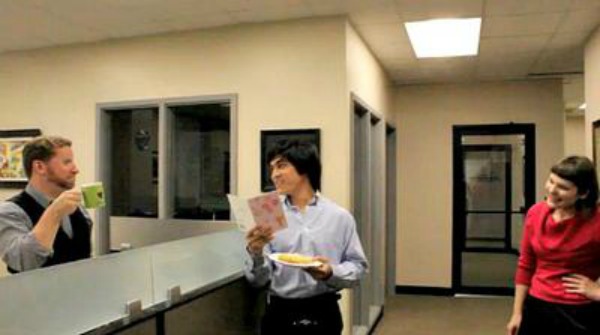
“Dark Romance” (2013), the debut short from co-writer and director Matthew Mahler, accomplishes in eight minutes what most thriller features need approximately an hour and a half or more to do. It tells a complete tale, albeit a familiar one, without the excess often utilized in a full-length fiction. But, the most intriguing element about Mahler’s account is that there is a considerable build-up. There is a high level of of suspense generated in its brief run. We, as cinematic patrons, are also offered a consistent focus on the obsessive signposts of affection directed toward our lead, Tim Cooper (another remarkable portrayal from Timothy J. Cox). They begin simply enough. But, soon they spiral quickly, wildly out of control. On Monday, Tim is given a card with a poem inside. They announce the regards of a mysterious someone in his office. By Tuesday, the chain of events have become violent. Wednesday is the bleakest day of them all. Thursday unveils a darkly smirk-inducing epilogue.

This condensed frame works beautifully. It also helps keep the intensity and pace wire tight. This also assists, in the tradition of the best white knuckle fabrications, in keeping our interest piqued to increasing levels throughout. Mahler makes the scenes showcasing the rapidly bizarre episodes for each of the previously stated spells as diminutive and to the point as possible. This narrative modus strengthens all of the aforementioned components terrifically well. Such is utilized via Mahler’s smart and claustrophobic direction. It is also strikingly unveiled in the sturdy screenplay he co-wrote with Ross Mahler. We are only allowed enough space in each sequence to see how unhinged Tim’s admirer is becoming. Before we can begin to fathom what is occurring, Mahler moves onto the next cringe-worthy instance. This makes for an undertaking that certainly delivers the exciting, expected ingredients of its genre.

To its discredit, the central figures are vaguely etched. Nevertheless, we know enough to care for them. It more than suffices given the scant duration of the piece. This is especially true of our labor-minded advertising executive antagonist. But, Cox more than makes up for this by being continuously affable. He fluently projects the type of managerial individual everyone at any place of employment, be it genuine or imagined, would like to have making the daily decisions. Tim’s secretary, Tiffany (Tiffany Browne-Tavarez), shares nearly as much screen time as Cox’s character. She proves herself to be a capable counterpart to Tim. This is with a simultaneously vulnerable, unflinching and bravura enactment. Though she is as broadly authored as the personality Cox brings to life, the duo both make their respective interpretations feel clearly unique. Because of this, we are more than willing to overlook the expository gaps in the Mahlers’ script. The proceedings are so well-done that we can also forgive another lingering sensation. This is that there is nothing new about the Fatal Attraction (1987) style confines of the straight-forward story arc. The twists are mostly expected. Correspondingly, the reveal of Tim’s devotee is obvious.

But, Mahler, who also provides the impressive cinematography and editing found herein, builds a plethora of memorable horror moments in an undersized expanse. Aside from the depictions and technical aspects, with Brian Shields and Ross Mahler both giving stirring turns in brief roles, this is where the real strength of the photoplay lies. Besides the already noted finale, what occurs on Tuesday is macabrely amusing. It is also masterfully designed. The segment optimizes its impact by eluding, but never glimpsing. Wednesday proves an appropriately unsettling, and grandly designed, climax. This arises as it more than ups the ante on the murderous crush taking place. The more light-hearted occasions of Monday mechanize just as well. They add a natural sense of enhanced disposition to Tim, Tiffany, and fellow employee, Cam (in a likable, credible and proficient representation by Cameron Rankin). It also adds similar personality to the composition as a whole. This is reflected in the natural, jesting banter that we hear early on. Such an attribute is just as active when the speech is more somber and terrifying in the advanced stretches.

Mahler has offered an all-around solid exertion with “Dark Romance”. The 8mm Films production, made for a mere $500 as a part of The 48 Hour Film project, excels as an exhibition of perpetually worrisome mood. It lacks the visual potency and risk-taking apparent in Cox and Mahler’s later collaboration, “What Jack Built” (2015). In this concoction not a word was spoken. Furthermore, the entirety of its eleven minutes was a one man display. Still, this is a gripping effort. The New York shot opus intends to both entertain and frighten. This is while summoning a vibrant aesthetic and authentic sensibility. It does this splendidly. The chemistry between Cox and Mahler, as well as the crew and their spectators, is more than visible in every frame. There is abundantly enough here to recommend this labor of fanatical love. The devotion to the craft from all involved resonates throughout. “Dark Romance” is a true gem. Because of this, I greatly anticipate seeing what Cox and Mahler’s next collaboration, “Finality” (2017), brings about.

dark romance pic 2

“Transience” – (Short Film Review)

transience pic 1

By Andrew Buckner
Rating: ***** out of *****.

“Transience” (2013), the seven minute debut short from writer-director Tan See Yun, is a testament to the power of images projected silently on-screen. Without the use of sound or dialogue, until a haunting piano melody creeps emotively over the soundtrack at five and a half minutes in, Yun relies on simple motions, facial expressions and repeated pictures to tell his tale. For instance, there is a sight early on where Tom (in an enactment by Joshua Michael Payne that is credible and accomplished) is shown putting his wedding ring back on his finger. Our minds are left to ponder the visage: is he not being faithful in the relationship? If so, why? What is causing this fracture between him and George (Timothy J. Cox in a wrenching, human and heartfelt bravura performance)? With no speech to push us along and provide an answer, we search through what Yun allows us to spy to find out why. Such only heightens the emotional resonance of all we encounter, enhanced by the brute professionalism radiating through every frame in its brief span, immensely.

Likewise, there is a continued spectacle of a batch of flowers sitting in the middle of a kitchen table. This comes off as a symbol of George’s attempts to bring peace and re-ignited intimacy to the duo. There is also a moment that stands as a cornerstone of the endeavor. It arrives at three and a half minutes in. Such a happenstance oversees Tom coming across George by accident in a public place. This is an example of Yun’s tremendous capability to give a sequence a dream-like, poetic quality while maintaining a thoroughly authentic grasp. Such occurs as the bridges, lake and trees in this park area loom entrancingly, like gothic figures, in the background. Such is utilized to beautiful, chill-inducing effect. We also get a glimpse of George in this instant, as he sits in slumber with his hands on his stomach, clearly through Tom’s visage. It is than that we understand both of the points of view which culminate the project. We also comprehend the ability Yun has over his audiences all the more in gut-wrenches cases such as these. The result is further proof that what the psyche can conjure, especially in this manner, is far more substantial to the individual than any such reply pre-woven into the fabric of the narrative.

Yun tells the tale of Tom and George. Tom appears to be unfaithful. He may be leading a life that George may be unaware exists. George is the most commitment inclined of the pair. He has a professional life that is thriving. All the while, George seems to want to cling onto the mannerisms of the young bachelor. This is where much of the turmoil derives in their multi-year marriage. We see George making many attempts to patch up this distance. This is via a hug or a kind glance. Still, Tom is distant. Such triumphs as a unique representation of the early and advanced phases in the cycle of the existence. What is all the more impressive is that Yun has put them in frame together. This act makes their polar opposite natures unmistakable. It also exemplifies wonderfully how different personalities create unique angles, which may become problems, in a romantic rapport.

This is a fascinating concept. It is one which is stirringly erected throughout. With this, Yun gives us just enough to take in through his visual modus. Such is without weighing down the flow of the natural storytelling. Correspondingly, his writing and directing are similarly brilliant. They parallel moviemaking maestros such as Ingmar Bergman. This is in the way that the production often can be viewed as an extension of the stage as cinema. It also draws a sharp parallel to Federico Fellini. This is in Yun’s masterful aesthetic emphasis and command. All of these elements are sure to please fellow cinephiles. Yet, Yun showcases as much authority in his balanced, fluent pacing as in the aforementioned components. He has taken as many strides to make the piece a mirror to life itself, in its flawed and often harsh light, as he has a display of sheer talent.

Also assisting matters is Mark Boyle’s breathless, illuminating and gorgeous black and white cinematography. Yun’s editing is exceptional. Ekin Asar compliments both the ordinary and extraordinary components of what we spy in the composition with splendidly done set decoration. The location design and assistant camera contribution Asar provides is incredible. Fairful Nizam’s lighting is immersive and spectacular. It makes every shot all the more potent, dramatic and delightful to the eye. The uncredited, lately used score fares just as astonishingly. These technical attributes all add on-going awe to an already hypnotic, cerebral and poignant endeavor.

“Transience” begins, endures and ends remarkably. Furthermore, the New York City, New York recorded exertion is artistic, daring and refreshing. Yun’s undertaking harkens wonderfully back to the eloquence of the days of abstract, silent photoplays. This is while maintaining a consistently modern approach. In turn, Yun has presented an illustrious melding of the classic and contemporary. It is one which is simultaneously refreshing and necessary. This is a love letter to the big screen, derived by stripping cinema down to its bare essentials. Yet, the SIGH production is also a nuanced, striking and multi-dimensional character-study. It never forgets that focus. Moreover, it is an affair where even the meekest of optical bits, such as a flash where a game of Chess is quietly glimpsed in frame, seems to personify the twosome’s constant struggle for dominance in their nuptial link. A fiction which makes its spectators look that closely at all the details in the proximity of the account is evidently operating on a whole new level of prodigiousness.

Yun has consummated this and more with this intensely evocative tour de force. This is that increasingly rare undertaking that satisfies on all levels. It will captivate and demand multiple viewings to fully appreciate and recognize all that lies beyond its surface. In this era, that is equally infrequent. We desperately need more moving pictures such as these. Yun has erected an envy-inducing exhibition of skill. This is film at its finest.

transience pic 3


“The Convict” – (Short Film Review)

By Andrew Buckner
Rating: ***** out of *****.

“The Convict” (2014), the third short film from writer-director Mark Battle, deftly moves through its taut, claustrophobic man on the loose set-up to an undoubtedly human and incredibly satisfying conclusion. Such makes the closing instants of the twenty minute composition all the more intimate, poetic and resonant. This potent resolve makes our cinematic expedition with the lead of the narrative, David Eller (in a presentation by Dean Temple that fantastically conveys the commanding, yet broken, presence of so many genre heroes in a largely wordless portrayal), all the more triumphant and tear-jerking. The overall outcome is the structure of a filling novel or epic photoplay condensed to showcase the most important events in the fiction as playing one after another. In such a brief span, Battle tells a complete yarn. It is one made all the more varied by the wide range of sentiments it musters. This is true both in what is projected in the tale and within the hearts of its astonished spectators.

Battle heightens the intrigue by smartly only feeding us small details of David’s past. This is while keeping larger attributes, such as why he was incarcerated in the first place, an enigma. Such wise decisions keep us studying what transpires inside the affair. This is while searching what Battle gives us for answers to the many questions about this particular individual we are following. Such only keeps our interest piqued to ever-accruing levels throughout. An example of the strength of these attributes can be found at a sequence at nine minutes in. The scenario here finds David a passenger in a vehicle with a believed stranger named Buddy (in an enactment by Travis Mitchell which is just as watchable, gritty and impressive as Temple’s depiction). He seems to know much more about the title escapee than David could’ve ever imagined. Such cranks the ever-piquing interest and intensity on-screen, propelled by a rocket-like pace that never wavers, to increasingly unbearable levels.

When many of the pieces come together late in the last act, the journey is looked back upon as all more harrowing and personal. Though the personalities unveiled herein are purposefully more straight-forward and less banter driven than those perceived in Battle’s later masterpiece, “Here Lies Joe” (2016), it lacks none of the visual or emotional impact. Moreover, Battle paints the canvas of the screen with the same arresting, proficient and visceral style which has made his entire catalogue so incredible. Battle’s script share many of the same high-caliber attributes. It is also backed with an always reality based edge. This is in both characterizations, with David being himself being terrifically developed and alternately mysterious enough to add to the suspense, and situations. The Sweven Films release and winner for Best Short Drama in the Somewhat North of Boston Film Festival for 2014, is a perpetually athletic sprint of moviemaking muscle. It is one built with sheer craft and intelligence.

convict pic 1

Battle commences this riveting tale with a well-executed and attention-garnering arrangement. This concerns David breaking into an apparently random home. His intentions, whether they are villainous or heroic, remain secluded. With this pivotal bit kept deliberately cryptic, Battle travels as a silent partner alongside our protagonist during the runtime. We learn that he has escaped prison due to a parole denial. Yet, as he travels the wintry New England roads in hiding from the authority figures who are aiming to haul him back from where he once came, there are tender moments which come unexpectedly. They suggest David is aiming for more than a taste of freedom from reformatory bars with his dangerous travels. Such is evident in an interesting, and well-done, scene at six minutes in. In this section, David risks being seen. This happens as he walks into a local store to do a seemingly simple deed. This is to buy flowers for an unknown recipient. We are left wondering who these are for. Such is an inquiry we are not provided until the rousing final minutes unveil.

Such a brilliantly conceived modus to tell an intentionally thin chronicle such as this is made all the more remarkable by the amazing, starkly life mirroring performances and technical components all around. For example, Kieran Battle as Cameron, Suzanne Bryan as Mary and Michael Anthony Coppola as The Parole Board Chairman are all exceptional. Kevin Haverty as Store Clerk and Robin Ann Rapoport as Wife are equally spectacular. They all make a shining impression. This is in the small flash of screen time they are given. Additionally, Michael Beal III creates an impeccable atmosphere with the soundtrack he has conjured. All the tunes herein compliment the seamless genre shifts of this dramatic thriller magnificently. Correspondingly, “On My Knees”, written and performed by Dave Munro, sets the ambient tone for the essential segments it is played in beautifully. This is organized to wrenching consequence. Battle’s editing, visual effects, cinematography, art and set decoration are also top notch. His camera department work is just as striking. Similarly, Nicole Celso does a wonderful job with her make-up contribution.

The result is the raw, yet easy to look at and ponder, veneer of a multi-million dollar action production. The undertaking is all the more notable upon realizing that it was conceived with financially far less. Such is just one of the many jaw-dropping elements this ingenious endeavor radiates admirably through its every frame. Battle has issued an account that more than satisfies in all of its genre aspects. “The Convict” is a well-rounded, heart-pounding and heart-breaking opus. It is one which is as much about getting the pulse racing as it is in exposing the lengths one would go for a few fleeting seconds of love. Both are time honored fundamentals of storytelling. Rarely do they both combine so well. Battle has erected a tour de force. This is a masterful example of a white knuckle odyssey that stupendously elucidates genuine bite and soul. Fellow cinephiles take note: this is mandatory viewing.

convict pic 3

“Yeah, Love” – (Short Film Review)

yeah, love pic 1

By Andrew Buckner
Rating: ****1/2 out of *****.

“Yeah, Love” (2008), the seventeen minute and fourteen second debut short from writer-director Becca Roth, is simple, straight-forward and honest. This is in the most effective manner possible. The gentle sincerity it takes towards its coming of age content and characterizations elevates both the general charm and overall optimism of the piece tremendously well. Unlike most romantic comedy-dramas of late, Roth has derived a narrative credibly built from reality imitating dialogue, circumstances, causes and effects. Never once do we sense the project is deliberately pushing its audience and manipulating its leads towards a pre-conceived destination. Instead, we are given a finale which is merited, spectacularly designed, quaintly ambitious and sentimentally rousing. To its continued praise, the means in which the configuration doesn’t weigh itself down in melodrama or overwrought idealism, so prevalent in similar fare, makes this all the more genuine, joyous, upsetting and refreshing.

There is no lack of subtlety in Roth’s use of symbolism. These often expose the men of the fiction as stereotypically hormonal and occasionally combative. Regardless, this certainly enhances the perspective of hurt, angst, confusion and unexpected bliss which formulates the singular outlook of the affair. It is also just as reflective of the largely confusing teenage years as a whole. This range works exceptionally throughout. This is because it mechanizes, though often in a standard fashion, as a way of getting us inside the interior of our awkward heroine, Emmily (in an ever-likable performance by Crystal Franceschini which is impossible not to be captivated by.).

Roth taps into a portrait of youth that is charming and endearing. This is because it is so universally relatable. For instance, Emmily often tries to mask the embarrassment her loving dad (Timothy J. Cox in a standout role that is hilarious and earnest; proving again his chameleon-like ability to make any character he is given completely his own) unintentionally casts her way. We are also given more than our share of tear-jerking moments. Such is apparent when Emmily tries to shut the world out entirely. There is an extended segment where she lies on the floor of her home in complete defeat. Such arrives late in the second half of the arrangement. This is a deft example of such tropes operating at uniquely high levels of relevance. Emmily’s voice-over, credited to Roth, also adds infinitely to these sharply drawn qualities. This is because this aspect stings with often self-deprecating humor and wit. It is also laced with tragic doubts and observations. Such makes for a rounded, smartly paced, tonally fluent and always enjoyable slice of cinema.

Roth chronicles the shy, Emmily. Often seen avoiding social situations and making a fool of herself when all eyes are on her, the unimaginable pressures of high school on the introverted is beautifully and tenderly expressed. The nervousness that Emmily elicits when around others is heightened when she finds herself having a crush on an older female student, Milo (Paton Ashbrook in a wonderful turn; a perfect counterpart to Franceschini’s bold enactment). After a chance meeting in a park between the two, the once seemingly unmanageable relationship Emmily would like to have with Milo doesn’t appear so unlikely. There is a comically successful and engaging montage where Emmily tries to put her feelings for Milo into words. The next day, Emmily hesitantly and fearfully delivers the composition to Milo. The harsh laughter it exudes from fellow classmates causes a crushing, and terrifically captured, flash of pain and humiliation. From herein, Roth seems intent to make the heart soar. This is as the exertion hits an impassioned and splenderous zenith. Such is a sensation it carries on its back victoriously in resonate concluding minutes. All of these incidents are given extra dimension by the perfectly punctual songs which formulate the soundtrack. “Be Be Your Love” by Rachel Yamagata is especially atmospheric.

It is this canvas of alternating ambiances Roth paints this undertaking with spectacularly. The aforementioned sequence involving Emmily’s writ impressions is undoubtedly the centerpiece of the tale. Still, Roth turns out an arc that has more than its share of familiar categorical beats. Such is perceived in an opening that finds our lead riding in a form of public transportation by herself to personify her loneliness and isolation. Yet, the product endures as stalwart and refreshingly authentic. It never for an instance becomes as noticeably rote and stale as the similarly ardor filled entries which fill theaters nowadays.

This is largely courtesy of Roth’s uncanny ability to immediately pull us deeply into the Emmily’s vulnerable world. It keeps this watchable hold on its audience for the runtime. The result is the raising of the emotional stakes to unfathomable levels. We dearly want Emmily to unveil her happiness just as desperately as she does. This is proof of the brilliant writing Roth orchestrates. It is also a bravura showcase of the apparently effortless directorial style she demonstrates. Such is also a testament to the incredible caliber of the portrayals herein. Representatively, Paul Fabre as Toby, Ryan Radermacher as Brad, Michael Steiner as Duke, Monisha Chowdhary as Therapist and Isabel Hilario as Morgan are all fantastic in their small bits. Likewise, various other technical angles fare just as luminously. The cinematography from Aaron Fisher and Roth, who also issue the proficient sound gracing the endeavor, adds a gritty edge to the proceedings. The same can be said for Roth’s editing.

The Finding Emma Productions release is a massively illuminating achievement. Though Milo and those in the background of the story are intentionally only vaguely formed personalities, Emmily is incredibly developed. Roth has given us an exhibition of singular viewpoint that is fully encapsulating. This is a courageous student film. It is one brimming with talent and endlessly successful risk-taking. Though the theme Roth presents has long been utilized on the silver screen, it is as direct and necessary as ever. There is a natural, unrushed and clear touch to all we come across in “Yeah, Love”. Where lesser indulgences would sink beneath the acquainted components Roth weaves into the fabric of the saga, this opus is largely strengthened by them. Roth has crafted a real winner. This is a display of art imitating life at its finest.

yeah, love pic 2