by Andrew Buckner
Rating: ***** out of *****.
As someone who lost two grandparents to Alzheimer’s Disease at an early age, “Distant Memories” (2024), from writer-director Chris Esper, is undeniably effective. Outside of this personal experience, a large part of the inherent power found in Esper’s 10-minute short film lies in the fact that it gently, respectfully utilizes accessible symbolism. For example, the briefly glimpsed hourglass that is tapped and inspected in the opening moments as if it contains all of the answers to the mysteries of existence. Moreover, the mental representation which is the room where the entirety of the venture takes place. These visual emblems are incorporated in such a way that even those who haven’t been personally touched by the aforementioned ailment will find themselves swept up in emotion long before the climax of the undertaking reaches viewers‘ eyes.
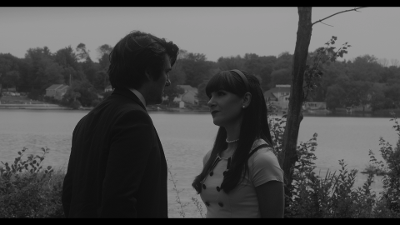
The broadly relatable flashbacks in Esper’s latest project, which range from a marriage proposal to the first signs of familial forgetfulness, as well as the deeply human body language displayed when reliving such instances by the protagonist of the account, Anna (in a quietly heart-wrenching and exceptionally believable turn from Sissy O’Hara), only makes this effortless relatability more evident. Esper’s compassionate, character-driven, smoothly paced, and never melodramatic or maudlin script, stylish at times but smartly straightforward direction, and Nelson Reis’ colorful but never overly showy cinematography capture a somber yet uplifting tone of reminiscence. It is one which is established in the inaugural seconds and soulfully reiterated until the closure of the exercise. The sheer strength of these latter-stated qualities only enhance the former attributes. Consequently, everything on the screen is made evermore tonally appropriate and resonant.
Returning to the ever-stalwart themes of past recollections, life itself, and our impending, eventual fate, often through the lens of a home movie, that made Esper’s “Yesteryear” (2020) such a masterpiece, “Distant Memories” chronicles Anna, a victim of Alzheimer’s. The audience meets her as she searches a basement-like chamber. It is filled with objects and recordings illustrative of her time on Earth. The recent pain of failing to complete basic tasks, a telltale sign of the chronic condition which is now overtaking her, and the blissful nostalgia of her being beforehand seamlessly intertwine. In so doing, confusion, joy, ecstasy, and the inevitable sorrow we all feel as we look back on our lives greet her. This is as she travels through the familiar and foreign landscapes of both the mind and the seemingly new area immediately before her.
This narrative foundation works primarily because Esper injects his saga with the earnest simplicity it deserves. Esper weaves artistic touches into the plot. Nonetheless, it is done sparingly enough to give the orchestration an even stronger undercurrent of grace. The minimalistic use of dialogue, top-notch performances from a relatively small cast (including Christie Devine, who is terrific as Noelle, and an equally superb Alyson Muzila as Middle-Aged Anna), deft use of both end credit sequences and well-acquainted musical cues, and the scant runtime of the configuration heightens both the intense credibility and dream-like nature of the offering.
Flawlessly edited by Esper and incorporating same said sound and costume design from Jay Sheehan and Grace McDade Babikian respectively, “Distant Memories” commences and concludes on notes that are perfect bookends for the material. Empathetic, enigmatic, ardent, and engaging, Esper has crafted a marvelous example of cinematic art. It is one which is as memorable for its indelible imagery as it is for its eternally relevant commentary on the human condition. Reportedly made for $6,000, this is another spellbinding credit to both Esper and his production company, Stories in Motion, as well as On Edge Productions and Del Negro Entertainment. It’s also the best picture of its type this year.





 awordofdreams.com