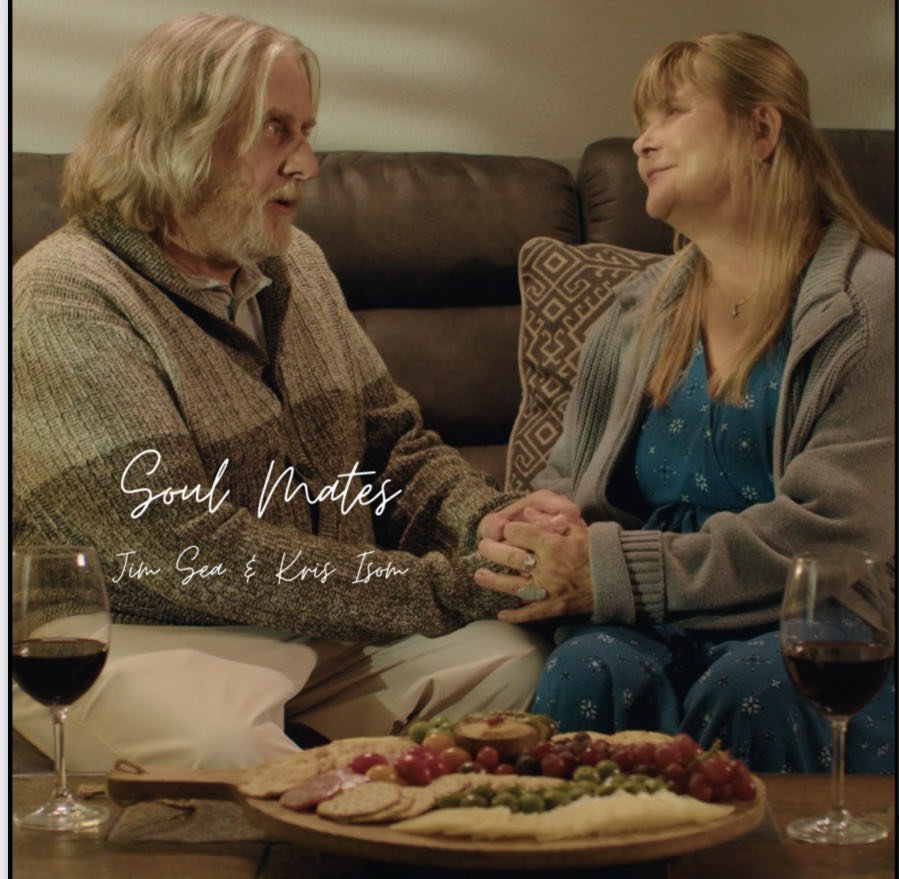
“Soul Mates” (2023), from director Michelle Tomlinson and screenwriter and co-star Jim Sea, is a gentle, honest, clear-eyed contemplation of the undying nature of love. The 12-minute short drama is an intimate character study that admirably takes a remarkably grounded approach to the ambitious concept at its core. Such a notion, which is briefly discussed early on but only fully showcased in an uplifting and touching manner that doesn’t defy the credible and sensitive nature of the piece in its extended concluding sequence, is as thought-provoking as it is heartwarming. Keeping in mind the perfect symmetry of strong, straightforward storytelling, sharply developed leads, and the underlying emotional intensity resonating from every frame of this exercise, such a climactic bit makes this compact four-course cinematic meal evermore brilliant.
The narrative revolves around Sean and Abby (Sea and Kristine Isom, respectively). After Sean imparts the news of a fatal sickness he just received upon Abby that only gives him six months to live, the couple decide to catch up on all the places they wanted to visit and things they have wanted to do in this lifetime. Before making these long standing dreams a reality, Sean and Abby have a conversation. It is one which presents a chance for eternal happiness amid Sean’s recent heartbreaking diagnosis. When Nigel and Poppy (Josh Horton and Sydney Carvill) meet one another in the climactic stretches of the outing and an all-too-familiar discourse blooms among the duo, Sean and Abby’s conviction in trying times is reaffirmed.
From this powerful springboard, the undertaking heightens its impact with a small, but well chosen, cast. All of whom memorably deliver in their individual roles. Chief among these presentations are the turns from Sea and Isom. They are as genuine, candid, and relatable as they are vulnerable. The energetic portrayals from Horton and Carvill, along with Ian A. Hudson as Jaime, are just as finely tuned. The often fleeting, knowing, and occasionally cryptic dialogue Sea offers these fictional entities, like the intelligent and superbly crafted script itself, is so impressively delivered that it further elevates the already high quality of these depictions.
Moreover, the overall guidance of the endeavor from Tomlinson is terrific. There are enough flashes of style for the composition to be both commendable and visually striking. Still, these elements don’t intrude upon the most pivotal aspect of the attempt: the tale itself. In particular, the deeply human personas who populate the confidently paced effort.
Adding to the technical mastery found within Tomlinson’s latest configuration is the dazzling cinematography from Orlando Skidmore. Continually, the editing from Tom Ragan is just as noteworthy. The production design from Carma Harvey, set decoration from Jacqueline Harvey, makeup, sound, and visual effects are all top-notch. This can also be said of the soul-stirring music from Jason Wolf. Wolf’s sonic implementations splendidly punctuate the sentimental beats of the creation to phenomenal effect.
Though the inclusion of Sean’s ailment to set forward the oft-utilized ticking clock motif is an overdone plot device, “Soul Mates” remains an invigorating, challenging, and endlessly engrossing configuration. Boosted by tried-and-true themes that are simultaneously timely and timeless, the venture plays beautifully upon the harp strings of the spirit. This is without ever manipulating it for its own gain. Quietly symbolic and philosophical, mature, and immersive, Tomlinson’s construction is one of the best films of its type this year.
Bloodthirst (2023), from director Michael Su and screenwriter Adrian Milnes (from a story by Massimiliano Cerchi), is an immensely entertaining, 88-minute mix of blood-drenched vampire tale, Mad Max (1979)-style post-apocalyptic action picture, and old-fashioned western yarn. It gleefully utilizes these categorical elements, which have been woven together on various occasions beforehand, into a briskly paced endeavor. It is one which rarely lets up in terms of its 1980’s grindhouse-influenced brand of brutally fun excitement. This is while sharply developing its central figures. In so doing, audiences are immersed into the lives of both the on-screen protagonists and antagonists, which prove relatable, engaging, and easy to root for in all arenas. It’s this impressive blend of compelling leads and situations which assist Su’s latest configuration in becoming so immersive and effortlessly enjoyable. I just wish the themes were richer and the plotline wasn’t so familiar and routinely structured.
The narrative revolves around John Shepard (in a bravura performance from Costas Mandylor that plays like a unique spin on Clint Eastwood’s pairing with director Sergio Leone in 1964-1966’s Dollars Trilogy). He is a vampire hunter who is tasked with a seemingly impossible errand. Shepard must find and kill the Vampire Queen (in a fantastic enactment by Tara Reid, who is clearly relishing her role). Led by the Vampire Master (in a commanding turn from Robert LaSardo), a coven of these immortal fiends begin terrorizing and transforming the locals into an undead brood. With the lives of these citizens at stake, Shepard must think and act as quickly as possible to complete his assignment.
Bookended by an appropriately thrilling opening and closing fifteen minutes, Bloodthirst also offers standout depictions from Elissa Dowling and Sarah French as Elena and Brooke Thompson, respectively. Bishop Stevens is just as memorable as Torque. What is just as noteworthy is that, despite a larger than usual cast (all of whom are terrific in their corresponding representations), the feature is equal doses intimate and ambitious. The sparse yet imaginative use of locations, efficient runtime (with not an excess scene in sight), and deft editing also helps matters.
Though the dialogue is at times difficult to discern, the venture is still competent in this field. Said speech is consistently natural and ominous in both sound and delivery. Additionally, these interchanges recall to grand consequence the most endearing traits of the previously-stated sub-genres from which they derive motivation. The commencing narration is where such an observation is most readily apparent. These virtuoso facets are complimentary of both the high-caliber on-screen portrayals as much as they are Milnes’ gripping, smartly penned script.
Moreover, the makeup and special effects, particularly the gore, are never overdone. They impeccably suit the intended tone of the exercise. This is also true of the skillful, focused, and captivating orchestration and breathtaking cinematography from Su. His output in these individual departments makes the simultaneously brooding and classically diverting atmosphere of the undertaking evermore proficient. The grounded yet stirring sequences of combat and gothic horror are where these attributes are most evident.
From Mahal Empire Productions, Bloodthirst stands alongside Andre Ovredal’s brilliant, well-mounted adaptation of the seventh chapter of Bram Stoker’s Dracula (1897), The Last Voyage of the Demeter (2023), and Harley Wallen’s thoughtful and character-driven Beneath Us All (2023) as a triumphant example of the lingering power of the cinematic vampire saga. Guided by tense and emotive music from Scott Glasgow, Su’s composition, like Ovredal and Wallen’s above-stated work, is considerate of time-tested genre idiosyncrasies. This is while feeling wholly fresh and new. Like Su did with recent outings such as the exhilarating, pleasantly straightforward zombie opus Bridge of the Doomed (2022) and Death Count (2022), which was inspired by Saw (2004), he delivers exactly what spectators demand from his movies. Because of this, Su frequently provides engrossing, endlessly rewatchable material. Bloodthirst is no exception.
Beneath Us All (2023), from director/co-star Harley Wallen and screenwriter Bret Miller, is another tremendous showcase of Wallen’s transcendent knack for relatable, smartly character-oriented, and topically relevant horror pictures. It operates just as successfully as an effective exercise in classic genre situations and atmosphere. Wallen’s latest development is also noteworthy for its ambition. Such a trait is instantly perceptible from the tense, compelling, Scandinavia 912 AD set opening sequence, which is nearly five minutes in length.
This bit immediately draws attention from its viewers with its rich, beautiful, earthy cinematography by Alex Gasparetto. It erects supplemental inquisitiveness with its gripping and ominous melodies, Viking songs, and in its era-appropriate dialogue. The violent scenario that unravels in this commencing passage sets the engrossing, if occasionally predictable, plot on its course in stalwart fashion. Wallen’s fabrication also ends in a similarly strong, surprising manner. It is one that is, like everything that came beforehand in the venture, commendable for its grounded, organic, quietly menacing, and consistently well-made nature. In this sense, the smoothly paced 91-minute undertaking stands alongside the likes of Andre Ovredal’s recent adaptation of the seventh chapter of Bram Stoker’s novel Dracula (1897), The Last Voyage of the Demeter (2023), as an example of the lingering power of both the prototypical, hair-raising vampire chronicle and of patient, confident, foreboding storytelling in modern cinema.
Advantageously carrying on Wallen’s recurring theme of dysfunctional families, Beneath Us All weaves a versatile tale of metamorphosis. It primarily concerns Julie (in a spellbinding turn from Angelina Danielle Cama), who is on the verge of her eighteenth birthday. She is in a constant state of fear and loathing towards her abusive foster father, Todd Gibbs (in a captivating depiction from Sean Whalen that is equal doses uncomfortable, absorbing, and authentic). While trudging through the woods one day, Julie unearths an ancient beast, Frey (in a sinister, mesmerizing rendering from Yan Birch). Despite Todd’s warnings to not bring outsiders in the house with her, Julie allows Frey to hide within the Gibbs’ property. As Frey begins to mentally manipulate Julie and his nightly feedings transform into rumors of assaults from local critters, an opportunity unfolds for Julie to gain control over Todd in a way the cruel man would never expect.
This engaging narrative foundation is made ever-sturdier by an exceptional enactment from Maria Olsen as Julia’s foster mother, Janelle Gibbs. Correspondingly, Wallen is a commanding presence as Detective Donovan Booker. Julie’s younger foster siblings, Stephen (Malachi Myles), Erica (Emilia Wallen), and Sarah (Hanna Wallen), are all superbly portrayed. A subplot involving a social worker named Rebecca (Kaiti Wallen) is another illustration of the magnificent performances unveiled in the enterprise. The inclusion of this element also attaches auxiliary depth and dimension to the dramatic aspects of the outing. Additionally, the segments of raw terror, especially in the fog-laden second half of the endeavor, are top-notch. They call to mind the immersive gothic horror of Hammer Film Productions from both the 1960’s and the 1970’s. Namely, Terence Fisher’s brilliant Dracula: Prince of Darkness (1966) and Alan Gibson’s outstanding The Satanic Rites of Dracula (1973).
Skillfully guided by Wallen, the project is deftly penned by Miller. The script, though routinely structured, utilizes enthralling, sharply developed lead personas, believable interchanges, and an admirable balance of sensitivity and shock. All of this is heightened immeasurably by the all-around stupendous music from Firoze and Kaizad Patel. Moreover, the editing from Johnny Flynn is seamless. The makeup, cleverly and sparsely used effects, and costume design all help craft a technically muscular backbone to this already Herculean construction.
Ultimately, Beneath Us All is as spectacular as Wallen’s previous features Ash and Bone (2022) and The Devil’s Left Hand (2023). It’s efficient in runtime and haunting despite its familiar touches. The thoughtful yet unnerving work is further proof of why Wallen is such a terrific filmmaker. Low on gore but high on enigmatic trepidation, Wallen’s excursion is a marvelously realized lesson in the tried-and-true theory that what remains understated, especially when spied through an unflinchingly human lens, is often the most dynamic in the realms of visual apprehension. With Beneath Us All, Wallen has once again unleashed one of the best movies of its type this year.
“Clean Up Duty” (2023), from director Christopher Di Nunzio, is a grounded yet quirky, disarmingly funny, and exceptionally well made take on the type of violent gangster sagas commonly associated with filmmakers like Martin Scorsese. The eleven-minute presentation further aligns itself with Scorsese in the sense that it masters the deftly sewn character focus and underlying intensity that coolly courses through Scorsese’s trademark style of picture. Yet, the last act of Di Nunzio’s undertaking takes on an unexpected, darkly comedic tone. It is one which wonderfully fuses with the ambiance of the otherwise generally sincere production. Moreover, it showcases a propensity to successfully surprise and take risks with the material which is always welcome.
The jokes demonstrated during this final stretch can be seen as lowbrow. Still, the organic and all-around terrific performances from lead David Graziano (Henry) and supporting actor Fiore Leo (Lou) make them work. The effectiveness of these instances, as well as the exercise as a whole, also masterfully reverberates from the excellent screenplay from Skip Shea. Said script is alternately thoughtful and playful. This is especially evident in the dialogue, particularly the banter between Henry and Lou, that is lifted from this arena. Furthermore, the climactic gag, which is exhibited in the effort as a twist of sorts, is a potently punctuative note for the piece. While slyly winking at the title of the composition, the humor spied here may also prove to some viewers to be cathartic. This is given certain fears that culminated during the Covid-19 pandemic.
The narrative revolves around Henry, who is in the Witness Protection Program, having his daily routines upended. This is when Lou, a shadowy figure from Henry’s past, appears in Henry’s house with a gun aimed at Henry’s head. Utilizing the ruse of having to use the bathroom before he is killed, Henry tries to outsmart Lou. When these attempts turn unconventional, it becomes another sign of the incredibly adventurous abilities of both Henry and the creation itself.
Such is an intriguing, if overly familiar, setup. The plot is at its finest in its dialogue-free opening four minutes and also in its previously stated conclusion. In the commencement, as we spy Henry going about his usual paces while nervously keeping an eye out on his surroundings, the affair is fueled by an addictive air of enigma and suspense. It’s compelling because it casually shows instead of blandly telling its audience what is transpiring. Such heightens the atmosphere of believability brought to the forefront by Di Nunzio’s superb editing, cinematography, and guidance of the project. The midsection, though engaging and pleasantly carrying on the nail-biting demeanor executed in the first act, is when the routine components of the story are most perceptible. Such elements momentarily hinder the fabrication.
Recorded in Exeter, Rhode Island, “Clean Up Duty” is boosted by a strong demonstration of sound from Laura Fietz and Patrick Timothy Yeo. It also implements tenor-appropriate music, which is wisely used in small doses, to pepper the proceedings. In turn, these items help make the construction an ambitious, layered, and memorable short subject. Di Nunzio’s latest offering is a marvelous venture and one of the best of its type that I have seen all year. It cleverly echoes the spirit of his brilliant features A Life Not to Follow (2015) and Delusion (2016). This is while proudly standing as a triumph on its own merits.
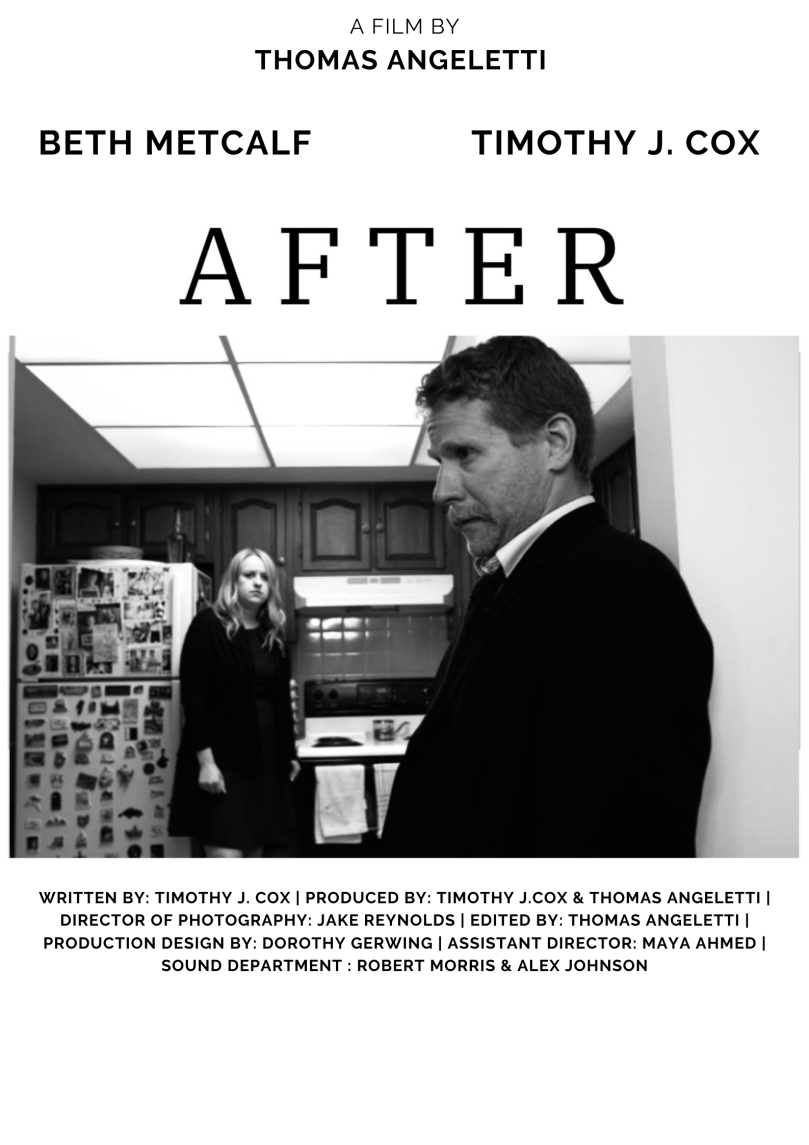
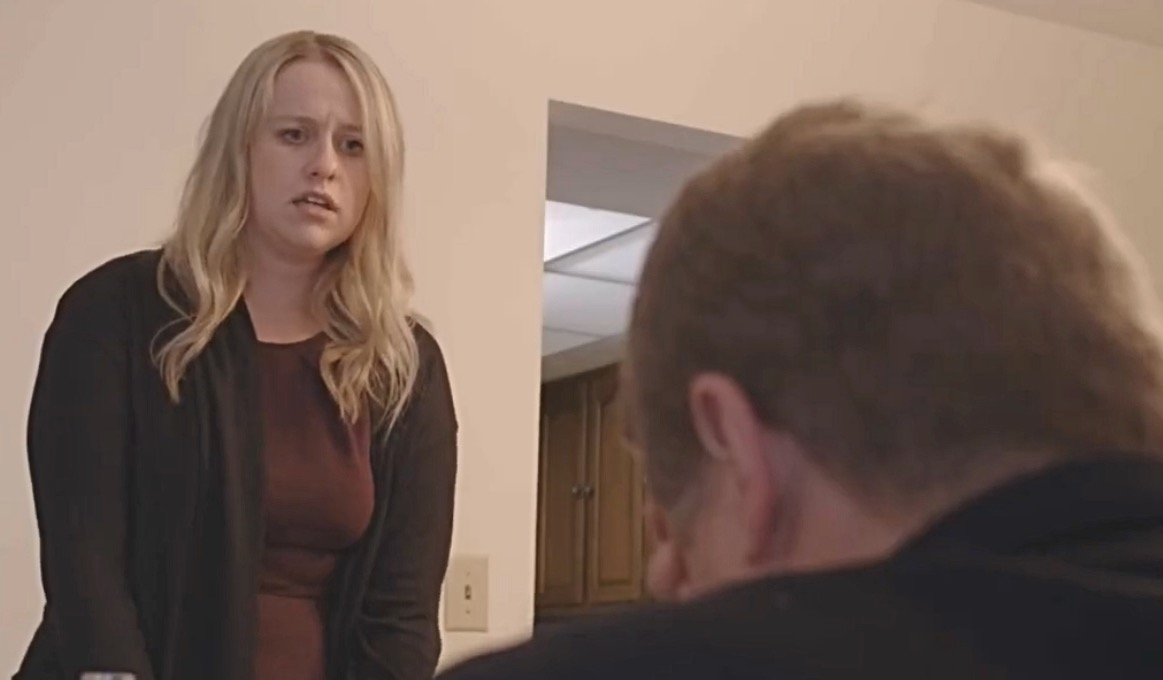
“After” (2023), from director Thomas Angeletti and writer/star Timothy J. Cox, is a one-setting, two-person, seventeen-minute meditation on anger, grief, and revenge. It is one where the oft-uttered expressions “riveting”, “poignant”, and “powerful” can be attached to practically every facet of the endeavor. This is most visible in the pain-filled primary performance from Cox, which immediately draws viewers in with its intelligence and emotional depth. Cox’s take on his character, the adept police detective Michael Darcy, is an all-around brilliant portrayal. Ranking among Cox’s finest achievements to date, it convincingly illustrates a father torn between warring thoughts which revolve around enacting his own vengeance or putting his hopes for retribution in an unreliable legal system. This is after his son, who was a police officer, is slaughtered while on assignment.
In the venture, what functions just as dominantly as Cox’s depiction is the believable on-screen chemistry between Cox and Beth Metcalf. Metcalf plays Cox’s daughter, Annie Darcy, with quiet, focused effectiveness. Her nuanced, sensitive depiction of someone who, like her father, is trying to understand, in her own ways, the cruel hand fate has dealt her family compliments, in tenor and sentiment, Cox’s lead delineation. Moreover, it is, like Cox’s enactment, credible every step of the way.
The equally organic, cryptic, and brief dialogue Cox has crafted for the undertaking, which gradually fleshes out the events and details of the story in an almost noirish manner, is every bit as impressive and skillful as the aforementioned representations. Said speech adds to the general mystery, ardor, and suspense mounting from the previously mentioned decision Cox must make, which forms the focal point of the narrative. These verbal exchanges, like all genuinely strong conversational elements in cinema, is a looking glass into the essence of the central figures of the exercise. It is one which sheds far more light into their hearts and minds than what is being stated outright in the piece. The Herculean nature of this discourse alone is as much a compliment to Cox’s internally and externally tense, flawlessly paced, sharply realized, and always character-oriented script as it is the capabilities of the individuals reciting these words.
Deftly directed by Angeletti in a fashion that is as mature and compassionate as the material dictates, the effort is further bolstered by Jake Reynolds’ striking, tonally appropriate cinematography. The editing from Angeletti is seamless. Alex Johnson and Robert Morris offer crisp, remarkable sound work. The production design from Dorothy Gerwing is just as apt. Additionally, the beautiful, haunting, piano-driven track “Waiting”, marvelously penned and performed by Kadir Demir, is heard over the sleek, smartly simple credits sequences. The tune helps fashion perfectly atmospheric bookends for the project.
“After” is an undeniably affecting and deeply human drama. It is one which uses both of its guiding personalities to potently exemplify two differing approaches to a traumatic situation. Moreover, they masterfully personify the moral quandary that arises from such an event. Utilizing compelling and relatable themes, Angeletti’s understated presentation is as commanding in its plot as it is in its execution. Stirring, memorable, and technically triumphant, it is undoubtedly one of the best short films of the year.
The Devil’s Left Hand (2023), from prolific writer-director-co-producer Harley Wallen, instantly establishes its laser-like focus on its characters and on its classic horror atmosphere. This occurs in an attention garnering three-minute long opening sequence which involves a medium, Vesna (Aphrodite Nikolovski), a seance, and an evil spirit. From herein, the 98-minute picture, which was filmed in Pontiac, Michigan, U.S.A., rarely wavers from these admirable points of initial interest. This is as practically every scene in the tightly paced, if routinely structured, movie either further develops the relationships and dealings of the leads or gives us acutely assembled and photographed bits of terror fused tension. These latter stated ingredients masterfully recall the time tested tone established in the commencement of the piece. Oftentimes, these elements are issued in the same section to great emotional and unnerving effect.
The narrative concerns Richie (in a strong, credible, and commanding chief turn from Kris Reilly). He is a young man who is forced to face both his murderous past and his bleak future after a shapeshifting demonic entity, Agramon (persuasively depicted by Calhoun Koenig), takes control of his life, threatens him and his friends, and challenges his perceptions. This is after a chaotic supernatural event at a housewarming party. Soon the fiend begins growing in power and killing those closest to Richie and his companions. In an attempt to thwart these violent actions, Richie and his confidants band together to find a way of obliterating the hellhound.
In The Devil’s Left Hand, Wallen smartly continues the central theme of dysfunctional families that he previously utilized in an equally gripping fashion in his excellent backwoods slasher feature, Ash and Bone (2022). This topic is at its most impactful in the early moments in the production, which involve Richie and his hospitalized mother, Sharon Stann (brilliantly played by Laurene Landon). The aforementioned segment reminded me in setting, tenor, and in its subtle displays of internal grief of the harrowing episodes that take place in Bellevue Hospital between Father Damien Karras (Jason Miller) and his mother, Mary (Vasiliki Maliaros), in the originating stretches of William Friedkin’s masterpiece, The Exorcist (1973). A similar resonance is also spied just as capably in a flashback to Richie’s childhood involving Carter Stann (in a marvelously ominous performance from Yan Birch) which arrives in the second half of the fabrication. This is a compliment to both the ability of the players as well as Wallen’s auteurship of the extract.
The dialogue resorts a bit too often to overused terminology. Still, the all-around solid cast, with Kaiti Wallen’s depiction of Cassidy and Harley Wallen’s representation of Zeb being some of the many standouts, as well as Wallen’s assured direction are more than enough to forgive these slight misgivings. Adding to the potent skill of the excursion is Bon Lucas’ moody and remarkable score. Moreover, the editing from Alex Gasparetto is top-notch. The introductory and concluding credits are slick and visually stylish. Additionally, the sound design from Kaizad and Firoze Patel is impressive. The special effects are wisely sparse, but enjoyable. Conclusively, the cinematography from Michael Kettenbeil is tremendous. It nicely enhances the overall timbre of the exercise.
The last few seconds of the cryptic and otherwise engrossing finale are less haunting than they aim to be. Furthermore, the undertaking, which starts to feel too talky in the climactic expanses of its third act, could benefit from a ten or so minute trim. Regardless, The Devil’s Left Hand, from Painted Creek Productions and Auburn Moon Productions, remains another stellar installment in Wallen’s terrific filmography. Tense, entertaining, and thoughtful, it’s one of the best genre outings of the year.




 awordofdreams.com