“7 Witches” – (Movie Review)

By Andrew Buckner

Rating: **** out of *****.

Co-writer and director Brady Hall’s 7 Witches (2017) is a masterclass in ever-darkening atmosphere. Hall’s quietly unsettling, often bass tonal music continuously suggests a sinister cloud of wickedness slowly encompassing the viewer. This can also be said of Mark Meseroll and Will Putnam’s unnerving contribution to the sound department. The creepy morsels the duo concoct frequently derive from the narrative itself. In the classic horror genre tradition, this largely stems from the din some unseen individual makes from afar. It is also heard, and felt from the perspective of the viewer, in the more brutal episodes of violence spied in the labor. Such a statement is piqued by Ryan Purcell’s ominous and grimly beautiful cinematography. Additionally, the variety of increasingly strained character relations, which begin slightly askew and become more aggressive as the ingeniously fashioned plot unfolds, only enhance this brooding orchestration. Hall’s gradual, layer by layer pace assists this element. There is also an equal doses subtle and dream-like manner that stylistically guides the project. Such a veneer weaves these components together brilliantly.

Hall commences his tale with a genuinely shocking and superbly done black and white sequence. It details a colonial massacre. The length of the segment is no more than three minutes. Yet, it leaves a lingering impression. It also mechanizes as an instantaneous expression of the technical prowess of the piece.

As the story moves to the modern day, Hall focuses in on a wedding. It is between Aggie (in a top-notch performance from Megan Hensley), a local, and Rose (in an enactment from Danika Golombek that perfectly balances innocence with underlying trepidation). The latter is a stranger to the area. Almost immediately we note the problems among those who have gathered for the matrimonial celebration. Chief among these is the sibling rivalry between Kate (who is enthrallingly played by Persephone Apostolou) and Rose. The film, especially the initial half hour, wisely utilizes this as a springboard. It is one meant to entertainingly develop these on-screen personas. Simultaneously, it keeps us biting our nails. This is by ceaselessly garnering unease. Such a sensation always appears to be incessantly tightening its malicious grasp around these otherwise mundane events. This impression is pushed into full force when Hall introduces a mysterious group of individuals. They gather with the assorted family members the night before Aggie and Rose’s festivity. The rest of the picture also astonishes in its ability to never lose sight of its sharp eye for its leads. This is while the affair delves further into its eerie, mesmerizingly constructed and imaginative terror arrangements. In turn, the payoff is every bit as satisfying as its buildup.

The deft screenplay, co-penned by Ed Dougherty, adds to the richness of the proceedings. This is as much as the all-around terrific depictions. Mike Jones as Kate’s (potentially ex) lover, Cody, and Macall Gordon as Paula are some of the strongest of these previously unmentioned portrayals. Nancy Frye’s representation of Elanor and Kris Keppler’s embodiment of Anne are similarly incredible. Adding to the charm is Kristine Hawthorne’s superb costume design.

At a mere seventy-one minutes in length, this is a lean, taunt, filler-less moviegoing experience. This Indican Pictures release rivals Robert Eggers fierce full-length feature debut, The Witch (2015), in sheer unpredictability and stark credibility. Likewise, Hall’s exercise is just as chill-inducing. This is even if some of the arrangements of exposition found in the first act are handed via formulaic circumstances. Still, the overall power of the presentation is never diluted. 7 Witches is a knockout. I look forward to whatever Hall does next.

(Unrated). Contains violence, sexuality and adult themes.

Available now on video on demand.

The Facebook page for the project can be found here.

“The Black Room” – (Movie Review)

By Andrew Buckner

Rating: ****1/2 out of *****.

Taking cues from The Entity (1982), Insidious (2010), Wishmaster (1997) and The Evil Dead (1981), prolific writer-director Rolfe Kanefsky’s The Black Room (2016) is stylish, tense, captivating and fun; an instant classic. The project tells the tale of a married couple who discover a demon that thrives on sexual repression and desire. Such an unholy entity threatens to destroy the lives of the once happy duo. This is almost immediately upon their arrival in their new home.

In so doing, Kanefsky instills a plethora of inventive ideas. They greatly enhance the occasionally formulaic mechanics of the plot. The endeavor also benefits from solid, character-oriented writing. Kanefsky also sports an undeniable capacity for visually stunning direction. Such a trait is wonderfully reminiscent of Dario Argento. The often gooey 1980’s influenced special effects, which come courtesy of Eric Chase and Vincent J. Guastini, only augment the joyously retro feel. Such pulsates ardently through every frame of the proceedings. Correspondingly, Savant’s booming, nail-biting and grimly gorgeous music compliments Kyle Stryker’s same said cinematography brilliantly.

Furthermore, Lin Shaye as Miss Black and Tiffany Shepis as Monica, a real estate agent, shine in their brief turns. Natasha Henstridge as our heroine, Jennifer, makes for a compellingly vulnerable counterpart. This is in relation to her possessed husband, Paul (in a bulls-eye turn from Lukas Hassel). Such is especially true once his increasingly eccentric behavior kicks in near the end of the first act.

In turn, Kanefsky has created a smartly paced, joyously successful horror outing. It is one erected from the most endearing qualities of the genre. Admittedly, the creature in the basement scenario is the most charming element in this respective arsenal. Best of all, the ninety-four minute picture commences with an extended opening segment that is impressive on all accounts. From herein, this largely unpredictable presentation only continues its enjoyably atmospheric and imaginative streak. The rousing, blood-soaked climax and post-end credit scene can be viewed as one magnificent, elongated final wink at the audience. Such results in an all-around superbly done and satisfying venture. Kanefsky has delivered one of the best cinematic terrors of the year. The mysteries of The Black Room are well-worth seeking out.

(Unrated). Contains graphic violence, sexuality, adult themes and nudity.

Now available on video on demand.

“The Salesman” – (Movie Review)

By Andrew Buckner

Rating: ****1/2 out of *****.

Writer-director Asghar Farhadi’s Academy Award-winner for Foreign Language Film, The Salesman (2016), is a quietly powerful and human drama. It is also a masterfully restrained and dignified thriller. The rich and unapologetically flawed characterizations, performances, emotive music by Sattar Oraki and brooding snd elegant cinematography from Hossein Jafarian are all first-rate. These elements strongly call to mind the qualities of his earlier work, A Separation (2011). Similarly, Farhadi’s latest one-hundred and twenty-four minute picture equals the afore-mentioned entry in Farhadi’s cinematic catalogue in pure craftsmanship. Yet, the manner of storytelling utilized in these two movies are wholly different. A Separation unveils its plotline quicklyThe Salesman unfolds in a more novel-like, gradual and competent fashion. This latter manner is more satisfying. It is also better suited for the material present in Farhadi’s recent endeavor.

This tale of a man, Emad Etesami (Shahab Hosseini), who tries to find the individual who broke into his new apartment and attacked his wife, Rana (Taraneh Alidoosti), and the doubts and suspicions that arrive from such an encounter, could’ve easily become cliche. In Farhadi’s ever-competent hands, it is nothing short of exhilarating. Likewise, it is brilliantly paced and filled with nuance. There is also a timeliness and immediacy to the variety of themes Farhadi smoothly incorporates into the presentation. Such is as delicately, yet believably, treated as the sentiments burning beneath the surface of both our leads and the film itself. The dialogue is also credibly penned and delivered. Correspondingly, Farhadi’s guidance of the project is terrific. It is consistently graceful, appropriately somber and proficient. Best of all, it is stylish without ever being, as is often the case, distractingly showy.

Farhadi’s seventh feature-length production is also, as is spied in the phenomenal final act, a welcome anti-revenge statement. The Alfred Hitchcock and early Roman Polanski reminiscent touches peppered throughout, as well as the pitch perfect concluding note the endeavor unveils, only makes the proceedings all the more hypnotic. It all comes together to create a definitive masterpiece; a wonderful celluloid exploration that is as intimate as it is transcendent.

(PG-13). Contains adult themes and language.

Available now on video on demand.

A Word of Dreams Recommends: “Buddy Hutchins”

By Andrew Buckner

Rating: ****1/2 out of *****.

A Word of Dreams’ latest independent motion picture recommendation is writer-director Jared Cohn’s brilliant Buddy Hutchins (2015). In this wildly entertaining and uniquely thought-provoking production, Jamie Kennedy gives the best performance of his career. This is as the gradually unhinged, recovering alcoholic title character. He is a man who is driven to violence from all the pressures and problems piling up in his personal life. This meltdown is prompted by the closing of his failed business and his discovery that his wife, Evelyn (in a quietly resonant performance from Sara Malukal Lane), is being unfaithful.

All of these previously stated plot traits are given ample concentration and build-up. What also further strengthens the affair is that Cohn’s direction and screenplay are both top-notch. They are both carefully constructed and paced. This is with a perfect balance of emotionally searing sequences of character development, effective dark comedy, many masterful mid-life crisis moments and tensely erected thriller elements. Likewise, the last act, especially its climactic scenes, ties these qualities together in a harrowing, beautifully balanced and satisfactory fashion. Augmenting the overall strength of the effort is a great soundtrack. There is even a cameo in one of the concluding bits from Los Angeles and Detroit based rapper Jonezen (Chris Jones).

Moreover, the 96-minute movie, distributed through Uncork’d Entertainment, is consistently compelling and well-done. Additionally, we have no problem relating to and understanding Hutchins’ pain and anger at any time in the feature. The result is consistently compelling and memorable. In turn, Cohn has given us Falling Down (1993) for the 21st century. This is a riveting endeavor. It is one that is just as intimate and powerful as Joel Schumacher’s afore-mentioned political masterpiece. The end credit montage is especially amusing.

See it now on Amazon Prime and other video on demand platforms. It is also available on DVD and Blu-ray.

(Unrated). Contains violence, adult themes and language.

“The Lure” – (Movie Review)

By Andrew Buckner

Rating: ****1/2 out of *****.

The Lure (2015), a horror/ musical based on Hans Christian Anderson’s “The Little Mermaid” (1837), is one of the most unique, imaginative, surreal and visually spectacular films I have seen in years. Jakob Kijowski’s cinematography is gorgeous, the writing and direction (from Robert Bolesto and Agnieska Smoczynska respectively) are beautifully done and Marcin Charlicki’s effects are credible and superb. Congruently, the acting is stellar. Michalina Olszanska and Marta Mazurek as our heroines, Zlota and Srebrna, are especially good. Moreover, the nearly wall to wall songs, and dance numbers that accompany them, are lively and emotive. Likewise, the moments of terror are memorable and effective. The non-linear storytelling, as well as its constant contrasts in cheery and ominous mood, only helps add a deeper sense of unpredictability, drama, poetry and art house allure to the proceedings. Additionally, the touches of love narrative and same treated, often darkly comedic elements are handled in a proficient and spectacularly blended fashion. It is in a manner that never takes away from the true focal point of the fiction: the bond of Zlota and Srebrna. Correspondingly, these cinematic components are anything but formulaic. Such only makes this production, originally titled Corki dancingu (Daughters of the Dance Club), increasingly layered.

The result is an awe-inspiring, ardent and breezily paced ninety-two- minute stroke of excellence. This is a consistently hypnotic endeavor. It is one that seems to take as many cues from Jim Sharman’s The Rocky Horror Picture Show (1975) as it does any number of grindhouse flicks from that era. Smockzynska’s feature length debut masterpiece, which concerns a pair of sea nymphs who find themselves working in an adult night club in Poland in the 1980’s, is as toe-tapping and, at times, head-banging as it is brilliant. From beginning to grisly and smirk-inducing end, this is one continually soaring, high-note of cinematic exhilaration. For those who claim there is little originality left in the genre, I strongly urge you to seek this one out.

Available now on demand and on DVD and Blu-ray.

Distributed in the USA by Janus Films.

(Unrated). Contains nudity, some graphic violence, sexuality and adult themes.

“The Wicked One” – (Movie Review)

By Andrew Buckner

Rating: **** out of *****.

Co-writer and director Tory Jones’ The Wicked One (2017) is a knockout retro style slasher film. It is tense, blood-soaked fun. Furthermore, it is clearly inspired by a plethora of classics in the sub-genre. John Carpenter’s Halloween (1978) and the Friday the 13th series are among them. Even Alfred Hitchcock’s masterpiece Psycho (1960) gets a nod. Jones’ sly references to these previously mentioned features throughout this skillfully done work only augments the high entertainment value derived from this aspect.

Furthermore, the performances are strong. Correspondingly, Eryk Kyr (who is phenomenal here in his enactment of Mr. Miller), Sean Thomas and Vintage Voodoo’s music is atmospheric and haunting. The same can be said of Roman Jossart’s gritty cinematography. Andy Palmer and Jossart’s editing is terrific. Additionally, the project ends as grippingly, if abruptly, as it begins.

Jones also respects the many traditions, especially in terms of characterization and their often inexplicable actions, inherent in this brand of cinema. This is even if Jones and Cheyenne Gordon’s screenplay invests a bit too much time in the protagonists’ personal dramas. The simple, straightforward plot, which concerns a masked maniac (Jack Norman as the brutal, no- nonsense title protagonist) systematically hacking up a group of young friends on a weekend getaway, also reflects these qualities. Yet, never once does the narrative ever feel trite. It also rarely comes across as unimaginative or underwhelming.

Movies such as these hit audiences on a primal level. Therefore, they will never go out of style. Jones’ latest venture is invigorating proof of such a statement. It is also a testament to his prowess as a filmmaker and collaborative scripter. I eagerly anticipate the sequel the ninety-one-minute affair sets up in such a smirk-inducing fashion its concluding moments. See it!

(Unrated). Contains graphic violence and some nudity.

Available now on video on demand.

A Brief Word on New Releases: “Resident Evil: The Final Chapter” and “Rings”

By Andrew Buckner

Well, this is a fascinating turn of events for me. Resident Evil: The Final Chapter (2017), the sixth addition in a video game inspired film franchise I always found satisfying (if for no other reason than these movies always seemed to know exactly what their spectators wanted and was unafraid to hand it to them in spades), is a gargantuan disappointment. Robotic enactments abound. This is most readily glimpsed in Mila Jovovich’s one-note and mumbling depiction of Alice. Worst of all, the movie jumps around at such a frenetic pace that within the first few moments it is hard to focus on anything but the rush this 106-minute presentation is in to get to its predictable climax. The incessantly annoying camera shots, largely evident in the first act, only further prove the stylistic mess writer-director Paul W.S. Andersen creates with the utilization of such components. It is also a testament to the jumbled storytelling, with the narrative concerning Alice returning to The Hive in Raccoon City after ten years to combat the evil Umbrella Corporation one final time, at hand. Moreover, the action scenes, though often intriguingly set-up, are poorly executed. They are also usually so brief that one can barely begin to figure out what is happening on-screen before they are gone. This is save for the occasionally gripping last half hour. We are also given an underwhelming battle that has been hinted at for ages in this section.

I will say that the various twists showcased in this afore-mentioned bit are unusually good. But, it does little to dilute the fact that there is little life and fun left in this ongoing saga. It doesn’t even provide sufficient number of run-ins with the undead to indulge bystanders from that basic angle. Congruently, Andersen’s paint by numbers screenplay fails to convey expository details as they were presented in earlier installments. I’m sure this isn’t just the zombie fatigue I’ve had for the last several years talking when I say, “Stay far, far away from this one.”

Rating: *1/2 out of *****.

(R). Contains occasionally graphic violence.

Now available to buy on video on demand.

On the other hand, Rings (2017), the third entry in a rebooted series I never really cared for before, is nowhere near as bad as most fellow critics and audience members would allow you to believe. It works better as a supernatural mystery than as a horror film. But, these elements still complement one another well. Likewise, the performances are strong all around. This is true of Johnny Galecki’s turn as Gabriel, a college professor, and Matilda Anna Ingrid Lutz’s portrayal of our heroine, Julia. Similarly, the script from David Loucka, Jacob Estes and Akiva Goldsman is paced in a confident and relatively character-oriented manner.

Correspondingly, the proceedings were rarely dull. The ending arrangement was also quite enjoyable. This is even if it was predictable from the get-go. It served as a nice apology for the ridiculous, if still attention-garnering, sequence set inside a plane that commences the 102-minute long feature. The picture also stands triumphant where most horror endeavors fail. This is in the fact that it doesn’t rely solely on its antagonist, Samara (Bonnie Morgan), to accrue intensity.

Additionally, the plot, which concerns Julia going searching for her boyfriend, Holt (in a well-done representation from Alex Roe), and becoming caught up in the dealings of a tape that is said to kill you seven days after you watch it, is vastly more arresting this time around. This is thanks, primarily, to the invigorating and unique manner director F.Javier Gutierrez utilizes to relay the fiction. The result of these qualities, in my opinion, is the best of The Ring ventures. See it!

Rating: *** out of *****.

(PG-13). Contains some violence and intense moments.

Now available to rent or purchase on video on demand.

These two features stand as definitive evidence that expectations, especially artistic ones, can be deceiving. Don’t let these pre-conceived notions hold you back from what could potentially be a pleasantly surprising and rewarding viewing experience.

“Deep in the Wood” – (Movie Review)

By Andrew Buckner

Rating: **** out of *****.

Deep in the Wood (2015), from co-writer and director Stefano Lodovichi, is a deftly crafted, psychological labyrinth of a thriller. It takes a notion that parents often jokingly ponder in passing, if their child is really their own, to horrific and mostly unpredictable extremes. For the first hour of the occasionally slow yet, deliberately paced eighty-eight minutes of the runtime, it keeps us ruminating over this exact inquiry. This is in relation to our leads, Manuel Conci (Fillipo Nigro) and Linda Weiss (Camilla Filippi). Such transpires after an ominous, immediately attention-garnering and visceral opening section. This concerns four-year-old Tommi (Alessandro Corabi), the son of Manuel and Linda, going missing at the annual Krampus festival. After this intense and wonderfully mysterious commencement, Lodovichi’s presentation fast-forwards to five years later. Inexplicably, Manuel and Linda’s offspring, complete with matching DNA (but no name or telltale documents), is found. Even though the individual is far more reserved than the Tommi they once knew, which would be understandable given being gone for such an extended length of time, Manuel is quick to embrace their progeny. Regardless, Linda senses something off about the whole situation. There is a wickedness about the youth. It is a trait that becomes harder to ignore, for Linda at least, once he enacts violent deeds. Fearing that this youngster, whoever he may be, is out to kill her, the dynamic between the now divorced duo drastically shifts. From herein, Lodovichi, who penned the brilliantly nuanced screenplay with Isabella Aguilar and Davide Orsini, captivates audiences with this certainly intriguing plot.

What is just as fascinating is the various shifts in perspective extant throughout the piece. This is with Manuel’s viewpoint being the most prevalent. There is also a great amount of admiration to found in the manner Lodovichi fluently has us looking to all three of the central figures in this motion picture as simultaneously the protagonists and the antagonists. Often, and to ingenious results, this alternating factor occurs in the same sequence. This is as we keep asking ourselves are if Manuel and Linda are guilty of kidnapping. Or is it that they are the victims of an evil presence? One that would be along the likes of Damien Thorn: the Antichrist from Richard Donner’s horror masterpiece, The Omen (1976). Alas, one of the strongest attributes of the endeavor is the perplexing journey Lodovichi weaves from this angle. I state this because, sadly, the conclusion is a bit underwhelming. This is given all that came beforehand. It is too familiar and closely aligned to the climactic moments of your stereotypical genre effort.

Still, the minimalistic use of the supernatural elements is admirable. It helps instill more of a reality based sensibility to this already credible undergoing. The performances are all top-notch. They all burn with a quiet passion; an almost never clearly verbalized fervor. Teo Achille Caprio, who hauntingly portrays the nine-year-old version of Tommi, is especially noteworthy in this department. Given the surprisingly small number of arrangements he is included into in the movie, this is increasingly impressive. He parallels his adult counterparts, Nigro and Filippi, in this respect.

Continually, this mesmerizingly atmospheric contribution to Italian cinema is graced with masterfully ambient music from Riccardo Amorese. The same can be said for the magnificent, elegiacally bleak and immersive cinematography from Benjamin Maier. Roberto Di Tanna’s editing as well as the sound work and effects are just as spellbinding. All of this is capped off by Lodovichi’s bold, phenomenal and constantly Hitchockian behind the lens treatment of the material.

Though there are instances when the narrative seems as if it could be tightened, this does little to hinder the proceedings. As a matter of fact, it is all in tune with the richly developed, character-oriented nature of the exertion. The intensity, whether it be in the unfolding circumstances on-screen or in the emotional layering of the piece, is also non-stop. Best of all, Lodovichi never resorts to any of the trappings of paranormal related entries to evoke these sensations. This is with faux scares and bumps in the night galore. Instead, Lodovichi garners all of this from his simple and striking telling of the tale itself. Such makes the minor flaws inherent in the affair, such as those declared above, increasingly superfluous. In turn, Lodovichi has gifted spectators with an audacious, memorable and undeniably worthwhile experience. His latest labor is another superb installment in his ongoing filmography. I highly recommend seeking it out. You can do so when Deep in the Woods becomes available on video on demand on June 13th, 2017 through Uncork’d Entertainment.

“To Be Alone” – (Short Film Review)

By Andrew Buckner

Rating: ***** out of *****.

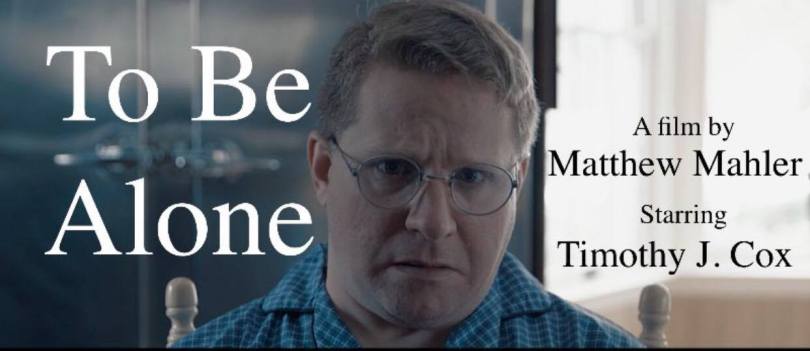
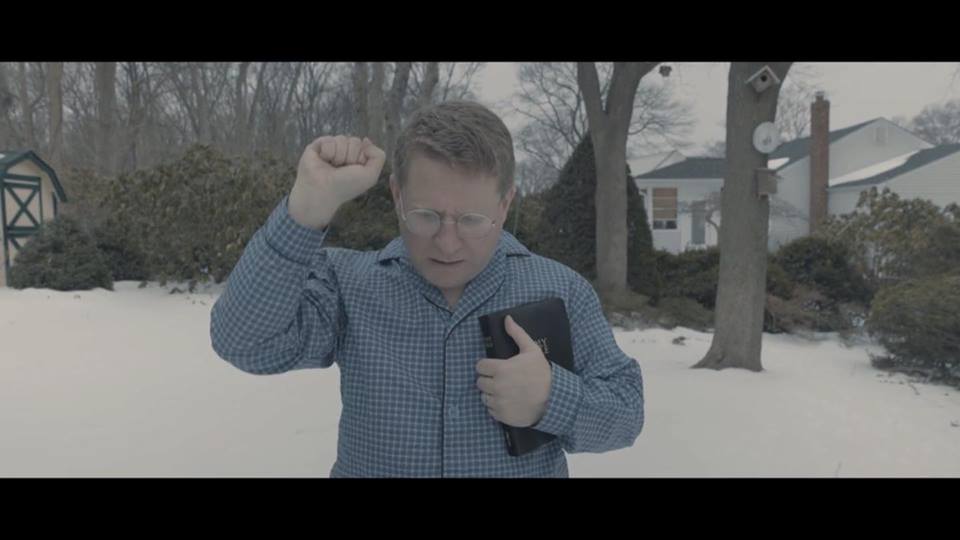
“To Be Alone” (2017), the seventh short film from writer-director Matthew Mahler, is a wholly unique, thought-provoking and brilliantly realized meditation on grief. Yet, it is as much about religious guilt, shame and the all-encompassing hopes of redemption which arise with theology. As a matter of fact, most of the sparse words spoken in the entirety of the twelve minute and forty-six second runtime are from unseen spiritual individuals. All of whom cry out from inside the television set to our lead, William (in a mesmerizing and quietly compelling turn from Timothy J. Cox). They angrily exercise the foremost element. In so doing, they almost immediately prompt William to run outside and engage in actions which suggest the last two latter stated emotions. Whether this is a symbol of the unquestioning fidelity or the apparently easy manipulation of the devout is left to the viewer. There is an equal balance of circumstances throughout the piece that could support both belief systems. Likewise, the non-judgmental tone Mahler crafts here, especially when dealing with such a touchy subject, certainly assists the piece. This is in evoking its continually haunting and meditative resonance.

What also helps is the underlying tension. This is erected most readily in a repeated sequence which involves law enforcement phoning William. Once this erupts, a certain darkness settles over the proceedings. This is as the audience begins to comprehend why he may be going through the previously stated catalogue of inward impressions. It also makes us understand how the pious personalities that are shouting at him have such swift control over his dealings.

The successfulness of these ingredients is a courtesy of Mahler’s deft, carefully constructed screenplay and same said direction. They perfectly compliment the material. What enhances this aspect is the inclusion of moments of sheer style. For instance, a spellbindly done sequence has William looking up the steps towards the closed door of his bedroom. The way it is shot, with Mahler’s ardently energetic music punctuating the bit with an electric fervor that makes it impossible not to step inside William’s nervousness at the unfurling situation, is reminiscent of what one might find in a classically designed opus of cinematic horror. Yet, there are other clever, smirk-inducing bits. For example,  there is a near climactic episode that features William carrying a cross. This is in a manner that is reminiscent of Jesus Christ in the tale of his crucifixion. The item William is holding is arranged with Christmas lights and other season appropriate decorations. Such details suggest a bit of playfulness amid this otherwise somber narrative. These items work immeasurably. They also add to the admirable and well-rounded qualities of the endeavor. This is while finding new ways to augment the representative essence of Mahler’s theme. It also makes for imagery that is as unforgettable as the fiction itself.

Adding to the immersive beauty of the project is Jonathan Giannote’s brooding cinematography. Mahler’s editing is also superb. The exertion also benefits from terrific makeup from Maggie Kurth and Morgan Mahler. Correspondingly, Jack Fitzmaurice’s sound contribution is exceptional.

Produced by 8mm Films, Mahler’s latest is among his most accomplished configurations to date. The brief undergoing is massively entertaining. Still, its lasting impact is undeniable. Best of all, it makes you ponder your own convictions. In turn, you can’t help but wondering if you would go through the same repetitive cycle of reaction that William himself is going through. This is if you were in an equally fateful circumstance. With “To Be Alone”, Mahler has fashioned a mandatory movie-going experience. This is one of the best storytelling fabrications of the year.

“A Dark Song” – (Movie Review)

By Andrew Buckner

Rating: ****1/2 out of *****.

Writer-director Liam Gavin’s invocation thriller A Dark Song (2016), is fascinating. This is true in the wide-spread knowledge of its subject matter that is dispensed throughout its one-hundred-minute length. Such a quality is also present in the manner Gavin keeps us questioning the motivations, actions and dedication of our credibly etched leads. These are the domineering Joseph Soloman and the vulnerable, audience sympathy-deriving Sophia Howard (Steve Oram and Catherine Walker respectively). This intriguing inquiry accrues in the deliberate lack of specifics in the early sequences. It is also spied in the authenticity of the unfolding event itself. Oram and Walker’s performances, Cathal Watters’ immersive cinematography and Ray Harman’s masterful, creaky and immediately classic score are just as riveting. Gavin’s ever-taunt guidance and meticulously crafted authorship of the project propels this factor. His dialogue is especially believable. The results are appropriately and endlessly eerie, unsettling and haunting.

In turn, Gavin’s impressive full-length feature debut calls to mind a decidedly darker version of several thematically related genre greats. These are Robert Wise’s The Haunting (1963), Tobe Hooper’s Poltergeist (1982) and Alejandro Amenabar’s The Others (2001). This is noteworthy in the methodical and carefully assembled structure inherent in these previously stated motion pictures. Such a comparison is also augmented in Gavin’s brilliant ability to immediately generate an unbroken mood of intensity and impending doom. This is while instilling an ever-extant sense of mystery. Best of all, Gavin avoids the easy trappings of narrative tropes, jump scares and clichés at every corner. As a matter of fact, the bulk of the nail-biting herein are held in the enigma of the unfolding plot itself. Such only immensely enhances the life-mirroring nature of the production.

Additionally, Gavin evokes an unyielding focus on characterization. Such makes this brooding, quietly tense tale of a woman who will go to great lengths to contact her deceased son again and a questionable occultist who may be manipulating her a stylistic masterclass. Correspondingly, the elegiac and engaging concluding configurations are perfect. They emotively cap off all the varied sensations that arose beforehand.

Ultimately, Gavin has provided viewers with an uncompromising, mature and unforgettable reminder of why movies such as these remain ever popular. In a year that is shaping up to be incredible for cinema of this ilk, A Dark Song, which was distributed through IFC Midnight, is certainly one of the standout entries in this category.

(Unrated). Contains brief nudity, adult themes and some gory moments.

Available today in select theaters and video on demand.