There’s an abstract beauty beneath the equally appealing visual style of writer and director Mike Messier’s 2014 short film, “Nature of the Flame”.
It is established early with shots of a body of water and feet, in a suggestion of serenity, wading in the stream. Suddenly we cut to a woman (Lindsey Elisabeth Cork in a tremendously wrought performance) sleeping.
After being told she isn’t prepared for enlightenment by an elusive figure (Jocelyn Padilla in an appropriately transcendent acting turn) in a monastery Cork wakes up in a cave.
From here the rapt audience participant wonders: “Did she die in her sleep?”, “Is this a glimpse of what awaits for her in the afterlife?”, “Is this merely a dream?”
Messier wisely gives us the room to come to our own conclusions with these inquiries. This is welcome since if concrete answers were provided it might’ve taken away from the ethereal, haunting, meditative experience at hand.
Despite these lingering questions one thing we know for certain is that Messier and company have captured the confusion and potential sense of ascension that can be tied to the narrative elements terrifically well. Furthermore, Messier evokes an even, appropriate pace throughout the endeavor.
But, the smartest move is that Messier allows the audience to attach his or her own conclusion as to the proceedings. This is done by letting a succession of gentle, intimate, ardent, and attractively executed and shot, sequences speak for itself.
There is no dialogue in the last five and a half minutes. This decision adds layers of skillfulness, invention and sentiment upon an already gripping set-up.
The musical score, along with Chris Hunter’s editing, enhances the illusion of going to what could be perceived to be a higher plane.
Moreover, Messier’s writing and directing are intelligent and illuminating.
The cinematography captures the allure and enigma of the storyline with an equally striking veneer.
“Nature of the Flame” captures all of the sentiment and drama of a full-length feature in just under eight minutes. It is always stunning to look at, to be caught up in and to think about long after its serene conclusion.
This is more than a brief fling with cinema: it is an exhibition of craft.
Most of the routes of dreams branch out maddeningly into avenues of failure so varied that we often lose sight of the sharply focused paths ahead. They are departures that can be falsely perceived as permanent. Yet, those who find themselves off-road, staring wide-eyed into the obvious sign posts of their addressed defects, especially if it is engraved in their ultimate ambition, often lose hope altogether.
Soon they find their feet sinking into the mire of abandoned hopes when such an incident transpires. With this they are wrought in disillusionment. This is rooted in what he or she believes to be the reality that they will never rise up. Furthermore, they feel as if they will never better these errors.
They become stuck, some momentarily and most others indefinitely, as the voices of those who pointed out their shortcomings ring forever in a cacophony of eternal humiliation. For many of us, artists especially, such small criticisms cause silent wounds. These forever inwardly scar. They make our once swift movement towards personal reveries immobile.
This is the focus of the 2012 short “Still Life”, a cinematic composition worthy of Ingmar Bergman, by writer and director Chris Esper. It concerns a student of photography, Martin (Timothy Bonavita in a part that perfectly conveys all the layers of vulnerability, intelligence and sentiment his character demands). He wants to be a photographer.
Yet, as we learn in a beautifully wrought early scene, the world around our wide-eyed and ambitious lead puts him in the line of fire for constant criticism. Still, he is devastated yet, optimistic.
The tale walks this fine line of emotion in a realistic, understated manner. It is done in a conscientiously ardent and understanding way. With this modus anyone who has felt defeated by negativity after it is cast at his or her aspirations will undoubtedly find liberating.
An early segment showcases him being criticized in front of his peers. This is done in a manner that suggests he just needs slight improvement to be where he needs to be to achieve the first steps of his intended success.
It is a sequence that is an analogy for how our main character is feeling. This also communicates his own contemplations about himself through emotion and action.
This draws us instantly into Martin’s existence. To further add to this intimacy the camera surrounds Martin like a close friend; one who should speak up in defense. Regardless, he never finds the strength to do so.
“Still Life”, made for only $500, finds the right note and atmosphere instantly and never departs from it. To its further credit, the pace is meditative and cerebral. Still, it is always fascinating.
This characteristic is, like the rest of the tale, appropriate. It also gives us the necessary time to learn and reflect on Martin’s situation. Such is done without the proceedings ever feeling as if it is ignoring the act of moving the story along rapidly.
Esper’s brief film never once steps away from following our starry-eyed persona as he continues on despite a succession of letdowns. The crisp and intimate largely black and white cinematography by Mark Phillips adds to the haunting, downtrodden yet inspiring poetry of this massive achievement. It also heightens the previously stated sense of luminosity amid darkness.
One especially poignant moment involving Young Martin (Charles Everett Tacker) and Martin’s Mother (Carlyne Fournier) are in color. This segment is highlighted by aching reminiscence. It is only amplified by the stupendous caliber of the aforementioned portrayals.
The gorgeously gentle drive of Ryan Campos’ beautiful score is perfectly in sync with the sentiment expressed on-screen. Jill Poisson’s editing is terrific.
This also issues exemplary acting turns from David Graziano, as Professor Lynch, and Mike Daniels, as Josh. The rest of the cast fares just as well.
All of these elements make “Still Life” a contemplative, deeply felt masterpiece. In but eleven scant, but quietly harrowing, minutes Esper and his filmmaking crew triumphantly executes introspection, drama and sorrow.
These elements all unify in a silent cry to love and understand those around us. Also, it assures us to that defeat is but a temporary obstacle meant to be overcome.
Martin states about a flower he photographed in the first few minutes of this heart-wrenching work that he wanted to “convey a solidarity of loneliness”. That is exactly what Esper and his crew have done.
They have framed the chief protagonist as the lone blossom. His seclusion is the focus of what lies enclosed in the picture. In turn, the work itself and the character radiate a melancholy splendor.
It illuminates the moving photograph it is contained in. From here it touches our core. In turn, we relate and feel unified with the central figure of the narrative.
The beauty of the silent film era lies primarily in the actuality that the actors had to use facial expressions to supplant the sentiment that would later be inserted into dialogue. This was usually accompanied by either recorded or live music being played in the theater the work was being projected in to punctuate the emotions glimmering through actions and countenances on-screen.
These, along with tale-telling through striking camera angles, shadows, mimes and title cards, were the sparse tools of the filmmaking trade in the years from 1894-1929. It gave the cinematic compositions of this period an underlying sense of poetry, even in comic endeavors, which have proven to be forever endearing.
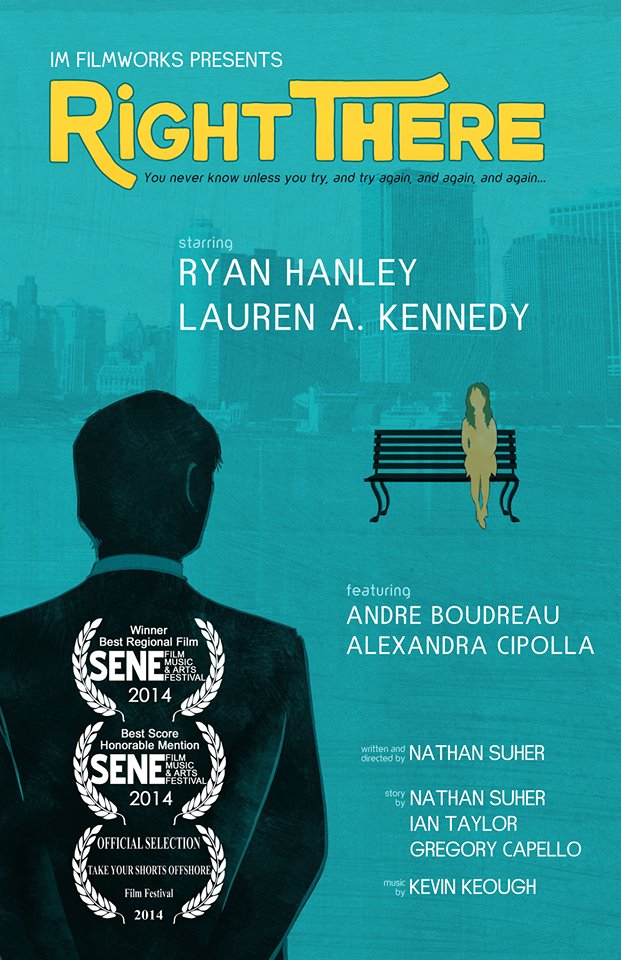
This time frame, more often than not, elucidates a constant sense of admiration for these aforementioned attributes alone. Such is just one of the many reasons “Right There”, a masterful eleven minute short from director Nathan Suher (2015’s “Next/ Door” and “Scary Little F*ckers”), is so immediately enjoyable and charismatic.
Suher, who wrote the delightful, well-paced script (from a story by Gregory Capello, Suher and Ian Taylor), captures the essence of Charlie Chaplin and the spirit of European cinema, which he has stated was his intention with this glorious piece, immaculately.
This wonderful, breezy homage concerns a man, The Guy (Ryan Hanley in a performance that is as energetic, endearing and enjoyable and perfectly fitting for the era Suher tributes) who tries to garner the attention of a woman, The Girl (Lauren A. Kennedy who does as phenomenal a job as Hanley, as does the entirety of the secondary cast, in conveying story through gestures).
He is drawn to her immediately. This intrigue only grows as he finds her sitting everyday on the same bench. Over the course of several weeks he tries to get her to notice him.
All the while we find ourselves riveted and wondering: “Is it his own shyness holding him back? Could he have been hurt in prior relationships? Was this pain recent? Will he get the girl?”
Because of the profoundly artistic nature of the epoch “Right There” is sending up we are drawn in by the nuance. Moreover, our intrigue is piqued by the high-caliber technical facets, the joy and broken-heartedness (sometimes in the same scene) that Suher and his filmmaking team pull off so effortlessly. Yet, because of the well-woven dramatic touches that balance the humor and heart terrifically we are forced to look deeper.
This is a testament to the profundity of the style of cinema Suher emulates so masterfully here. It is also a demonstration of the terrifically executed brilliance, the obvious admiration for the truly golden age of cinema Suher is tackling radiating on-screen. This is a gem.
The merry, often tender, and beautiful result of “Right There” is also thanks to a wonderful bit of opening animation by Dave Lubelczyk. Make-up artist Morgan Duffy captures the appearance of stars from the early 1900’s spectacularly. Chris Esper’s film editing is tremendous.
Jill Poisson’s cinematography and Kevin Keough’s score is striking and beautifully rendered. These characteristics, combine to make it all the easier to envision that we are sitting in a theater, before the age of “talkies”, and enthralled by this new invention that they call “moving pictures”.
Suher continues to showcase further range and a willingness to risk differing genres, atmospheres and approaches. The work he makes is transcendent to, not only fellow admirers of filmmaking, but everyone.
“Right There” is a sweet, lively brief work that reminds us of the tenderness, merriment, relatability and undeniable artistry the craft of unspoken big-screen storytelling can evoke.
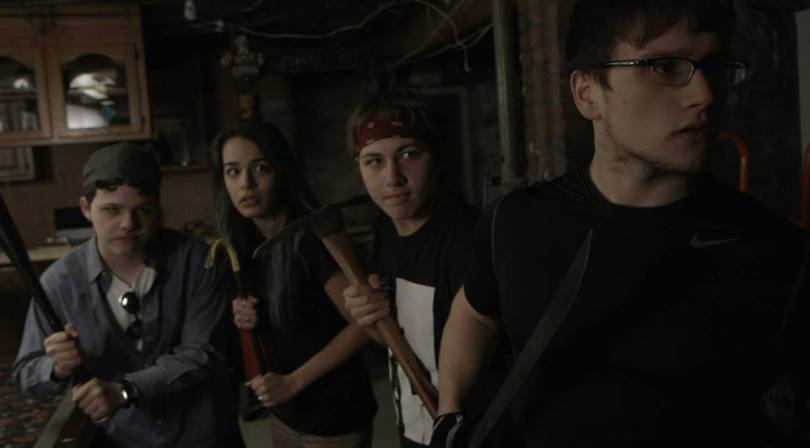
“Dead Hearts”, a sixteen minute short from director Ramzees Carvalho (2014’s “Night of the Damned”), opens with four young adults trapped in a cellar. Radio broadcasts are announcing that the reanimated are coming back to life. When a chilling chain of events transpire it is up to Dan (Carvalho himself in an impressive, spectacularly wrought performance) to take the reins of heroism. With this action he must face the ravenous hoards of the undead.
It’s a classic set-up that brings to mind visions of George A. Romero’s timeless 1968 gem, Night of the Living Dead. To further the sense of unabashed reminiscence this wonderful short (the second by Carvalho) induces is crisp, vivid and rich cinematography from Nelson Reis.
The special makeup effects by Manny Savini only heightens the appeal. The zombies, and their veneer, are stalwart, gritty and credible at every turn.
Such attributes resonate amid the numerous well-done decapitations and various other gory bits. This is because there is a palpable sense of camaraderie between all the leads.
This is most noticeable between Dan and Liz (in a performance by Alyssa Paige Moreno that is every bit as strong and understated as the role demands). Their relationship is the propelling force of most of the narrative. The work is all the more commanding because of the sheer strength of their portrayals.
Ramzees Carvalho and Moreno prove they are more than apt to take on what the taunt, intelligent script that has a Stephen King-like eye for characterizations, also by Carvalho, demands.
Cameron Perrault, as Luke, and Luke Eleuterio, as Alex, fare just as spectacularly. They further add to the sense of kinship and authenticity pulsating through every frame.
This isn’t the only factor which contributes to this triumphant success. The work constructed in all other technical arenas are phenomenal. They come together to formulate something truly special.
The smooth film editing by Ramzees and Luis Carvalho are further evidence of these high-quality characteristics solidifying to evoke brilliance.
In its quick-moving runtime it creates an atmospheric mood. In an exhibition of the artistry on display this is done before the story even begins to unfold.
It carries this impression out effortlessly. All the while it is constantly building upon this solid foundation. We are issued mounting trepidation throughout.
In turn, “Dead Hearts” is a persistent wall of ever-increasing suspense. It grips us with increasing intrigue until well after its elegiac, and cleverly wrought, finale.
We remain mesmerized, awe-struck by how well conceived the sum of this exertion remains. This is especially remarkable given its compact length.
The composition creates an illusion, brought forth by its genuine dialogue, performances, zombie make-up and effects, that we are with our leads.This is a credit to the incredible talent all around.
“Dead Hearts” has an obvious affection for the sub-genre it is rooted in. It showcases a knowledge of undead works of yore. Yet, there is also an abundance of originality here.
Carvalho’s brief film is distinctly its own entity. It is always fresh, vigorous and smart. Moreover, it is endlessly engaging, gripping and terrifying in ample doses.
“Dead Hearts” is riveting. It establishes Carvalho as a great new talent. Simultaneously it breathes fresh life and perspective into the much documented account of cannibalistic ghouls.
This is a must-see. It is a testament to how much can be done on a small budget. Furthermore, it proves the potency inherent when the components of affection and respect, as well as a phenomenal natural aptitude, for the craft and the composition being operated on unify among the respective contributions of all involved.
We live in a world where often we become so accustomed to a certain stroke of luck, whether it be good or bad fortune, that we almost expect it, feel it and await its presence. Some of us go about our daily routines in this state.
“Please Punish Me”, from director Chris Esper (2014’s “Always a Reason”, “Steak Knives”), is a meditation on such circumstances. It is balanced with splendid performances, beautifully humanized characters and ample doses of humor and heart.
The tale it tells in its quick-moving and smartly paced thirteen and a half minutes is that of a businessman named Scottie Lee (David Sackal in a tremendous and quietly moving performance). He is having a long streak of positive events transpiring in his life.
Among these incidents is climbing the corporate ladder, which he admits in a soul-bearing scene that he hasn’t even attempted to do, and he just can’t understand why. Our lead is a man who just wants to be an artist. But, for his success he feels the need to be disciplined for what he deems to be his “curse”.
This is when he turns to a place that dispenses such treatments at a price. Here he meets the woman meant to incorporate this specific brand of punishment, Michelle (Joanna Donofrio in a role which captures all the layers of her character incredibly well).
From this point on the two find an unexpected bond. With this wells an honesty flourishing where should be an exercise in momentary pleasure.
Rich Camp’s screenplay, from a story by Tom Paolino, is tremendously done. In its sparse runtime we leave this short feeling as if we sat down and conversed with them ourselves and know them intimately.
The first half is full of winning, well-timed, delivered and genuinely side-splitting gags. When we get to the second portion of the narrative we are drawn in by the poignant turn in the chronicle.
Camp has provided a delicate balance of opposite tones. It is one that he has done a phenomenal job of bringing forth on the page.
With Esper’s talented directorial hand bringing the story to life on-screen, with help from Mark Phillips’ sharp cinematography and Steven Lanning-Cafaro’s original score, “Please Punish Me” showcases talent in all technical arenas.
This is further aided by Felipe Jorge’s film editing, Jorge Mario Tobon’s sound work and Chad Kaplan’s delightful contribution to the striking animation in the opening sequence. Make-up artist Stefani Plante and hair stylist Nicole Bertoni do a phenomenal job as well.
This is a work that is emotionally searing, illuminating and beautiful all around. It is light and breezy when it needs to be. Still, it is also ultimately tear-jerking, poetic and heartfelt.
Esper has crafted a gargantuan accomplishment. He has established a triumphant victory juggling the story’s many moods evoked with effortless gusto.
Among its various accomplishments is ending on a note that is both thought-provoking, contemplative, genuine, brilliantly understated and real.
Most full-length films would not be able to establish their characters as well as “Please Punish Me” does in under fifteen minutes. Furthermore, it would not make us feel for them the way Esper and his cinematic crew does here.
This is lively, but potent, material. It is inspiring, gentle and cathartic. Moreover, it wisely finds the right fit to execute the narrative with a sense of natural love. It also incorporates an optimism that is delicate, stalwart and frank.
“Please Punish Me” received great acclaim from the 401 Film Festival. I can see why. It is intelligent, cinematic art.
“Scary Little F*ckers: A Christmas Movie”, directed with tongue in cheek brilliance by Nathan Suher (2014’s “Right There”, 2015’s “Next/ Door”) and written with same said characteristics by Lenny Schwartz (2012’s Murder University, 2013’s Normal) is endlessly uproarious. Furthermore, it is an immediately gratifying, wonderfully amusing dark comedy. It also fares just as well as a horror venture.
This fast paced, twenty-three minute short film sinks its vicious teeth into the usually quaint presumptions of its holiday setting. In turn, it merrily turns it blood red.
“S.L.F”, as it has been abbreviated, tells the tale of a functioning alcoholic, Saul (impeccably realized and charismatically played by Rich Tretheway). Hoping to purchase a Christmas gift which will help replace some of the distance between him and his son, Kyle (Josh Fontaine; who does just a tremendous job as Tretheway in giving his character a distinct, multi-layered and likable personality), Saul buys a vicious little creature called a Fookah.
When he returns home the terror begins. It is than up to Kyle and Saul, along with local girl Peggy (Anna Rizzo in a gratifyingly wild, endlessly terrific performance), to stop the ensuing rampage.
Suher and Schwartz fill the screen and dialogue with on-point gags. Moreover, it contains many sly nods to Joe Dante’s genre re-defining 1984 classic Gremlins galore.
For example, the story itself begins on Christmas Eve of the year Dante’s work was released. In another parallel: the Fookah also comes with its own set of rules that the owner must precisely follow.
We see this most readily in the opening sequence. It is set inside a quaint shop. This is one uncannily akin to the commencing segment of Dante’s aforementioned gem.
This is a wink at the audience that showcases both Suher’s immediate tonal mastery and a prelude to the continuous stride of cleverness “S.L.F” issues through the whole effort.
There are many bulls-eye bits from composer Timothy Fife. The scores he conjures in this short captures the spirit of the proceedings beautifully. This is especially evident in an early credits sequence which plays like “Silent Night” as performed by The Crypt Keeper.
Those who grew up admiring both of Dante’ Gremlins films, as well as the four features produced under the Critters moniker, will have an especial affinity for “S.L.F”.
We see the similarity between Suher’s composition and these fellow beloved classics in, not only fragments of the Fookah appearance, but in their quirky characteristics.
Yet, the Fookah is matchlessly its own entity. There’s a unique attitude it has that is as diverse as the specific personality traits awarded to all three of the leads. This is only heightened by visual effects supervisor Richard Griffin’s tremendous work.
These previously stated characteristics are, like the sum of the short itself, charmingly crafted. They will have you grinning with increasing merriment from the first frame to the last.
But, this is much more than a homage. It is a character study about the bond between a father and son. There is genuine sentiment propelling the story forward.
“S.L.F.” cares about its leads. It’s one of the various elements Suher instills to keep us riveted throughout the whole endeavor.
The rest of the cast also contributes brilliantly to the project. Jill Poisson does a masterful job with the cinematography issued. The film editing by Chris Costa is sharp and well-done. Margaret Wolf’s art direction is phenomenal.
“S.L.F.” is a nostalgia inducing, witty terror-fest. It may model itself after monster films from the 1980’s, which it succeeds delightfully at, but it never forgets its soul.
It builds a glorious bridge to both the modern and the classic. This is the type of film Hollywood often tries to replicate with multi-million dollar budgets with results that are tepid at best.
Suher and company have, once again, astonished. “S.L.F” is affectionate, fun and never loses sight of its leads.
Director Nathan Suher (2014’s “Right There”, 2015’s “Scary Little F*ckers”) and writer Brian Pickard (The Leslie Taylor Show) issues a Hitchcockian mastery of tone and ever-heightening intensity in the twenty minute thriller, “Next/Door”.
From its commencing moments of chilly silence, even before the unnerving psychological portrait Suher and Pickard have in store is introduced, we can sense something is amiss. We note this in the quiet presentation of the title card. It is visible beneath the menacing isolation captured in the camera’s slow pan to the home where “Next/ Door” and its immediately alarming narrative commences.
It also signifies an eerie prelude, hidden in the unearthly quiet, to the labyrinthine twists which Suher and Pickard utilize with rapidity and mounting fascination throughout. We are immediately in instant admiration, and endlessly intrigued, by both the set-up and the talent on display.
Awakened by an argumentative couple’s spat heard through the walls of his home the lead, Otto, in a tremendously realized and multi-layered portrayal by David Ryan Kopcych, senses violence. After his neighbor, Hector, leaves he goes over to the neighboring residence where the conflict sprang to check on the situation. What he uncovers is a scene so startling it cannot be given away but, only seen and witnessed.
This is a pulpit of intrigue that “Next/ Door” uses as a launch pad. It is a springboard meant to engage us. This is also meant to make us challenge our own surroundings throughout. Such attempts it carries out masterfully.
The way Suher and Pickard play with Otto, as well as the sudden situation he is thrust into and what transpires becomes of it, is inventive and ingenious. It is also one of the many ways the tale remains fresh and vigorous at every turn. What Suher and company have crafted here is endlessly watchable. It is also complimented by a swift-moving runtime.
“Next/ Door” hinges on its ability to successfully build an ever-increasing sense of dread and unease. It executes this with skill. This is thanks largely to its fervent, palpable credibility and charisma. We see this pulsating beneath the incredible talent the performances convey.
Lindsey Elizabeth Cork, as the object of Otto’s strange obsessions, Patty, and Gio Castellano, as Hector, bring their respective characters to life. These are all genuinely stalwart acting turns.
There is an immediacy to all of the enactments that makes the proceedings all the more realistic. In turn, it makes the tension all the more relentless and stirring as it resonates on-screen.
We believe these characters. Furthermore, we’re involved with them. We care about them and their well-being. This is a sympathy, a concern many horror works try to evoke but fail at miserably.
“Next/ Door” is captivating, breathlessly suspenseful and gripping material. It is also beautifully written and brilliantly directed. Moreover, it is break-neck paced throughout.
To its further credit, Travis Gray’s gorgeously grim cinematography captures every taunt plot element with nuance. Gray drapes the work in a veneer that is impeccable and well-suited for the attitude of the account itself.
This stunning characteristic, along with an equally atmospheric score from Kevin MacLeod and seamless film editing from Suher himself, all comes together to create a nerve-jangling rollercoaster ride. Excellent make-up work by Lauren Buckman and Nicole McLaughlin and exceptional sound work from Luis Carvalho and Nelson Reis heighten this point. These are among the various reasons that you don’t just watch “Next/Door”: you experience it.
Suher’s latest pulls you immediately in its initial seconds. It encapsulates and grips the audience’s imagination. Furthermore, it challenges our own sensibilities long after it has finished. To say this short is simply “haunting” is quite the understatement.
“Next/ Door” is a searing exhibition of what Suher can do as a director and craftsmen. Among its numerous charming attributes is how much narrative it holds in its small span.
This is a gift to, not only fellow admirers of the horror genre, but those who appreciate filmmaking in general. Because of this I eagerly look forward to seeing what other cinematic wonders Suher will present us with in the future.





 awordofdreams.com