”Distant Memories (2024)” – (Short Film Review)

by Andrew Buckner

Rating: ***** out of *****.

As someone who lost two grandparents to Alzheimer’s Disease at an early age, “Distant Memories” (2024), from writer-director Chris Esper, is undeniably effective. Outside of this personal experience, a large part of the inherent power found in Esper’s 10-minute short film lies in the fact that it gently, respectfully utilizes accessible symbolism. For example, the briefly glimpsed hourglass that is tapped and inspected in the opening moments as if it contains all of the answers to the mysteries of existence. Moreover, the mental representation which is the room where the entirety of the venture takes place. These visual emblems are incorporated in such a way that even those who haven’t been personally touched by the aforementioned ailment will find themselves swept up in emotion long before the climax of the undertaking reaches viewers‘ eyes. 

The broadly relatable flashbacks in Esper’s latest project, which range from a marriage proposal to the first signs of familial forgetfulness, as well as the deeply human body language displayed when reliving such instances by the protagonist of the account, Anna (in a quietly heart-wrenching and exceptionally believable turn from Sissy O’Hara), only makes this effortless relatability more evident. Esper’s compassionate, character-driven, smoothly paced, and never melodramatic or maudlin script, stylish at times but smartly straightforward direction, and Nelson Reis’ colorful but never overly showy cinematography capture a somber yet uplifting tone of reminiscence. It is one which is established in the inaugural seconds and soulfully reiterated until the closure of the exercise. The sheer strength of these latter-stated qualities only enhance the former attributes. Consequently, everything on the screen is made evermore tonally appropriate and resonant. 

Returning to the ever-stalwart themes of past recollections, life itself, and our impending, eventual fate, often through the lens of a home movie, that made Esper’s “Yesteryear” (2020) such a masterpiece, “Distant Memories” chronicles Anna, a victim of Alzheimer’s. The audience meets her as she searches a basement-like chamber. It is filled with objects and recordings illustrative of her time on Earth. The recent pain of failing to complete basic tasks, a telltale sign of the chronic condition which is now overtaking her, and the blissful nostalgia of her being beforehand seamlessly intertwine. In so doing, confusion, joy, ecstasy, and the inevitable sorrow we all feel as we look back on our lives greet her. This is as she travels through the familiar and foreign landscapes of both the mind and the seemingly new area immediately before her. 

This narrative foundation works primarily because Esper injects his saga with the earnest simplicity it deserves. Esper weaves artistic touches into the plot. Nonetheless, it is done sparingly enough to give the orchestration an even stronger undercurrent of grace. The minimalistic use of dialogue, top-notch performances from a relatively small cast (including Christie Devine, who is terrific as Noelle, and an equally superb Alyson Muzila as Middle-Aged Anna), deft use of both end credit sequences and well-acquainted musical cues, and the scant runtime of the configuration heightens both the intense credibility and dream-like nature of the offering.

Flawlessly edited by Esper and incorporating same said sound and costume design from Jay Sheehan and Grace McDade Babikian respectively, “Distant Memories” commences and concludes on notes that are perfect bookends for the material. Empathetic, enigmatic, ardent, and engaging, Esper has crafted a marvelous example of cinematic art. It is one which is as memorable for its indelible imagery as it is for its eternally relevant commentary on the human condition. Reportedly made for $6,000, this is another spellbinding credit to both Esper and his production company, Stories in Motion, as well as On Edge Productions and Del Negro Entertainment. It’s also the best picture of its type this year.
“The Deja Vuers”- (Short Film Review)

By Andrew Buckner
Rating: ****1/2 out of *****.

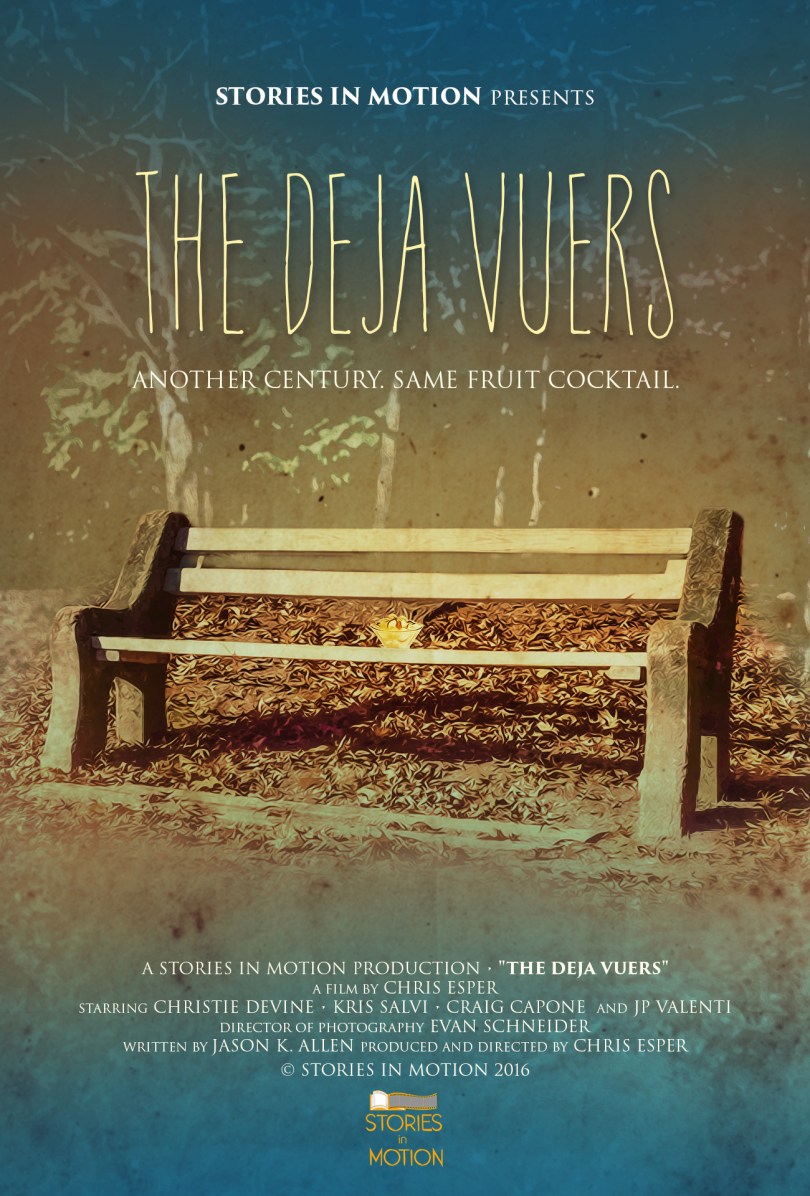
“The Deja Vuers” (2016), an eight-minute short picture from director Chris Esper and screenwriter Jason K. Allen, is a charming, frequently funny and endlessly engaging experience. It is ingenious in the way it takes a commonplace set-up, a man approaching a woman on a park bench, to comically absurd levels. This is without it ever becoming too over the top. Simultaneously, Esper and Allen inject trademark components of fantasy and science-fiction, time travel and dreams, into an undertaking that is consistently fresh and exciting. This is while maintaining its commonplace relatability. Likewise, it never once utilizes humor that isn’t naturally born from the unfolding circumstances of the plot itself. With these un-related items, a balance of the mundane and the fantastic is seamlessly created. It is one that is built on dialogue. The articulations heard throughout are rich in everyday observations, exchanges and quiet insights. Furthermore, Allen’s penned characterizations are accessible. This is without coming across as archetypical or lacking in dimension. Such is certainly a tremendous feat unto itself.

The attribute apparent in the writing of the protagonists is amplified by the herculean strength of the lead performers we follow on-screen. Christie Devine is outstanding in her enactment as Morgan. Kris Salvi is phenomenal in his portrayal of Chuck. Yet, even the comparatively smaller roles, such as Craig Capone as Elias and J.P. Valenti as “Repairman”, offer well-rounded and memorable depictions. Adam Miller as “Teenager” fares just as well.

The potency of these qualities is vastly a courtesy of Esper’s masterful administrative hand. It is just as evident in Allen’s sharply designed and intelligent authorship of the material. The duo immediately establishes, via their respective contributions, a quietly whimsical tone for the piece. It is propelled in the opening moments by the smoothly upbeat music of Steven Lanning- Cafaro. This can also be said for Evan Schneider’s sumptuous, vibrant and suitably cheery cinematography. Schneider’s influence also benefits from taking full advantage of the natural beauty of its budding fall backdrop. The result is a smartly penned and honed, effortlessly enjoyable production. It is one that visibly triumphs from both a technical and narrative stand-point.

Esper, who also produced, and Allen chronicle Chuck coming across Morgan in a chance assembly. He has never met her before. Yet, a reverie Chuck had from the night before, where Morgan is sitting in the precise location she is at that initial instant and with an identical expression of the confused look that overtakes her countenance, makes him come up to Morgan and address her in conversation. While the explanation of such an act itself could easily be perceived as a pick-up line, it is immediately conveyed that Chuck and Morgan both find each other “repulsive”. But, Chuck states, in one of the many efficaciously guffaw-inducing bits herein, that the mutual unattraction between the two doesn’t mean they shouldn’t be intimate. This is just on the off case that a bizarre fate is bringing them together. Soon after this smirk-inducing gag is administered, a chain of circumstances, often built around loose connections and clever ironies, amusingly unfurls. This begins with something as small as a container of fruit cocktail. Soon it evolves into an assortment of individuals from bygone eras and lives. Included in the mix is a personality who could well be conjured from a vision induced through slumber itself. It isn’t far into these episodes before Morgan and Chuck realize that there may be more to this sense of de ja vu than a vague sense of familiarity. It is than a portal unveils. Such an incidence threatens to pull Chuck and Morgan apart from their moment together. In so doing, it promises to bring them to a place and time more matched to their personal desires.

This Stories in Motion production, budgeted for $2,000 and shot in Attleboro, Massachusetts, further benefits from this truly original plot. The single position found in the piece is also impeccable for a celluloid invention such as this. Moreover, it activates intriguingly and ends much in an equivalent fashion. This is on a wildly satisfactory note of paradoxical enigma. This stretch is also striking in that it seems to express the general outlooks of the personalities viewed in this pre-closing acknowledgments succession. This is through decision over exposition. Best of all, it incorporates this without being obvious about its intentions. The construction is just as confident in its pacing as it is in its sly execution of such happenstances. Such an affair issues a commencing and concluding credits segment that is as quaint, stimulating to the eye and proficient as the sequences these portions bookend. Correspondingly, Esper’s editing as well as the optical effects from Robert L. Lopez are outstanding. Andrew P. Marsden provides deftly issued sound. Danielle Schneider’s make-up is expertly fashioned. These ingredients are eye-catching on their own. When combined, these details illuminate and augment splendidly the effortlessly admirable appeal of all we encounter herein.

Esper’s latest accomplishes an incredible amount in its brief run time. It efficaciously juggles a multitude of genres and ideas. All of which are difficult enough to pull off individually. Yet, with all these various foundations at play: there is an undeniable air of gentle romanticism to the proceedings. This is fitting and welcome. The composition is much like Esper’s “Please Punish Me” (2015) in this respect. This is also accurate when pondering its ability to explore human interactions and regressed passions. Such occurs in a package that operates equally well as both an unexpectedly cerebral character study and as a witty comedy. In turn, “The Deja Vuers” is a wonderful display of talent and wise storytelling moves all around. It continually exhibits Esper’s as a craftsman of the photoplay at every turn. The work also serves as perpetual evidence of the equally deft capabilities of his cast and crew. More than anything, the exertion reminds us of the illimitability and experimental nature inherent in arrangements such as these. Because of this, Esper and company have erected a must-see; another fantastic addition to his increasingly spellbinding filmography.