by Andrew Buckner
Rating: ***** out of *****.
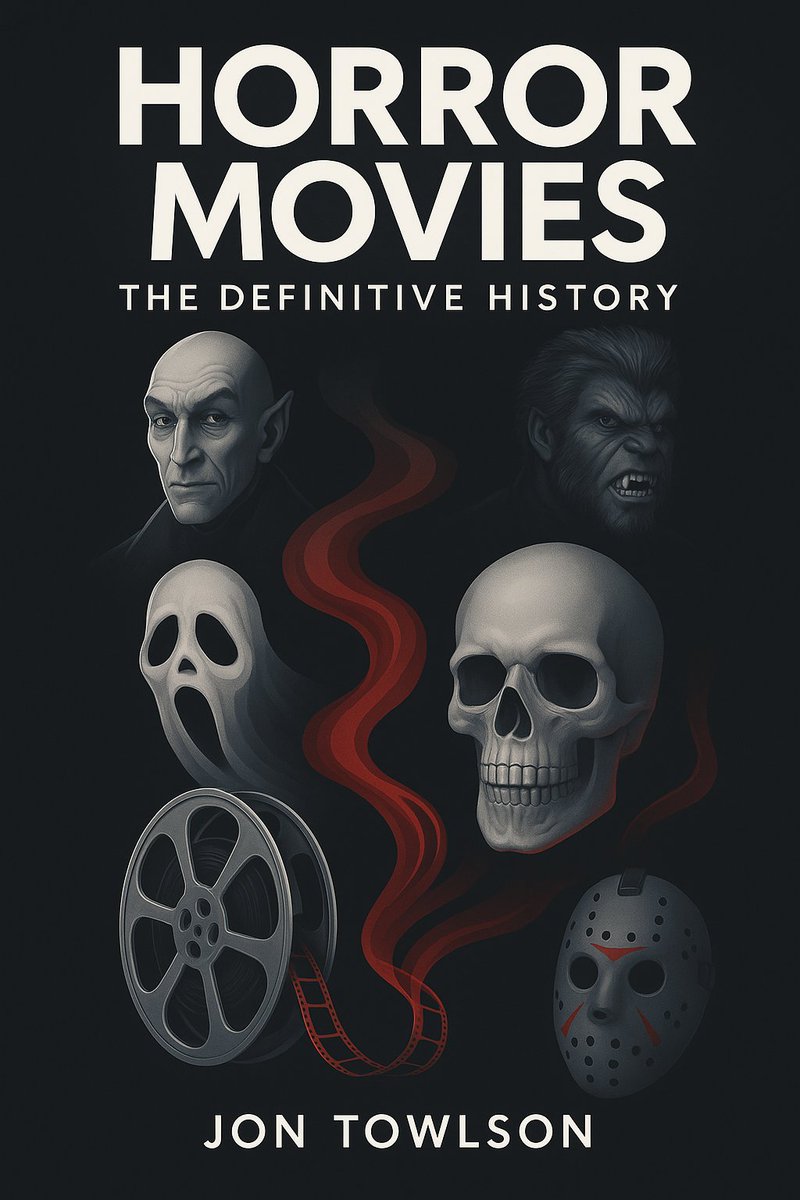
Horror Movies: The Definitive History (2025) by Jon Towlson is as significant for its intelligent, meticulously researched, concise, straightforward prose as it is for the abounding respect it holds for the title-referenced genre. Clocking in at a brisk 302 pages in length, the latest volume from Towlson ambitiously covers nearly one hundred years of audiovisual terror. It does so by cleverly and efficiently discussing, as they are first called in the subtitle to the engrossing Introduction to the project, the Three Golden Ages of Horror. These are 1931-1945, 1968-1982, and 1999-present.
Such an approach, which showcases Towlson tackling the creation and impact of key fright films in their corresponding age, makes the wide scope of the endeavor evermore intimate, organized, and focused. It also makes many of the long-standing social issues and major events that are frequently reflected upon, whether directly or indirectly, in the full-length presentations Towlson speaks about in the undertaking (such as racial injustice, the Kent State massacre [1970], The Vietnam War [1955-1975], and the Manson murders [1969]) more visible. What is just as striking is the manner in which Towlson demonstrates how these on-going matters and aforesaid incidents continue to shape modern masterpieces of the macabre. The method in which the chronicle also addresses how censorship drastically altered these compositions throughout the years, especially when it is considering how the Hays Office began enforcing the Motion Picture Production Code in 1934 in Part 1: The First Golden Age of Horror (1931-1945), is similarly captivating.
What immediately riveted me about the tome is how the early sections utilize passages of script from the features being talked about at the time. It also incorporates reviews from critics, journalistic commentary, letters from filmmaking insiders, and initial audience reactions to make the enterprise as immersive as possible. The emphasis on distinct cycles, such as both the pre-code horror and the early stages of the Universal Monsters cycle discoursed in Part 1, as well as associated features that were once considered “lost”, like Michael Curtiz’s two-tone Technicolor wonder Mystery of the Wax Museum (1933), in the literary design is just as fascinating.
Towlson also does a terrific job of showcasing the trials and tribulations many of the artists whose arrangements are mentioned in his document underwent to get their ventures out into the world in a fashion they deemed acceptable. This is while fighting the ever-shifting barriers of creative suppression and audience expectations. The units in Part 1 which detail these particular difficulties during the making of Tod Browning’s Dracula (1931), James Whale’s Frankenstein (1931), and Browning’s brilliant and revolutionary Freaks (1932) were of the most interest to me.
Part 2: The Second Golden Age of Horror (1968-1982) is as consistently intriguing and informative as Part 1. The essays Towlson weaves herein on both the fabrication and release of George A. Romero’s magnum opus Night of the Living Dead (1968), Roman Polanski’s seminal Rosemary’s Baby (1968), and Wes Craven’s controversial and uncompromising Last House on the Left (1972) were the standout pennings in this portion.
Part 3: The Third Golden Age of Horror (1999-Present), aside from a riveting and wildly entertaining probe into Daniel Myrick and Eduardo Sanchez’s groundbreaking found footage classic, The Blair Witch Project (1999), and a few other associated endeavors, doesn’t seem as concentrated on individual features as the two previous parts. Though this section is also the most critical of the configurations it disputes, it envelops the largest selection of silver screen offerings. Such a diversion from the formula Towlson has already established is welcome and refreshing. It helps make this component every bit as valuable and enjoyable as Part 1 and Part 2. The related legacies and trends conveyed in Conclusion: Beyond the Horror Boom, which arrives directly after Part 3, ends the configuration on a satisfying and appropriately punctuative note.
I cannot imagine anyone with even a passing interest in fearful cinema not being completely spellbound by every word of Horror Movies: The Definitive History. It’s a superb companion piece and extension of many of the ideas crafted in Towlson’s equally enlightening and in-depth 40 Cult Movies: From Alice, Sweet Alice to Zombies of Mora Tau (2023) and 40 More Cult Movies (2025). Thematically rich and resonant, smoothly paced, endlessly entertaining, and featuring a relatively even amount of time offered to most of the exercises examined in the publication, Horror Movies: The Definitive History is an essential guide to many of the most memorable big screen outings of the past. It ranks among the best books I’ve read all year.
You can purchase Horror Movies: The Definitive History in Kindle or in paperback format here.


 awordofdreams.com